
Sensory attributes discriminate zones geographic denominations over vintages
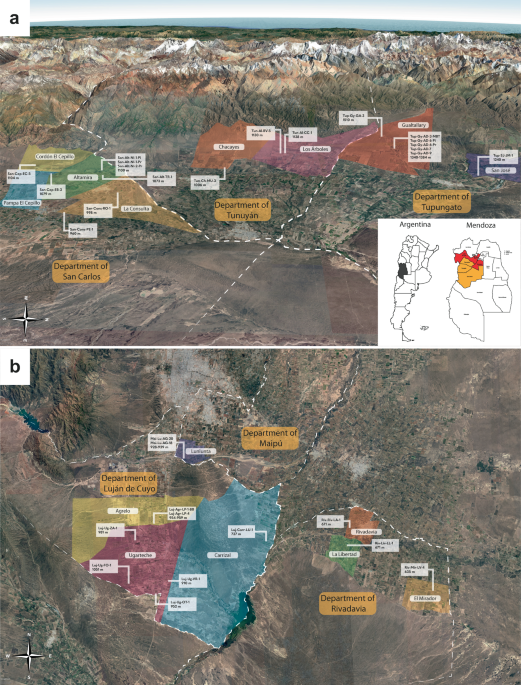
From a wine production standpoint, Mendoza is divided into zones; the Uco Valley, for example, comprises the Departments of Tupungato, San Carlos, and Tunuyán (Fig. 1a). The main characteristics of the Uco Valley are a relatively cold climate with alluvial soils typical of the Andes mountains—where fluvial deposits predominate, generating fans that extend across the plains17. The First Zone encompasses the Departments of Maipú and Luján de Cuyo, where a warmer climate, in relation to the Uco Valley, predominates. As for the Eastern Zone, a single department—Rivadavia—was included in this study (Fig. 1b). Compared with the first two zones described, Rivadavia has the warmest climate, lower elevations, and predominantly wind-formed soils that are heavier, clay-based, and sandy.
Fig. 1: Satellite image of study parcels in Mendoza, Argentina.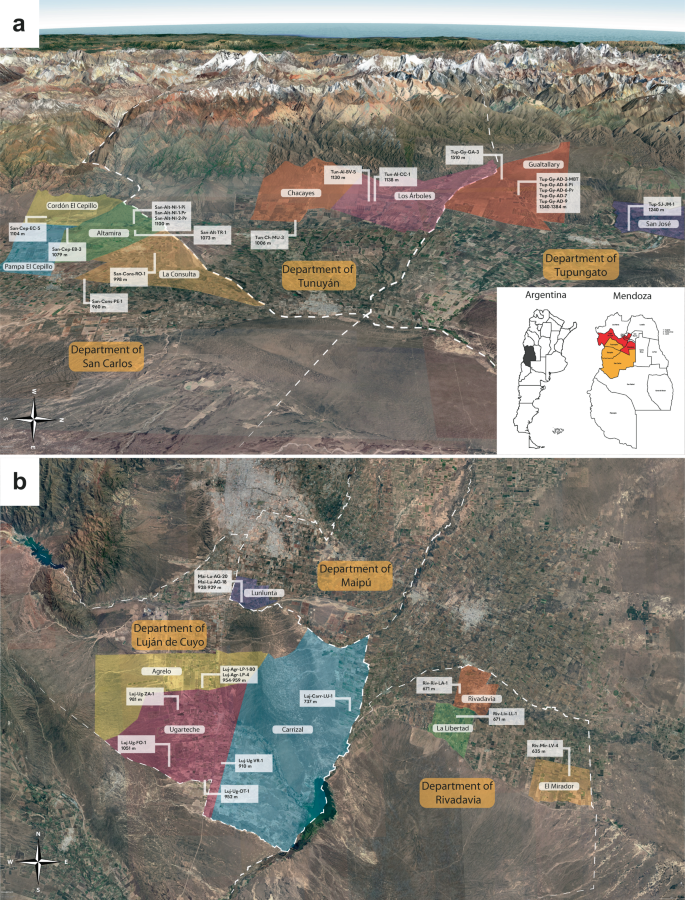
Satellite image of study parcels in the a Uco Valley, b First Zone, and East Zone of Mendoza, Argentina, with their respective GI and departments. Elevations are also shown.
For zones, the three-way MANOVA was significant for location, repetition, judge, location:judge interaction and repetition:judge interaction in vintages 2017 and 2018 (Supplementary table 1). Using a p-value < 0.05, the wines by zones were significant in 8 descriptors for 2017 vintage and 9 descriptors for 2018 vintage (Supplementary table 2).
For the 2017 vintage, significant descriptors were eucalyptus, hot (aroma), nutty, vegetable, smoky, bitter, astringency and hot (mouthfeel). For 2018 vintage, hot (aroma), red fruits, roses, smoky, humidity, acetic, astringency and spicy mouthfeel were significant. Hot (aroma), smoky and astringency were those with significant differences in both vintages (Supplementary table 2).
Vegetable, hot (mouthfeel), red fruits and astringency descriptors, have all been significant in previous studies on Malbec, where different zones and departments within Mendoza were compared16,18.
To better understand the differences between zones, a PCA was performed with all the descriptors involved, including those with no significant differences (Fig. 2). In 2017, a clear separation of each zone was observed (Fig. 2a). The East Zone was positively associated with vegetable, tobacco, smoky, sweet, viscous, leather, and grassy descriptors, while the Uco Valley was associated with eucalyptus, astringent, bitter, spicy, hot (aroma and mouthfeel) and sour. Eucalyptus and cherry appeared in the First Zone as well (Fig. 2b).
Fig. 2: Principal components analysis with descriptive sensory data of Malbec wines vintage 2017 and 2018 evaluated by a trained panel using “Zones” as classification.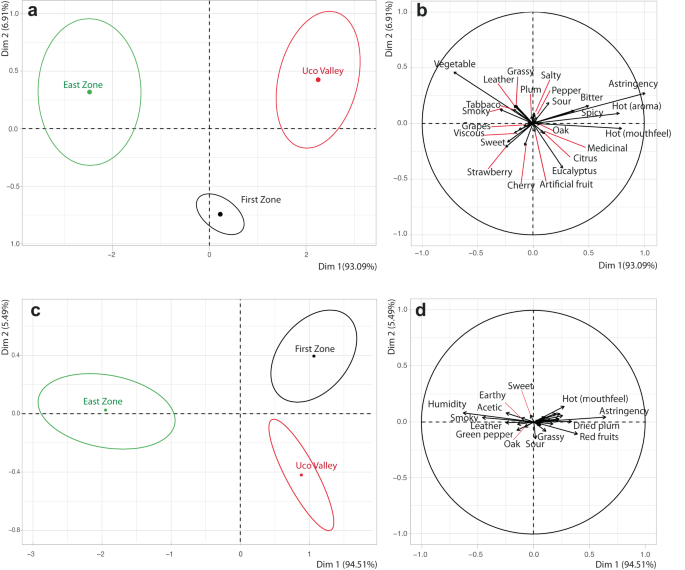
a Confidence ellipses based on multivariate distribution of Hotelling’s test for p < 0.05 indicating 95% confidence intervals in vintage 2017. b Sensory attribute loadings in vintage 2017. c Confidence ellipses based on multivariate distribution of Hotelling’s test for p < 0.05 indicating 95% confidence intervals in vintage 2018. d Sensory attribute loadings in vintage 2018.
In 2018, the First Zone and Uco Valley were both positively associated with descriptors such as hot (mouthfeel), astringency, plum and red fruits, whereas the East Zone was associated with humidity, acetic acid, smoke, leather, green pepper and earthy aromas (Fig. 2c, d). PC2 contributes to the difference between First Zone and Uco Valley, where Uco Valley had descriptors associated with sour and grassy aroma.
In terms of vintage, there was a measure of consistency over zones: smoky and leather descriptors remained consistent in the East Zone across both vintages. Likewise, in the Uco Valley descriptors such as astringency and sour were present in both 2017 and 2018.
The Uco Valley has higher elevation conditions, thus higher UV-B exposure and lower temperatures which can affect the concentrations of phenolic compounds19,20, mainly those associated with descriptors such as astringency and bitterness, as reported previously21,22. The discrimination between zones observed in Fig. 2a and c is like our previously reported discrimination using chemical data for the same wines in the vintages: 2016, 2017 and 2018, where a strong influence of the vintage was also reported14.
Not all Mendoza wines are from very small specific places or parcels, with well-known terroir characteristics. Wine labels don’t always include specific information about the origin—the use of such general terms as: Uco Valley, First or East Zone is common. Data from this study provides sensory typicity information for these regions, contributing to the identification of their unique characteristics, and providing a tool for assessing a wine’s origin within a regional geographic denomination. Beyond the identification of GIs or parcels capable of providing highly recognized wines, it is both meaningful and useful to ascertain the sensory characteristics that make the wines of a zone unique—with aim at protecting their typicity and traceability. Both the physicochemical and sensorial data are important from scientific and commercial points of view, building regional identity from individual parcels to zones. In this vein, the evidence presented here offers new knowledge to trace the typicity of Argentinean Malbec and to build a representative sensory typology of these wines. From a commercial standpoint, our research provides scientific evidence to support new world winemaking regions in understanding the typicity of their wines.
To understand the discrimination of the zones by sensory data over different vintages, an MFA analysis integrated the data obtained from each zone over the 3 years examined. For the 2016 vintage, data from Urvieta et al. was included18. As Fig. 3a shows the influence of vintage in zones classification is clear. The Uco Valley and East Zone were best explained by the second dimension. There was a better agreement between the First zone than in the other two zones. Sensory descriptors that were loaded on the MFA (Fig. 3b) in proximity and agreement between the three vintages were hot aroma, vegetable/herbaceous, astringency and smoky. The aroma of red fruits was associated with the East Zone in the 2016 vintage, but with the regions of the Uco Valley and the First zone in 2018. The vintage effect has a very strong impact on the chemical composition of Malbec wines from Mendoza, and therefore on its sensory properties. In terms of climatic conditions and unlike the 2017 and 2018 vintages, the 2016 vintage was classified as very cold, rainy and humid, conditions that are not typical for Mendoza. In the case of the 2017 and 2018 vintages, the climatic characteristics were similar to those historically observed in Mendoza, and this was reflected in the chemical characteristics of the wines, which shared some of the discriminant descriptors. The 2017 and 2018 vintages showed climatic characteristics similar to Mendoza’s historical averages, and the vintages can be easily predicted using models such as PCA and PLS-DA14.
Fig. 3: Multifactor analysis using different scales of geographical denominations for the discrimination.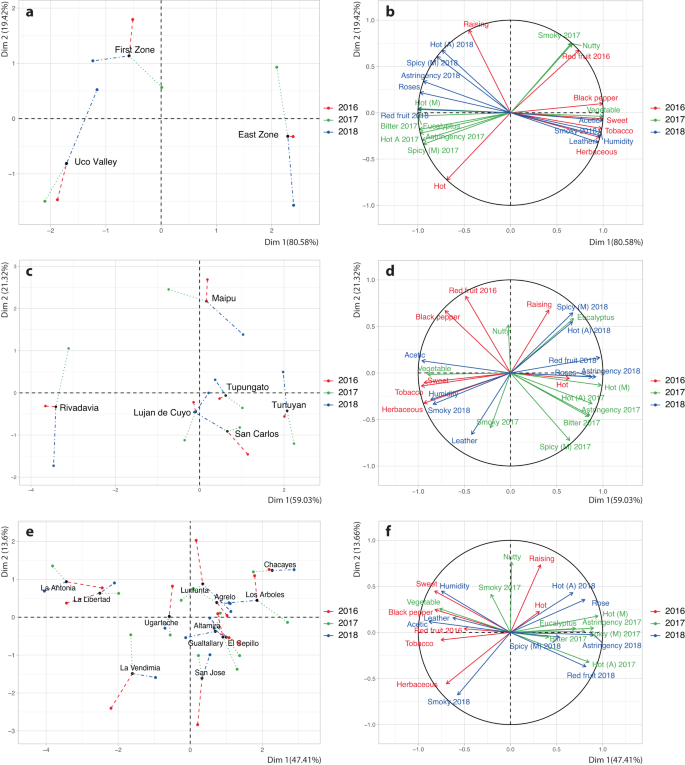
Zones (a, b), Departments (c, d) and GIs (e, f) were used as classification. In the plots consensus MFA sample space (a, c, e), the length of the line is inversely related to the strength of the agreement. Data from 2016 vintage was obtained from our previous publication (Urvieta et al.18).
Sensometrics partially discriminates departments and evidence a strong vintage effect
The same number of significant descriptors was found when ANOVA was performed using departments as geographic classification denominations (Supplementary tables 3 and 4). Significant descriptors for the 2017 vintage were eucalyptus, hot aroma, nutty, vegetable, smoky, bitter, astringency and hot (mouthfeel). For 2018, descriptors with significant differences were hot aroma, leather, red fruits, roses, smoky, humidity, acetic, astringency and spicy. Descriptors that are also significant in both vintages and within this particular zonal classification are hot aroma, smoky, astringency and spicy (Supplementary Tables 1 and 2). In our previous study on 2016 vintage wines using the same department classification, the descriptors with significant differences were red fruits, raisins, black pepper, herbaceous, tobacco, hot and sweet18. The astringency descriptor was significant in the 2017 and 2018 vintages (Supplementary tables 4 and 6), but not in 201618. According to data from these same years, wines from the 2017 and 2018 vintages had an increased level of anthocyanins and flavonols. Descriptors such as astringency and bitterness are associated with these compounds and are relevant in the discrimination of departments for these vintages.
When applying the same sensometric tools for the department classification, the aggregate effect and the consistency in discrimination is different from the classification by zones. We observed that while some departments have a clear separation, others cannot be easily discriminated against (Fig. 4). Since the objective of this study was to evaluate the typicity, all the aromas and flavors that each region has in common were included independently if they were significant or not in the sensory analysis. Figure 3b and d show the descriptors associated with each department.
Fig. 4: Principal components analysis with descriptive sensory data of Malbec wines vintage 2017 and 2018 evaluated by a trained panel using “departments” as classification.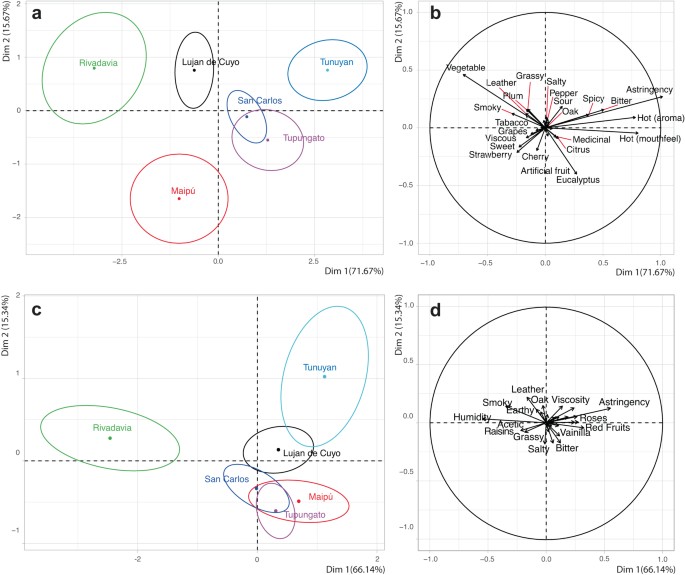
a Confidence ellipses based on multivariate distribution of Hotelling’s test for p < 0.05 indicating 95% confidence intervals in vintage 2017. b Sensory attribute loadings in vintage 2017. c Confidence ellipses based on multivariate distribution of Hotelling’s test for p < 0.05 indicating 95% confidence intervals in vintage 2018. d Sensory attribute loadings in vintage 2018.
In both vintages it is consistent that Rivadavia is separated from the rest of the departments, mainly with descriptors associated with vegetal, smoky, grassy, leather, plum and humidity. The same result in wines from Rivadavia was observed for the 2016 vintage, where it was associated with herbaceous, tobacco, black pepper and sweet18. Of the descriptors mentioned, herbaceous or its family of aromas is the most consistent in all vintages for this department. Aromas within the vegetal family have been reported in previous studies of Malbec—descriptors such as cooked vegetal, green or vegetal characters, including herbal or herby16,23. As mentioned above and based on climatic data published in other studies, Rivadavia lies in the warmest region of Mendoza at a lower altitude (650 m asl) than Valle de Uco and the First Zone regions.
The astringency was associated with departments of the Uco Valley (Fig. 4). This descriptor is closely linked to the concentration of phenolic compounds. The concentration of phenolic compounds, responsible for flavors and tactile sensations, is influenced by environmental conditions—temperature, rainfall, light intensity, soil—where the vineyards are located24,25. Previous studies showed that as elevation increases, the intensity of ultraviolet-B (UV-B) radiation also increases due to the reduced absorption of atmospheric gases at higher altitudes, a phenomenon further associated with an increase in phenolic compounds such as quercetin, trans-resveratrol and di-hydroxylated anthocyanins19,20. These environmental characteristics of higher elevation and cooler climates are those found in the departments (and consequently GIs) in the Uco Valley zone studied. The information presented suggested a potential correlation between chemical and sensory data because some of these compounds, such as quercetin and (+)-catechin, have been associated with the astringency and bitterness descriptors of wines.
The MFA with the averages of each sensory variable for the three harvests classified by department showed a clear influence of vintage in some departments of Mendoza, such as Rivadavia and Maipú (Fig. 3c, d). Rivadavia is more strongly correlated with the second dimension, while the observation from Maipú is more strongly correlated with the first dimension. The worst consensus on the discrimination of Rivadavia and Maipú is in the 2017 and 2018 vintages. San Carlos and Tunuyán have a good consensus in the 3 years of study. Tupungato, Luján de Cuyo and San Carlos could be potentially forming a large group due to similar sensory characteristics. Looking at the individual PCAs of the 2017 and 2018 vintages (Fig. 4a, c), and the 2016 data from our previous paper, they could be closely related by their sensory characteristics18. The RV coefficient calculated between the 2016 and 2017 vintage configurations is 0.89, 2016 and 2018 is 0.86 and 2017 and 2018 is 0.71.
Understanding the interactions between sensory typicity and geographic proximity of GIs across vintages
A MANOVA analysis was performed using sensory data by GIs classifications. Using a p-value < 0.05, the wines by GI were significant in 12 descriptors for vintage 2017 and in 5 descriptors for vintage 2018 (Supplementary Tables 5 and 6).
Figure 5 shows heatmaps with the GI groupings when all the sensory variables were used over 3 vintages, including the 2016 vintage with data from Urvieta et al. 18. These groupings help to understand the differences and similarities between GIs using an unsupervised analysis. Most of the GIs in all parts of the world, as in the case of Argentina, were determined based on political boundaries. These limits were not decided based on the sensory differences of the wines or their typicity. There are cases such as Chacayes and Los Arboles that form a group in the 2018 vintage. In terms of location and geographic proximity the grouping is logical because they belong to the same alluvial cone and are located next to each other17. The fact that they form a cluster does not mean that the wines are identical, only that they share sensory descriptors and characteristics that group them by similarities, just as the combination of descriptors makes the wines from these sites unique.
Fig. 5: Heatmaps and hierarchical clustering of GIs (small areas) by sensory descriptors in Malbec wines over different vintages.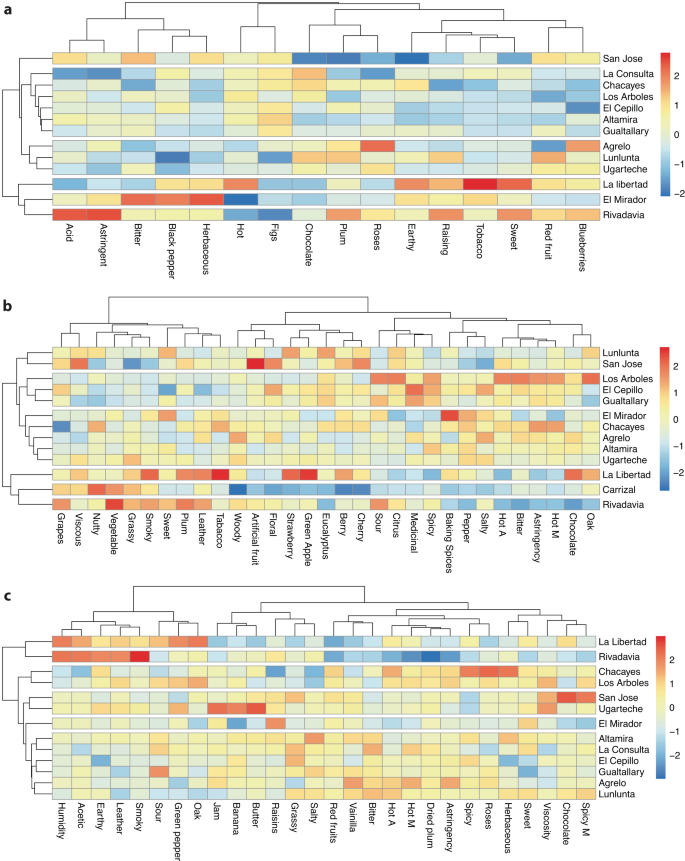
2016 (a), 2017 (b) and 2018 (c). Values and cell colors indicate a relative intensity for each GI; blue corresponds to the minimum value and red to the maximum value (‘heatmap colors’).
The clustering observed in this study with many GIs using sensory data represents a novel finding that has not been previously reported in the literature. This result provides a valuable contribution to the field of terroir research, as it allows for a better understanding of how GIs can be created or reclassified based on sensory characteristics. Moreover, our study facilitates the identification of the unique attributes that define each region, thereby contributing to the conceptual typicity and improving communication within the wine industry. Overall, our findings have important implications for future research in this area and demonstrate the usefulness of using sensory data to study GIs.
The multiple factor analysis (MFA) (Fig. 3), integrating sensory variables for the three vintages using GIs as classification criteria, presented a less clear distribution of the GIs by geographic location. However, there are places that are separated from the rest that are also geographically close. La Libertad, La Antonia and La Vendimia—all located on the left side of the MFA—were associated with red fruit, vegetable, herbaceous, leather, humidity, black pepper, smoky, acetic and sweet. This separation of GIs from the zone was also observed in the classification by region and departments, showing consistency in the classification over different geographic denominations.
Los Arboles and Chacayes are in the upper right quadrant. Both GIs are in the same department and next to each other. A good consensus is observed across all three vintages for these two GIs.
MFA analysis is useful in understanding that there are zones where the impact of the vintage was stronger than in others. Understanding the behavior of each zone throughout different vintages is crucial, the more when vintages have contrasting climates. So, for example, the 2016 and 2018 vintages were very different in terms of climate, causing GIs such as Lunlunta to present a different behavior for each vintage, unlike other GIs such as Agrelo, where the consensus between all three vintages is much greater, probably evidencing more consistency of sensory characteristics of that place between vintages. Although climate is a fundamental element of terroir, recent variations in ‘typical’ climatic patterns could challenge the traditional dimensions of wine typicity from specific locations. Given that climatic conditions are increasingly dynamic and subject to rapid, extreme changes, the sensory profiles of wines may start exhibiting ‘atypical’ characteristics, as observed in our study with the 2016 vintage. This trend highlights the potentiality of the proof of concept presented here to understand the typicity of a grape variety, in this case Malbec, but readily translatable to other grape varieties, in wines from regions around the world.
Tracing the typicity of wines from different origins has implications for both consumers—deepening their understanding of the product—and producers—furthering the construction of robust signatures to support the concept of terroir with scientific evidence. From a sensory analysis perspective, the possibilities presented here: different ways of classifying the typicity of wines at varying geographic scales and across vintages, may move the discussion towards greater consensus, by providing evidence of consistent sensory signatures for specific terroirs. Looking more specifically at the Malbec findings, knowing the typicity of Malbec and whether it is possible to distinguish between different geographic scales allows for a more detailed and confident communication of the identity and characteristics of wines from Argentina. The presence of common sensory descriptors in different vintages, affected by different climatic characteristics, allows for wines from the different geographical areas under examination to be fingerprinted for typicity. In the future, we believe the methodology presented here could contribute to an extensive understanding of the effect of terroir from a sensory perspective.
Dining and Cooking