
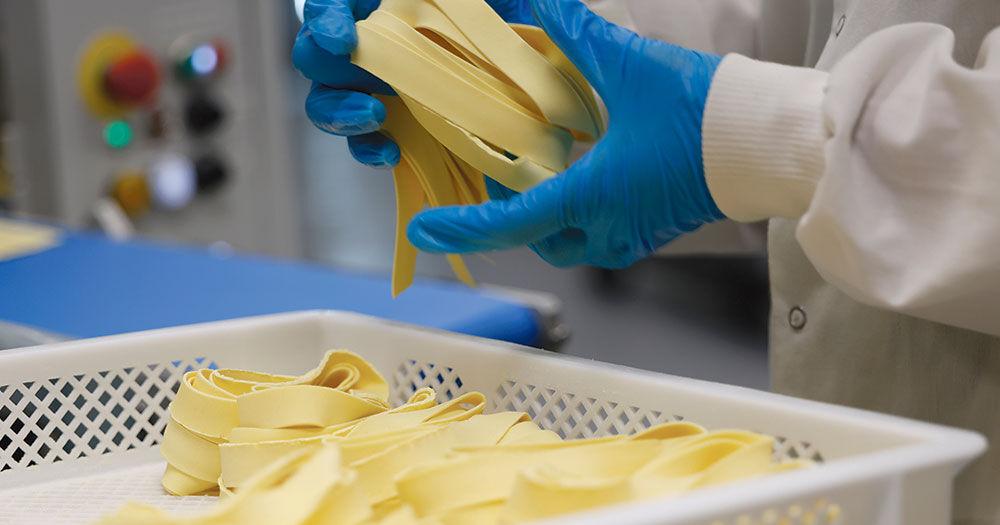
Water, flour and eggs equals passion when it comes to pasta-making.
It’s this pursuit of excellence that caused Chef Michele Cremonese to dedicate his business to pasta-making rather than just cooking. “I never strive to do something for business or money,” he says. “I want to put quality first.”
Cremonese came to the United States in 2000, landing in Los Angeles after being trained in Verona, Italy. Eight years later, he moved to Carmel, where he eventually landed as the Chef de Cuisine at Basil Seasonal Dining. There, he made pasta by hand until becoming a victim of his own success.
“We were so busy that I had to source out the pasta and that’s when I saw there was a lack of places where you could buy a good, traditional, homemade product,” he says.
Bigoli – a thick spaghetti shape – is not only his favorite, but also the name of his pasta business, which happens behind an unassuming industrial garage door in Sand City. Accompanying a sign above the business is a red Vespa scooter parked out front – a clue that something Italian is happening inside.
Cremonese says the pasta that’s made at Bigoli uses a combination of 00 (dopio-zero) flour, semolina flour and semolina rimacinata flour sourced from small mills in Italy. Nothing is mass-produced.
“A big company will sell you whatever they have from their stiff inventory,” Cremonese says.
Remaining small allows his product to be flexible. “Being a chef, I can definitely relate and work with [other] chefs to create custom fillings or something particular for them,” he explains.
Cremonese visits other restaurants like a pasta consultant to dial in their dishes and menus on a regular basis. He hesitates to disclose his client list, but validates any time “handcrafted pasta” is written on their menus.
Control over a product as versatile as pasta is so paramount that some chefs opt to make it in-house. Similar to Cremonese, experience is the conduit to being able to add a laborious task to a dinner service. Il Vecchio in Pacific Grove has dedicated pasta-makers that diners can see working at a station.
“It’s definitely a lot fresher,” owner Kelly Shatto says. “It has a great fluffiness to it that you don’t get with a boxed pasta.”
Shatto says the pasta shaped at Il Vecchio is made each day. “We usually run out by the end of the evening,” Shatto adds.
When it comes to the blend of water, flour and eggs, Shatto says it varies and depends on the type of pasta that’s being made. Some pastas do not require eggs.
At Bigoli, however, egg-based pasta is a signature.
“There’s a difference in texture,” Cremonese says. “If you don’t make the pasta properly, the texture is way different and there’s a difference in flavor.”
This is where mass producers fall short, according to Cremonese, making them a poor choice for restaurants. He explains that one way corners are cut is by reducing the amount of eggs.
“Lower-quality pasta tends to overcook really fast,” Cremonese says. At this point, the finished product cannot be controlled at all, especially since some kinds need to hold their shape and be served al dente, while others need to be softer but thicker, such as ravioli, which must contain the filling.
Softer sheet pastas like fettuccine and pappardelle are pressed using a different machine than others. Regardless, the gold standard for making pasta is using a bronze die – the cylindrical mold to press the shape of the pasta. Cremonese says the bronze die is superior over plastic or teflon, providing a more rustic texture.
“The bronze die permits the pasta to have more of a rough surface,” Cremonese says. “If you look under a microscope, you’ll see the pasta is more porous.” This trait allows sauce to cling.
Bigoli uses about 500 pounds of eggs per week, which Cremonese also says makes his product more nutritious in addition to richer. And these are features that only come with hand-crafted care.
“If I make the best, then I don’t have to worry about the headache of competition,” he says.
Dining and Cooking