
On memory, erasure, and the loss of another L.A. icon. Did you know LARB is a reader-supported nonprofit?
LARB publishes daily without a paywall as part of our mission to make rigorous, incisive, and engaging writing on every aspect of literature, culture, and the arts freely accessible to the public. Help us continue this work with your tax-deductible donation today!
I think I saw you in an ice cream parlor
Drinking milkshakes, cold and long
Smiling and waving and looking so fine
Don’t think you knew you were in this song
—David Bowie, “Five Years” (1972)
MY FATHER ONCE told me, “The only thing you can count on as an Angeleno is that the city you grew up in won’t be there when you go looking for it.” As a second-generation Angeleno, he knew of what he spoke. He’d spent a great deal of time coming and going from his family home: to Tijuana as a teenager, joyriding his Nash Rambler to the bars and clubs on the other side of the border, where my grandfather, at 2:30 on a school night, was once summoned to bail him out of jail; later to Vietnam, where he was transformed into something out of Tim O’Brien’s The Things They Carried; and finally to Kauai, Hawaii, in 1991, where he went to find himself, or get lost, or maybe both.
Each time he returned, something was missing, some touchstone of his childhood gone. This, he assured me in his prophetic summation of what it is to be an Angeleno, came to be the most reliable thing of all. To be born and raised in Los Angeles is to enter into a relationship with loss—one that will shape and define the contours of your life.
Los Angeles haunts itself. Impressions of the past press against the busy denizens of its streets and clogged freeways. Everywhere you turn, a 1960s structure—which replaced an 1890s Victorian home that had staked its claim on a coyote den nestled in the shrubby chaparral—comes crashing to the ground. On March 29, Taix French Restaurant, one of the oldest restaurants in the city, joined the pantheon of erasure. What Norman Klein got right in his seminal work about the city and its nebulous relationship to stasis, The History of Forgetting: Los Angeles and the Erasure of Memory (1997), is the way places and locations that “used to be” leave impressions on “what is.” Even as the location of Schwab’s soda fountain has become a foggy memory, it remains a symbol (or cliché) of the wide-eyed Midwestern hopeful, hopping off the Greyhound bus across the street, hungry for a new beginning, only to find a seedy underbelly waiting to devour them. Klein writes:
[T]he “phantom limb” is often an empty lot where a building once stood, perhaps on Sunset Boulevard. Scraps of lathe and façade mix in piles with broken brick. The foundation is momentarily a ruin, like a photo of someone’s toothless mouth held wide open. The grading left by the bulldozers form[s] ridges along the dust. It seems that if you could simply rest your ear close enough to the point where the blades have sheared away the joists, there might be the faint echo of a scream, or a couple talking at breakfast.
Klein posits that Los Angeles cannibalizes its own history, which is never quite regurgitated into a remembered, documented, or celebrated past. (Since his book was first published, small plaques in quickly gentrified enclaves, like Highland Park, have come to adorn light poles, extolling the history of a neighborhood with antiquated images of the street before the vintage store or fancy coffee shop opened.) While Klein’s argument was accepted in academic communities that circle the drain of urban history, I’d like to counter that for Angelenos, this is not the case. Klein recounts that his earliest experiences of Downtown Los Angeles were filtered through his memories of Brooklyn, New York, as a boy, as many of the bricked facades that then lay empty had a similar semblance to the ones of his youth. For me, however, to drive down the same street can only tell the story of what that brick facade has been since I’ve known it: an abandoned place.

Photo by Sophie Buhai.
The memories of Angelenos are shaped, like all people’s, through the experiences of their upbringing, and we do not bring with us context from an earlier life we left behind. We start here and come back here, at least in memory. There is no forgetting for the Angeleno; there is only a remembrance of what used to be, an archival process foisted upon us, whether we asked for it or not. If an Angeleno wants to return, they first must assure themselves that they don’t forget.
This past October, while working on my new book, I found myself writing about Taix in the context of a first date:
We’d agreed to meet at Taix, one of the oldest restaurants in Los Angeles, famed for its turn-of-the-century take on French cuisine. The menu has remained entirely untouched. I liked to think of it as the quirkier little sister to Musso & Frank Grill, the storied, dark-lit celebrity steakhouse on Hollywood Blvd. that actually holds the title of Hollywood’s oldest restaurant.
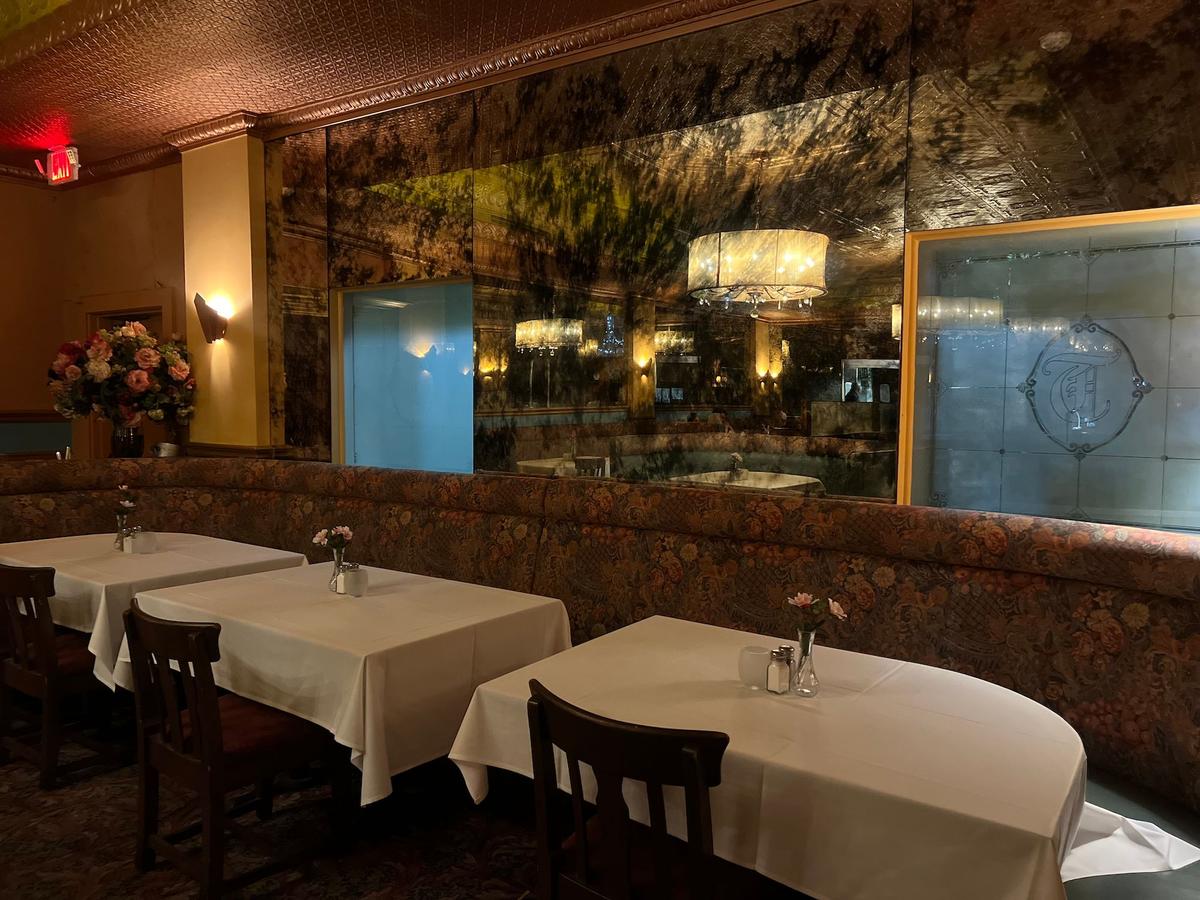
Taix had a sizable lounge and bar area that, when one said they were “meeting at Taix,” was largely what they were referring to. The walls were brick, the chairs and stools a dark burgundy leather, the carpet a similar hue. Remodeled in the 1960s, it had all the characteristics of a place where one might meet Steve McQueen for a drink. The restaurant’s exterior was that of a charming French château designed in the style of Norman Revival. It looked like an invitation to grape vineyards, cottage farm life, and homemade butter, smack-dab in the middle of Sunset Boulevard. Its current location wasn’t its first, however, and the restaurant made its move from Downtown in 1962 after its original location was sold. It arrived just in time for the swinging sounds of the Beach Boys, the Byrds, Buffalo Springfield, the Doors, and the Mamas and the Papas—rolling from surf rock to folk rock to the psychedelic hallways of the mind that became the “California sound.” Its lounge was the spot to be seen and remained a hangout for dusty rockers and aspiring creatives looking for camaraderie.
I had parked my car around the corner from the restaurant among the many houseless individuals taking shelter in the streets. Echo Park was covered in both the graffiti of yesteryear and the new type that was bought and paid for by high-end advertisers pushing things like Apple AirPods and new albums by hip noisemakers. Over the past decade, Echo Park had been transformed—like almost every cityscape across the country—into a Disneyland for the moneyed young: a place meant both to inspire affluent comfort and to mimic reckless creativity. This combination manifested in eight-dollar cold brew coffee, 30-dollar candles, specialty-curated clothing stores that sold high-priced vintage, and diners that served a simulacrum of the food that the joints these new diners had torn down and replaced used to serve. To all those who could not afford the creature comforts of tiny dogs and oat milk, the alleys and corners became tent towns. In the midst of all this urban renewal, however, subsisted some relics of a bygone era—a Los Angeles that was still rugged and dangerous, unpredictable and exciting: the Los Angeles of my youth.
I was headed for the heavy, ornate wooden door—where the valet men in red jackets smoked cigarettes, leaned against the cobblestone walls meant to resemble country drawbridges, laughed, and shot the shit—when the door flew open.
For an author from Los Angeles who writes about this shifting landscape, it’s impossible, of course, not to consider the fault beneath our feet: the constant threat of collapse and destruction, fire sucking everything into a towering inferno of slash-and-burn. The city stays one step ahead of the apocalypse at its heels. Why fear the loss of landmarks to natural disasters when the city leaders and developers can shatter them ahead of time? Nothing crumbles and decays in Los Angeles except the hopes and dreams of those looking for something to hold on to when the earth rolls and breaks beneath their feet. For a city so deeply invested in storytelling and myth, it is a surprisingly unsentimental place.
¤
On a recent evening, I travel to Taix with a group of friends with whom I’ve shared countless memories—in the lounge, in a rented back room for a birthday, grabbing mussels and fries after a reading—to say goodbye. The restaurant is busier than I’ve ever seen it. Like Mona Lisa Vito in My Cousin Vinny, I snap gum and take pictures of everything around me, while my party and I wait for the flustered hostess to take us to our table. I don’t want to forget a single thing: not a portrait, not a small ceramic vessel full of toothpicks, not the glass vitrine holding 40-dollar Taix caps. A steady stream of gaily laughing people spills into the restaurant, like a creek hitting rocks; they either head to the lounge or bump up behind us—an ever-growing crowd shouting that they have reservations or asking if there is room for walk-ins.
After we are seated, a waiter in a maroon beret comes to take our order. He’s waited on me before, most recently with a not-so-long-ago romantic partner who left Los Angeles after living here for 25 years to return to St. Louis, from which he’d originally defected. When he got back, he told me how so much looked the same that he felt as if he’d walked into a phone booth time machine and emerged in 2000, the morning he’d first decided that he needed to leave. He felt a deep sadness, as if his life was a reverse Interstellar. He’d undergone change—to the core of who he was—while the place where he was born hadn’t changed at all.

Photo by Sophie Buhai.
Such an experience I could not relate to. When I returned to Los Angeles in 2008, after living in New York for seven years, I found that landmarks had been refashioned so much as to make them wholly unrecognizable. Yet still I cling to what remains and what’s here: the Ávila Adobe, all of Olvera Street, the skyline (even as it grows), the Wilshire Grand Center (completed in 2017).
He was the man who’d flung open the door on a first date, an image that I incorporated into the narrative of my book. It was here that we met, that he courted me, and that we dined on a final meal, accompanied by his elderly father, who’d come to help him pack and drive the 1,800 miles back to Missouri. Taix is like that. Or, now, Taix was like that—a place where entire lifetimes could blossom and die, a place a book could pivot an entire plot point around, because it’s a pivotal kind of place. There’s a verse in a Neko Case song in which she sings:
I only hear things secondhand
And consider you from far away-way-way-way-way
You’re like some silent movie star
Swanning off to heaven, or Arizona, or wherever they’d go
And I know you fight to keep it all aligned
You’re too much life for just one body, body, body
Your gravity undesigns you all the time
And I remember, I remember
Perhaps Los Angeles is too much life for just one body, her gravity undesigning her every chance it gets—shaken memories in a snow globe that someone born and raised amid her freeways and empty lots and alleys considers from far away. A place that’s always calling, “I must be remembered. Do you remember?” The answer is always yes and no. This actual place, not just the idea of it. A place where kids choose Halloween pumpkins and Christmas trees and light menorahs and ride their ten-speeds down graveled hills and smoke their first joints in those same remembered alleys of yellowed grass and cracked concrete, the graffiti of some East or South L.A. gang adorning the wall behind them like the pair of painted wings that now appear on every gentrified corner. A place where parents lost their hardware stores, burned to the ground in the 1992 uprisings; a place where someone was the last kid to get picked up, sitting on the asphalt, waiting for their single parent, with the only teacher willing to stay after an earthquake brought the city to a halt. Every place a story, like Klein’s missing teeth in the empty joists of no-longer-erected walls, where fentanyl addicts now light up the night, hundreds of glowing embers like a concert crowd calling for an encore of a song long ago gone silent.
Two years before my grandfather passed, my father and I drove him around the city so he could recall his memories of growing up. He told us stories of attending Aimee Semple McPherson’s church; he recalled holding on to my great-grandmother’s hand in the crowded lobby and how McPherson glided around the stage like a movie star. He remembered what the lake looked like before Echo Park was bisected by the 101, and how they had to lift and move the firehouse to make way for a future that was soon to come barreling into being. He would trail off occasionally, hand to window, and I imagine he was remembering something that no longer was—something that only he could see, that perhaps words could only fail to capture.
¤
After setting down a basket of warm bread and butter, our beret-wearing waiter stops to answer our questions. He’s worked there 25 years. He loves it. It’s like a family. None of the five Taix children wanted to take the restaurant over. Two chefs offered to buy it, but they couldn’t match the offer made by Holland Partner Group, the Vancouver-based real estate developer that’s going to build condos on the site. Many of the waiters have been here over 40 years; some came from Mexico, started as dishwashers, and are now sommeliers who own homes. I watch a group of frail women holding hands and smiling, wearing brightly colored chiffon blouses and large costume jewelry, laughing as they pass our table, followed by a scowling pair of young people. We debate if they are in their teens or early twenties; I feel melancholic for the story of this place that ends too soon for them, their vintage punky vibe a callback to my youth, when we’d end up here after a night sucking face and smoking cigs at Spaceland or some other noisy, moody club.

Photo by Sophie Buhai.
As we grab our coats and make our way back to the front, I take in the tin ceilings, which I’ve since learned are not really tin, and the faux smoke-stained mirrors. A group of drunk and joyous, stylish people, perhaps in their thirties, offer to take our photo as we attempt a selfie. “No, let me!” says a beautiful dark-haired woman. “Let me.” We smile and pose. “Can I get in one too?” she asks. Of course, we say, pulling her over. Our waiter, in the beret, joins us.
“Do you know who we are?” she asks, laughing.
“No,” we answer.
“We’re the architects redesigning the restaurant and building.”
“Seriously?” we inquire.
“Yes!” they shout in unison.
I snatch my camera from the man in her party. “Well, let me tell you who I am,” I say. “I’m a journalist, and I’m writing about the demolishing of this place! So, thank you for this!”
She looks horrified. “No, no! We love this place!” she says, as we head for the door—maybe for the last time—her voice trailing away behind us.
Los Angeles: too much life for just one body, for just one story. It remakes itself each time it’s told by someone new who just dropped into town. But for the Angeleno, we remember. How can we not? The sparkling Echo Park Lake reflects the moon. A coyote—whose life, not long from now, will be saved by the Wallis Annenberg Wildlife Crossing, its construction inspired by the loss of P-22, the city’s most famous mountain lion—heads into the chaparral to build again.
¤
Featured image: Photo by Sophie Buhai.
LARB Contributor
Nikki Darling is a writer, artist, and high school teacher who serves on the MFA writing faculty at Antioch University. She is the author of the novel Fade into You (Feminist Press, 2018) and the forthcoming The Call Is Coming from Inside the House.
Share
Copy link to articleLARB Staff Recommendations
Anahid Nersessian people-watches at Taix in the most recent installment of I Come Here Often, from LARB Quarterly no. 47, “Security.”
Nikki Darling pays homage to two women authors forever associated with Los Angeles.
Dining and Cooking