
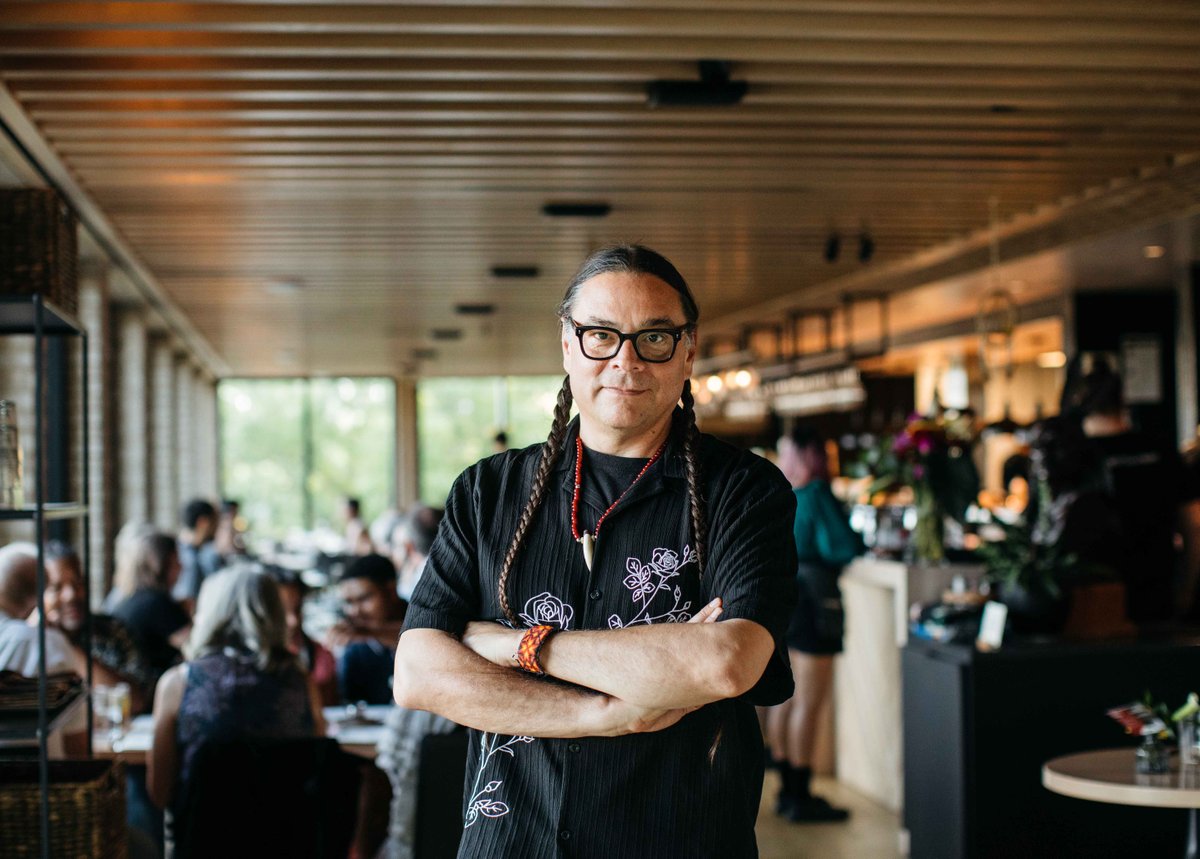
Big, big news, Minnesota. I barely know where to start. Lock in, it’s complicated.
You know how Owamni is probably the most important restaurant that Minnesota ever had, and one of the most important in the country at this particular cultural moment?
If you’re new around here, it’s that important because tens of thousands of years of North American Indigenous cultural foodways were wiped out in the blink of an eye in the 1800s, and then we all looked around in great surprise when local chef Sean Sherman brought those and some related issues to our attention in the 21st century. So we all said: You’ve got a point, Sean! If we live on Dakota and Anishinaabe land, if our state has a Dakota name and so do many of the states around here (and ditto for a heck of a lot of the city and town names), why on earth is French food considered “normal” and common, why are Italian and Thai and Ethiopian cuisines and even our state fair’s Australian blooming onions “normal” and common, but Dakota and Anishinaabe food feels…totally uncommon and actually maybe even something so unheard of that we know nothing about it?
And so Sean Sherman started the work of developing a pan-Indigenous restaurant cuisine of North America, and his 2017 cookbook, The Sioux Chef’s Indigenous Kitchen, (co-written with local cookbook luminary Beth Dooley) won the James Beard Award for Best American Cookbook. Then, the city of Minneapolis redeveloped a gorgeous restaurant space with unbelievable river views for his restaurant, Owamni, and the James Beard Foundation named it the Best New Restaurant in the country in 2022. It became the one place all your friends from out-of-town wanted to visit, and the restaurant was always fully reserved, even in the dead of winter, and we all learned to be the kind of person who says “extra crickets” or “hold the crickets” when ordering a salad. Last fall, it was gargantuan news when Owamni announced it was leaving its original location for the Guthrie Theater’s long-empty restaurant space that was once Cue and later Sea Change. Then, Sherman released an even bigger cookbook, Turtle Island, which provided an intellectual framework for an Indigenous culinary understanding of the vast expanse of land currently called Canada, the United States, and Mexico. Meanwhile, we were all like: Oooh, what will the Guthrie’s Owamni be like?
Surprise! There is no Guthrie Owamni. Sort of.
If this was The Lord of the Rings or something, I’d now put an end to the Book I title page here, for this first Owamni chapter doth endeth. (Officially speaking, it ends May 1, so get in your last meals if you want to say farewell.) Owamni, we loved you so much, and goodbye!
Welcome: Indígena by Owamni. Book II. I even have a handy-dandy pronunciation link: In-DEE-heh-nah.
“Indígena?” I said. “Spanish? Isn’t Spanish a colonial language? I thought the whole point was to get rid of colonial everything?”
“It comes from the Latin indigenae, which means ‘born of the land,’ same root as ‘indigenous,’” said Sherman, who met me in the raw shell of the new Guthrie space, currently under construction. We pulled down a corner of plastic covering the windows to peek at the little sliver of view of the Owámniyomni falls outside, that sacred spot for so many Indigenous tribes of the Upper Midwest.
“Why is Latin any better?” I asked, and Sherman shrugged and laughed. He explained that after running the complicated entities under his NATIFS umbrella—which are both for-profit (restaurants and cookbooks) and not-for-profit (feeding Indigenous communities, educating cooks and kids and everyone, raising up Indigenous food producers all over North America)—he came to think that the main thing he needed to do was communicate across cultures, since everyone is already speaking colonial languages. He wants to be able to talk, for instance, to food growers and harvesters from the Long Island Shinnecock, the Oregon Umatilla, and the Seri fishers of Sonora, Mexico. He’s not going to be able to do it in the language of the Dakota, so pick your battles. Thus: Indígena by Owamni.
“Elk!” said Sherman, snapping me back to the present. OK Twin Cities, let’s talk the other red meats and giant cuts of game, to share.
Here’s some hot news: As you may have already absorbed, the new Indígena by Owamni space inside the Guthrie is massively bigger than the old space, with 200 seats inside, 100 patio seats outside. The Guthrie space also has a lot of cooking capacities and bells and whistles that never fit inside the original Owamni kitchen.
This size will allow Indígena by Owamni to serve a lot of big, big pieces of meat—think elk, venison, bison, and other traditional game meats ranched or farmed by Indigenous producers around Canada, the United States, and Mexico. (Of course, you can only serve farmed and ranched meats in restaurants; meat from hunting is a whole different story, and it’s not a restaurant story.)
Ask yourself: Do you love going out with the fellas to Manny’s for a big, big steak to share? There may be a very interesting new destination in your future. Sherman tells me he’s going to pull in a huge table for private events, if you want a full Flintstones bison rib roast crown roast for your holiday feast this year, it may be possible. Me, I put in a request for pheasant and grouse on the menu. I would love to be able to show off Minnesota pheasant more reliably; I’ve always said it’s one of the world’s greatest treats.
But those are not the only treats on our near horizon. The Guthrie’s first restaurant in that space, Cue, was built with a huge custom oyster bar as a centerpiece. Indígena by Owamni will be using that setup, but filling it with different shellfish and fish raised by Indigenous producers from all over North America. Think oysters from three coasts, crab, whelks, periwinkles—wherever Native folk are raising or fishing seafood, you will find those at Indígena by Owamni.
More news: Indígena by Owamni is going to open with a series of chefs de cuisine running the spot, so Sherman can continue to juggle what he juggles. The first will be Joseph Shawana, who has been working with Owamni and Sherman for a while. Having a CDC is standard restaurant industry practice, but it’s also a bid for growth, Sherman told me. Ideally the large staff and unique culinary training at Indígena by Owamni will raise a new generation of chefs ready to run their own Indígenas elsewhere—could there be an Indígena in Bozeman, or at a tribal casino, or in Mexico City, with chefs who came up through Indígena by Owamni at the Guthrie? Could be!
At which point we put a big Book III and go on into our glorious future.
I know you’re asking: When? Early May, if we’re lucky, but you know what restaurant construction is.
When I walked through I saw cement floors ready for a laminate to go over the top, and staff tasting Indigenous and BIPOC wines. I saw a rendering of paint colors, replacing those under-the-sea colors that have been there most recently with darker reds, browns, and golden corn shades. I saw a rendering transforming the grid over the current bar into something that looks like Indigenous beadwork. I heard plans for a special menu targeted at Guthrie theater-goers of foods that are quick to serve when you’re rushing to hit curtain time. I met the bartender who was developing the bar program, with no citrus and no cane sugar.
Are you ready for some agave spirit drinks made with a sour element that comes from sumac? They’re coming to this big new bid for international leadership in Indigenous foods on the Mississippi riverfront, very soon.
Exciting times, Minnesota! Indígena by Owamni. Practice saying it a few times in your head, because if the past is any indication of the future, you’re going to bring every out-of-towner you know there every three months for the rest of the year, and into our glorious future.
Dining and Cooking