
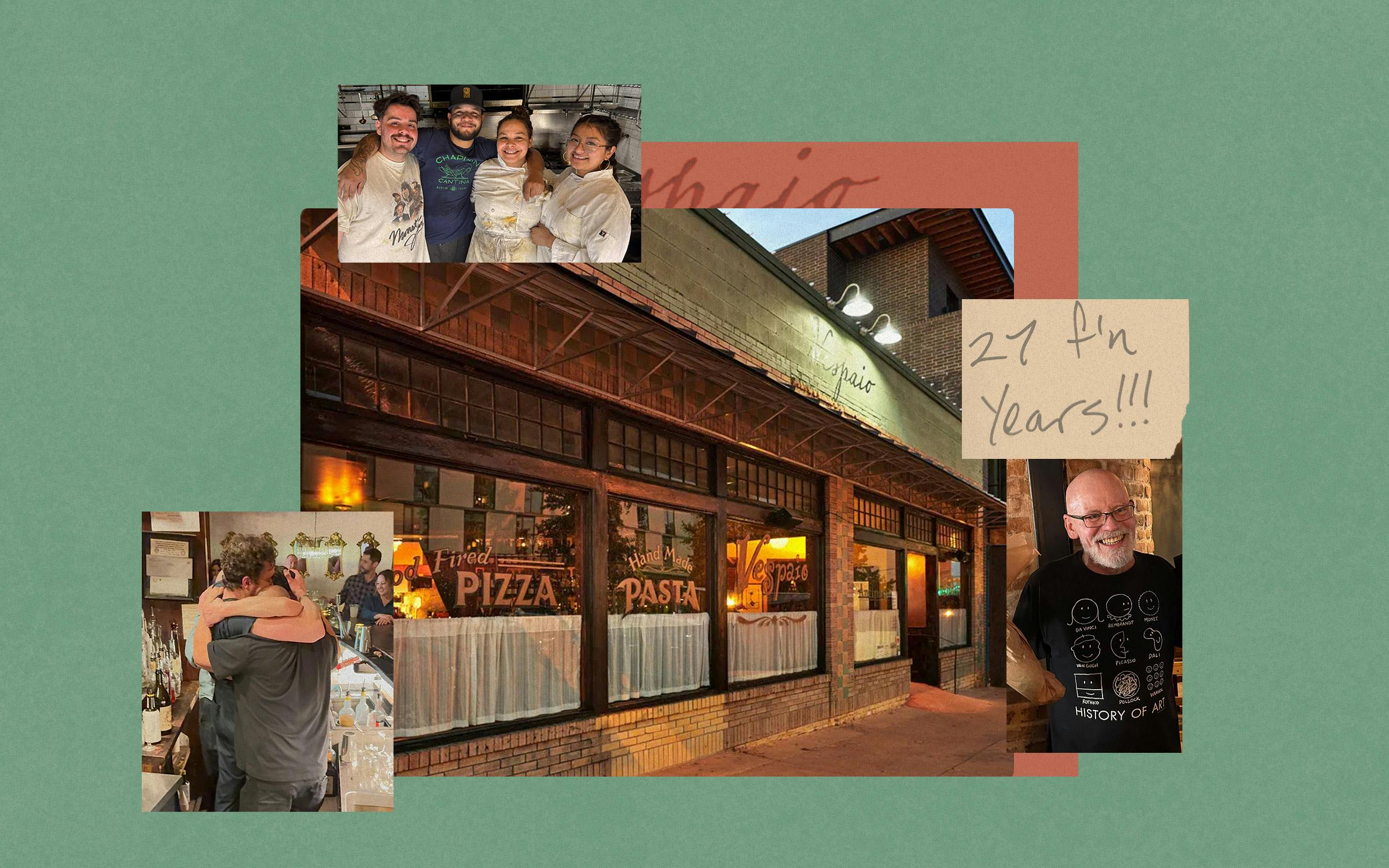
Except for the long line out front, the dozens of former employees sitting at tables, and the occasional outbursts of applause, the last night at Vespaio, an Italian restaurant on Austin’s South Congress Avenue, felt like any other over the past 27 years. The dining room and bar area were packed, the small kitchen was busy, and the bartenders and waitstaff were in constant motion.
It was 5:30 on Saturday evening, and my wife, Liz, and I sat at the crowded bar, as we had a hundred times before, and stared at the menu, even though we knew what we were going to get: the lasagna. “I don’t regret having the thing we’ve had fifty times,” I said.
“Because we’ll never have it again,” Liz replied.
We looked around at the room where we had sat so many nights with our kids, friends, neighbors, and strangers. Everyone seemed to share our feelings: sad that this extraordinary place was closing, grateful for one more night. Since the news in January that the building had been sold, it had been even harder to get a seat at Vespaio. All the reservations had been booked, and lines formed at four in the afternoon to get a seat at the bar. Many longtime customers made one last pilgrimage and posted photos on social media to let the world know how they felt. “End of an era,” wrote local writer Jesse Sublett on Facebook, with a photo of himself and his wife, Lois, at the bar. The Goodpastors—neighbors who had their first date at Vespaio in 2010 and later took their two young kids—sat together at the bar and took a photo with bartender Tom Upthegrove. “I usually handle change decently enough,” Kelly Goodpastor told me. “This one hurts.” They were losing an emblem of their family, a tangible reminder of who they are.
Liz and I talked with two bartenders, Joshua Clark and Wiley Greene, who had worked together in the narrow space long enough to know each other like dance partners. They are both musicians, though Greene, with his light blue work shirt, beard, and long hair, looked like he was in the dad band Wilco, while Clark—tall with curly hair, retro glasses, and a full mustache—looked like he was in seventies pop group Sparks. The duo worked diligently, shaking martinis, pouring glasses of wine, and opening beers. “It’s like being a bartender on the Titanic,” Clark said. “There’s a thin line between tragic and funny. And if this isn’t tragic, I don’t know what is.”
People in Austin are obsessed with the past, and we like to measure ourselves by when we think the Old Austin—the cool, authentic version of the city—died. For some, it’s when Armadillo World Headquarters closed, in 1980; for others, when Liberty Lunch was torn down, in 1999. The shuttering of UT-area joint Les Amis Cafe in 1997 and downtown restaurant Las Manitas in 2008 were too much to bear for some old Austinites. And now we have a new marker: February 28, 2026, when Vespaio served its last plate of lasagna. Our city won’t be the same.
Neither will our neighborhood. No place in Austin has changed as much over the past generation as South Congress Avenue. Today the area—often called SoCo—is a destination for tourists who come from all over the world to wander among fancy boot stores and stay in boutique hotels. But back in 1998—before Nike, Hermès, and Lululemon—South Congress was a seedy part of town. Ladies of the evening stood on street corners calling out to strangers. Dealers sold hard drugs and junkies dozed in the alleys. If you had called the area SoCo, you would have been laughed at. Or punched in the mouth.
When I bought my home, a half block from South Congress, in August 1998, my main dining choices were Güero’s Taco Bar and Fran’s Hamburgers. Two months later, Vespaio Ristorante opened just two blocks away. No way, I thought, is an elegant Italian restaurant going to last here.
No way could I have been more wrong. Vespaio was jam-packed from the very first night, in large part because its three partners, Claude Benayoun, Alan Lazarus, and Scott Bolin, had a lot of history in Austin, especially within the food community. Benayoun was a Frenchman and wine connoisseur who had waited tables at the downtown bistro Chez Nous, while Lazarus had been a chef at Italian restaurant Basil’s. Bolin, a tall, good-natured Houstonian, seemed to know everyone in Austin. “We never advertised,” Lazarus told me. “The three of us had really cool friends and they all came to the opening, then met each other and created an even bigger circle.”
The venue was pretty fabulous, too: a turn-of-the-century grocery store that had later become a Western wear shop. The new guys didn’t own the building, but they completely reimagined the inside, stripping the wood from the walls to reveal the ancient yellow brick and ripping down the dropped ceiling to find the original tin. They hired the architect Aubrey Carter, who came up with a concept of rounding as many walls and edges as possible and had a curved bar built out of longleaf pine planks taken from an East Texas barn. “There were no angles in there,” Benayoun told me, “nothing sharp. Visually, emotionally, it invited you in.” The trio found a name for their spot when, during the renovation, workers uncovered a bees’ nest and an Italian friend who was watching called out “E’un vespaio!” The owners liked the sound of the word, which literally translated to “wasps’ nest” but also hinted at something buzzy.
That was exactly what you got at Vespaio. When you pulled open the V-shaped wrought iron door handle, it was like stepping into another world, one that was warm and bustling at the same time. Vespaio opened for dinner only, and Liz and I liked to sit at the bar or at one of the small tables along the brick wall. It was here that we met bespectacled bartender Upthegrove, who seemed to be working every night. Upthegrove was a cheerful, veteran Austin bartender (Antone’s, La Zona Rosa) and guitar player (Billy Bacon & the Forbidden Pigs) who knew how to have an actual conversation while making elaborate cocktails and giving you tips about the menu.
The food was Italian with a French influence, such as the Funghi con Polenta e Marmellata di Cipolle (a crispy polenta cake served with caramelized-onion marmalade and a portobello cap) and the Risotto al Zafferano con Frutti di Mare (saffron risotto with seafood), much of it made from scratch under the influence of chef Ryan Samson. In the small open kitchen, workers pulled mozzarella by hand and cured olives. During the day, they pulled together tables to butcher whole and half cows and pigs, cut steaks, and made sausage. They got their basil, oregano, lettuce, and carrots from the garden out back and local organic farms.
My favorite dish was the seafood pizza, cooked in the oak-fired brick oven; Liz loved the mussels and fries. The handmade gnocchi was incredible—as was the ravioli stuffed with crabmeat. One of the most expensive things on the menu was the cioppino, a rich seafood stew, the recipe for which came from a wine-scouting trip to Italy. The lasagna was the most popular dish, a giant square of beef-and-pork Bolognese and béchamel layered between leaves of spinach pasta and adorned with a thick pork link made on-site. When Vespaio’s specials sold out, the manager would note it on the menu, along with a stamp that read: “Just get the lasagna.”
Vespaio wasn’t cheap, but it wasn’t insanely expensive. Liz and I went there after we got married, in 2000, drinking wine and trying to figure out where exactly Ellison and Natalie—Liz’s teenage daughters—would live in our small house; we went there after our son, Jack, was born in 2003 and we began talking about renovating; we went there when Jack was old enough to eat lasagna; we went for anniversaries and birthdays with family and our closest friends; when we needed a break from our lives; when we needed to huddle at the bar and get Upthegrove to make us a negroni or pour a Peroni. We would see friends and neighbors doing the same—introducing their young kids to a grown-up restaurant. Like us, they would return for anniversaries, birthdays, graduations.
The restaurant always felt like a family place, but the bar was usually crowded with characters—dancers from Exposé (now the Red Rose), musicians getting ready for gigs, lone businessmen. The celebrities who visited—David Byrne, Billy Gibbons, LeVar Burton, Justin Timberlake—usually opted for the dining room. Every night, Lazarus or Bolin would make their way through the restaurant, talking to customers, making sure the food was right. Upthegrove would ask about our jobs and top off our drinks as he made his own concoctions, like the South Austin Speedball (espresso, vanilla vodka, Kahlua) and the Vespa (reposado tequila, lemon, homemade honey-jalapeño syrup).
Even as our lives changed—parents dying, kids leaving—and even as the neighborhood got more upscale and the small art galleries and shops were priced out, we could walk the two blocks and feel at home. Vespaio went through changes too, including its opening of a sister restaurant next door in 2005 called Enoteca, which served lunch and had a deli case. But, remarkably, Vespaio kept many of the same staff members through all those years, like Upthegrove, busser Pedro Hernandez, Clark, Samson, and manager Daniel Brooks. Vespaio was a family for its staff too. Because of its reputation among foodies, the restaurant became a training ground for cooks and restaurateurs, many of whom went on to form other successful joints, like Dai Due and Micklethwait Barbecue. “We made everything from scratch,” Benayoun told me. “That attracted quality people.”
Vespaio was our go-to spot through the 2010s, even after the original three owners sold to chef Samson and manager Brooks in 2018. During the pandemic, we got our lasagna to go, and by 2023 we had returned to our usual spots at the bar, watching the cooks in the kitchen spin pizza dough into the air, checking out the couples huddling at the tables along the wall, listening to the jingle-jangle all around us. After dinner we would walk home smelling like smoke from the wood-fired oven. I figured Vespaio would be in the neighborhood as long as we were.
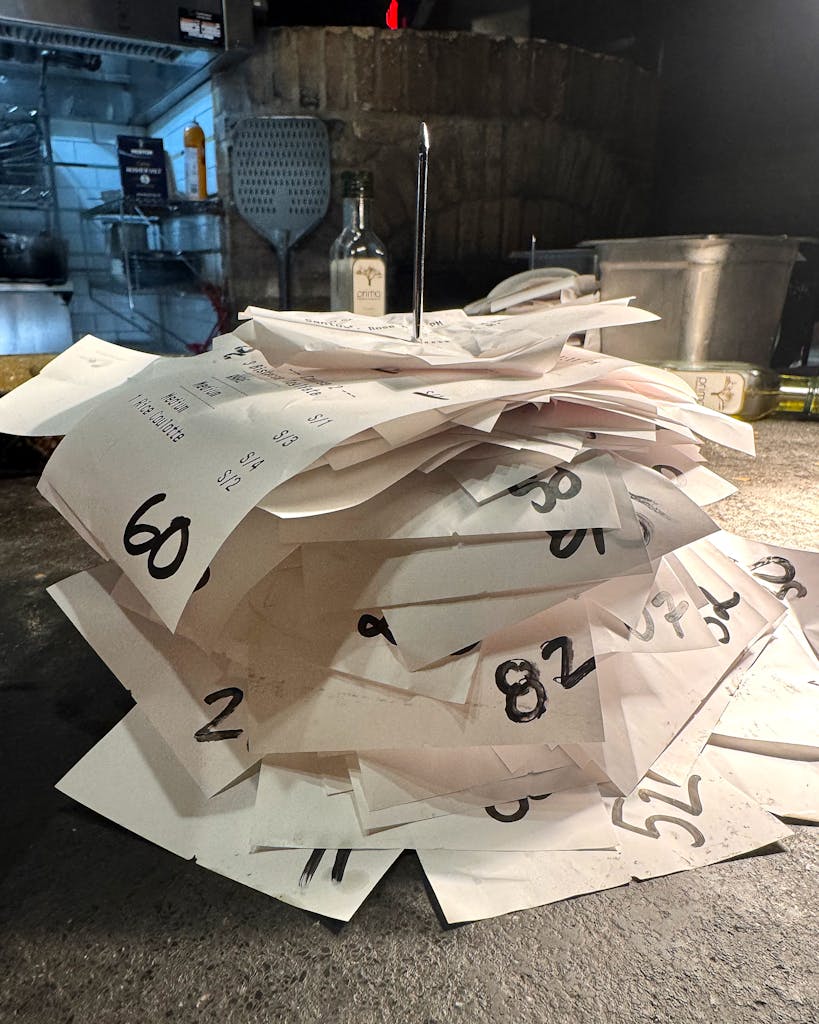 Order receipts from the last night of service at Vespaio.Courtesy of Vespaio
Once again, I couldn’t have been more wrong. Everywhere we looked Saturday night, we saw people we knew saying goodbye. Next to me at the bar, Bart Brown, who had been coming since 1998, did what we had done. He ordered his favorite, the bistecca tagliata (hanger steak with fries and sautéed spinach). When we were done with our lasagna, he asked, “Is it the best you’ve ever had?”
“It’s the same,” I said. “In other words, yes.”
Carter, the architect, was there, and so was Jennifer Long, who’d helped redesign the interior in August 2021 and had flown down from Colorado with her husband. Lawyer Steve Bresnen and his wife sat on two stools at the end of the bar, their favorite spot for eighteen years, a place from which they could watch the cooks in the kitchen and the waiters rushing past. At a table in the window sat longtime Austin scenester Wayne Nagel; musician Jon Dee Graham; his wife, professor Gretchen Harries; their son, musician William Harries Graham; and William’s girlfriend, Jes. Lazarus came to the table and reminded William, who is 26, of how his mom used to breastfeed him in a chair at this very table back in the early days of Vespaio. Everybody at the table smiled. This was family lore, and none of them would ever forget it.
Bolin seemed to know everyone; he could barely walk ten feet before seeing a former waitperson or cook and stopping for a hug and a photo. He figured some fifty former employees came to Vespaio for the last night, leading to a raucous round of applause whenever one of them approached a table of friends he or she hadn’t seen in years.
The last ovation came at 10:45 p.m., fifteen minutes after the managers had shut the front door. A small group in the main dining room began applauding Samson and the other cooks in the open kitchen—and soon the whole room was clapping. The applause went on for thirty seconds as Samson and the other cooks smiled and nodded. Then they got back to work.
Liz had walked home hours before, but I stood and listened one last time to the din—the talking, the laughing, the clinking forks, the shaking martinis. I wanted to remember this moment, this feeling, which, like all the other ones over the previous 27 years, seemed so important. Then I walked home, past the spot where just three months before, two other small businesses, Triple Z Threadz and Limbo Jewelry, had been open. Upthegrove had ruefully talked about them and other recent closures on South Congress. “I understand it’s progress,” he told me, “but don’t you miss all those funky secondhand stores and little gift shops? They got priced out. There’s no place for mom-and-pop on South Congress. I don’t want to sound bitter, because that’s a cliché in this town.”
I don’t want to sound bitter either. Great cities change, and so do great neighborhoods. I mean, I don’t miss the dealers, hookers, riffraff on the corners. But I already miss Upthegrove, Hernandez, the lasagna, and the feeling of sitting at that bar and watching the world spin around us.
Read Next
Dining and Cooking