
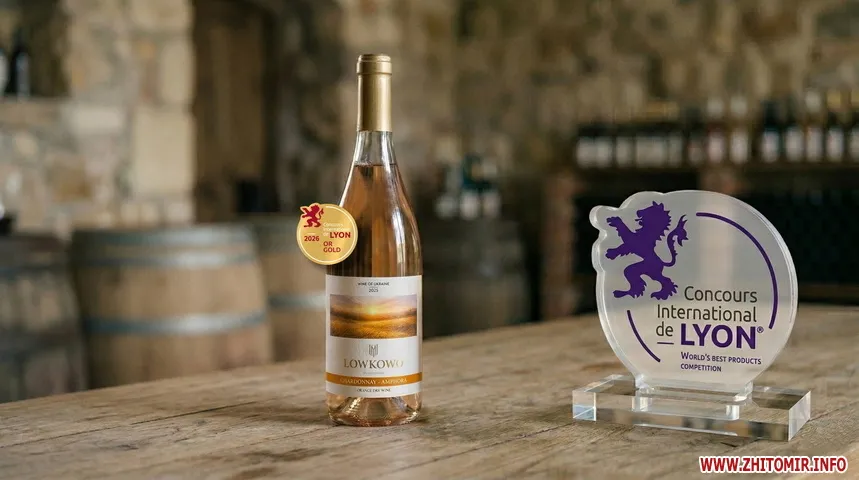
Ukrainian craft winery Lowkowo has won gold and silver medals at the international competition Concours International de Lyon in France, where in 2026 they evaluated 10,355 samples from 58 countries. Among thousands of samples, awards are given only to wines with the highest scores from the jury. Lowkowo is the only winery from Ukraine among the winners, competing with producers from traditional wine countries, including France, Italy, and Spain. This was reported by the company representatives, as reported by agronews.ua.
Читай нас також у Viber та Telegram.
“Lowkowo Chardonnay Amphora 2025 received the gold medal – a wine with a score of 91/100, which also received a separate trophy for the best Ukrainian wine of the competition – above the average jury score (85.6). This is an orange style Chardonnay – fermentation and aging take place on the skin in an Italian clay amphora. This approach gives a denser texture and a more complex aromatic profile. In the tasting evaluations, the wine received maximum scores for appearance and one of the highest scores for aroma and taste quality, placing it above the average scores of the jury and the competition as a whole,” the statement said.
The silver medal was awarded to Lowkowo Chardonnay 2025 with a score of 81/100 – also above the average jury score. This is a classic dry white wine – fresh, with clear acidity and fruity-citrus notes. This is a different approach – without experimental techniques, focusing on the purity of style and balance. According to the jury’s ratings, the wine consistently received high scores for all key parameters.
These results fit into the overall trend: Ukrainian winemaking is gradually expanding beyond the local market and appearing in international ratings.
Both awards are the result of blind tasting: samples are evaluated without indicating their origin, and the jury consists of hundreds of industry professionals – sommeliers, oenologists, wine buyers, and restaurateurs. The competition is held according to clear classification rules (naming, vintage, grape varieties), and the evaluation is carried out on a 100-point scale of the OIV model (International Organisation of Vine and Wine), which is an international standard.
Both wines are produced at the small Lowkowo winery in the village of Levkiv, Zhytomyr region – a region that was not considered a wine region just a few years ago. These results look atypical even in the context of Ukrainian winemaking, which is traditionally associated with southern regions.
The vineyards were planted in 2018-2019 after soil analysis and consultations with European nurseries, and the grape varieties were selected for their ability to adapt to the local climate. Production remains limited – a few thousand bottles per year – allowing for working with small batches and maintaining precision.
The Lowkowo project grew from a personal interest in wine and experience traveling through European wine regions. Today, it is a small team, where some specialists had to be trained from scratch, and all processes – from the vineyard to aging – are controlled manually. The production combines modern equipment, French oak, and experimental approaches, including amphora fermentation.
“I started as an experiment for myself, but it quickly became clear that the results could be shown more widely. This is not a story about volumes – it is an attempt to create a product that does not require explanations about its origin,” said the founder of the winery Mykola Yanushevych.
Today, Lowkowo wines are presented in restaurants and specialized wine shops in several cities in Ukraine, including Zhytomyr, Kyiv, and Lviv, and are also available online. The small production format allows working in a niche segment, focused not on volume, but on the quality and recognizability of the product.
In this case, it is not just about individual wines, but about the ability of Ukrainian products to compete at a global level – even beyond traditional wine regions.
In conclusion, this is a story not only about wine but about how new regions and small productions are beginning to influence the global map of the industry.
Views: 3
Dining and Cooking