Disregard the proofing times if you don’t proof at 28C.
Kamimitsu
A lot of the airy crumb comes from two factors: hydration and handling (though there are other things at play, these are kinda key… assuming you have adequate gluten development and aren’t over/under fermenting). Hydration is kinda set by the recipe (more hydration is usually more hole-y, but harder to work with, so there’s a trade-off), so I’ll just talk about handling.
The crux is that you want strong gluten, but you don’t want to knock out all the air. So, your handling in the early stages can be a bit rough, but needs to be gentle as time goes on. I’ve recently been doing coil folds instead of stretch and folds, and I’ve gotten an airier crumb without changing much else.
Edit: I realize I didn’t address the crispiness. Part of that is coming from being spread out fairly thin on the tray (I tend to make tall-ish focaccia, because I like it chewier), as well as likely being cooked at a relatively high temperature (my oven only goes to 230C, so I’m kind of limited in that regard) and with a fair amount of steam. You can add steam by throwing ice cubes in a heated tray/ramekin as the bread goes in. As for the right temp, I can’t say much since again, I can’t do high temp baking.
rogomatic
Have an oven that injects steam and heats up to 600F or more.
LumpyAtmosphere22
Yeah, those bubbles are what make bread baking so rewarding; I swear by a longer fermentation time to get that airy crumb.
To add to the other great comments, high hydration dough will get the bubbles but only if you cook it hot and fast.
If you cook it at a lower temp for longer your bread will be closer to a cracker. With a thick dense hard crust that snaps.
You want all the water trapped in the dough to explode out into large bubbles before it is dried out/hardened so much that the expanding steam can’t stretch it anymore.
That means max temp on your oven, but also you can employ a pizza stone or steel to really transfer the heat as fast as possible.
Adding ice/water to the oven helps to keep the surface of the bread from drying out as fast so it can help with volume, but too much will mean the crust is softer at the end and doesn’t have a crisp texture.
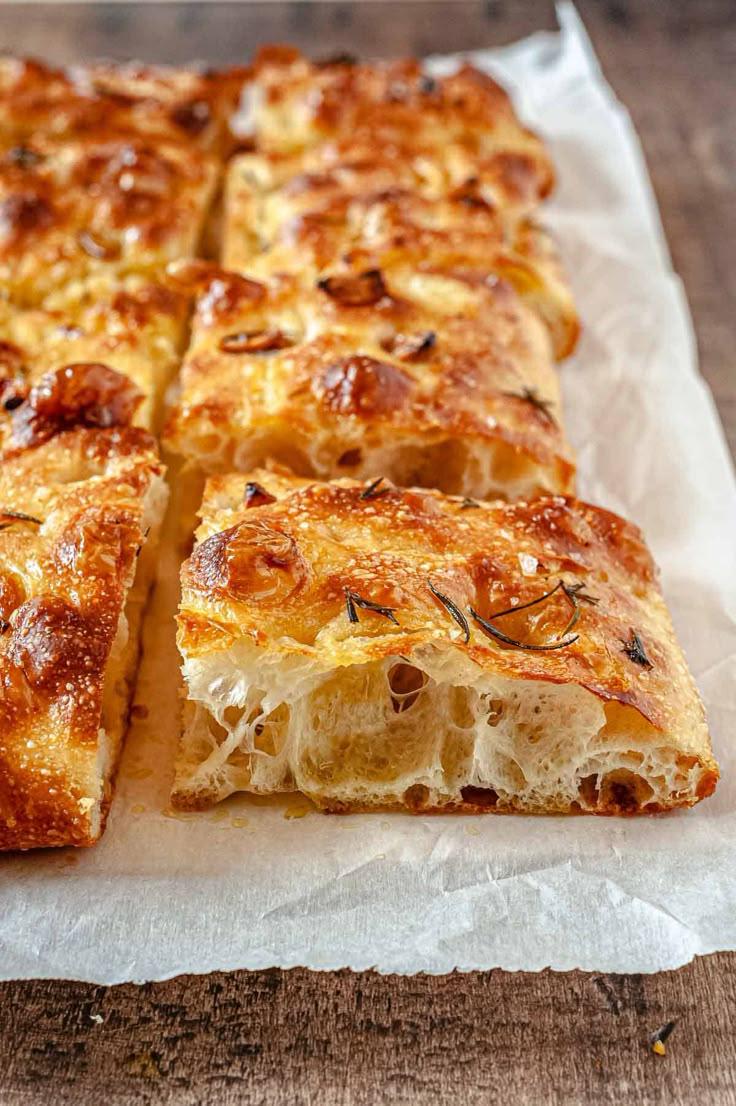
The photo does look like the surface of the bread is a lot shinyer than if it were just baked on a pizza stone, it looks more like it’s been cooked in a metal baking tray with oil in the bottom, something you would tend to do for Detroit style pizza which is basically very dressed up focaccia
No_Ocelot_6773
Water. Focaccia bread dough should be wet, like thicker than pancake batter but not like a sourdough loaf. There could be other things happening but my focaccia got better when I made it wetter
Snoopyla1
The focaccia recipe in the Claire Saffitz cookbook Dessert Person comes out like this.
Pie_Ranger
When I follow Claire Saffitz’s focaccia recipe – it turns out like this!
UncleDuude
Hydration
ecfle
The equivalent of making chips lol
IronPeter
It looks like Roman pizza.. how I do it:
75%~80% hydro
Good gluten development during mixing
Bulk proof until double in size (important)
Shaping building even more strength
Good final proofing as well but not overdo it
After stretching it out in the pan do not let it rise again
(I) Don’t hold back on yeast 1% or even 1.5% are acceptable
Cooking is also very important, as hot as you can with an Home oven
j_ksa
Just want to say this looks amazing! I would love all my focaccia to turn out like that.
dnlt
I agree with most of the comments, but the pic is pizza bianca romana, not the more common focaccia discussed in this subreddit.
Bottom line: bread and semolina flour, high hydration ~80%, and high oil content.
The preparation is also slightly different from typical focaccia.
A key thing is to use a blue steel pan if you do it in a home oven.
Now this type of pizza also get slightly different names as “pizza al taglio” and “pizza alla pala” depending on toppings or size of the final product, they all share the same base dough and preparation
This is a great starting video, he is one of the main pizza owner in Rome.

18 Comments
I’m really curious about this as well. Mine always comes out dense but I’ve been chasing for those airy bubbles.
Good strong flour, preferment helps, gluten development and some baking knowledge.
This is a good recipe:
[https://lilyartisan.wixsite.com/bakes/post/easy-yeasted-focaccia](https://lilyartisan.wixsite.com/bakes/post/easy-yeasted-focaccia)
Disregard the proofing times if you don’t proof at 28C.
A lot of the airy crumb comes from two factors: hydration and handling (though there are other things at play, these are kinda key… assuming you have adequate gluten development and aren’t over/under fermenting). Hydration is kinda set by the recipe (more hydration is usually more hole-y, but harder to work with, so there’s a trade-off), so I’ll just talk about handling.
The crux is that you want strong gluten, but you don’t want to knock out all the air. So, your handling in the early stages can be a bit rough, but needs to be gentle as time goes on. I’ve recently been doing coil folds instead of stretch and folds, and I’ve gotten an airier crumb without changing much else.
I actually tested out another redditor’s focaccia calculator app today, and got some [pretty airy focaccia](https://www.reddit.com/r/BakingInJapan/comments/1sa9kse/focaccia/), though I think I slightly over-proofed the dough (I had to make a slight modification due to cooking vessel). [Maybe give it a go](https://darcmuff.github.io/FocacciaFriday/)?
Edit: I realize I didn’t address the crispiness. Part of that is coming from being spread out fairly thin on the tray (I tend to make tall-ish focaccia, because I like it chewier), as well as likely being cooked at a relatively high temperature (my oven only goes to 230C, so I’m kind of limited in that regard) and with a fair amount of steam. You can add steam by throwing ice cubes in a heated tray/ramekin as the bread goes in. As for the right temp, I can’t say much since again, I can’t do high temp baking.
Have an oven that injects steam and heats up to 600F or more.
Yeah, those bubbles are what make bread baking so rewarding; I swear by a longer fermentation time to get that airy crumb.
[King Arthur’s Pan de Cristal recipe](https://www.kingarthurbaking.com/recipes/pan-de-cristal-recipe) has a focaccia variant at the bottom.
To add to the other great comments, high hydration dough will get the bubbles but only if you cook it hot and fast.
If you cook it at a lower temp for longer your bread will be closer to a cracker. With a thick dense hard crust that snaps.
You want all the water trapped in the dough to explode out into large bubbles before it is dried out/hardened so much that the expanding steam can’t stretch it anymore.
That means max temp on your oven, but also you can employ a pizza stone or steel to really transfer the heat as fast as possible.
Adding ice/water to the oven helps to keep the surface of the bread from drying out as fast so it can help with volume, but too much will mean the crust is softer at the end and doesn’t have a crisp texture.
The photo does look like the surface of the bread is a lot shinyer than if it were just baked on a pizza stone, it looks more like it’s been cooked in a metal baking tray with oil in the bottom, something you would tend to do for Detroit style pizza which is basically very dressed up focaccia
Water. Focaccia bread dough should be wet, like thicker than pancake batter but not like a sourdough loaf. There could be other things happening but my focaccia got better when I made it wetter
The focaccia recipe in the Claire Saffitz cookbook Dessert Person comes out like this.
When I follow Claire Saffitz’s focaccia recipe – it turns out like this!
Hydration
The equivalent of making chips lol
It looks like Roman pizza.. how I do it:
75%~80% hydro
Good gluten development during mixing
Bulk proof until double in size (important)
Shaping building even more strength
Good final proofing as well but not overdo it
After stretching it out in the pan do not let it rise again
(I) Don’t hold back on yeast 1% or even 1.5% are acceptable
Cooking is also very important, as hot as you can with an Home oven
Just want to say this looks amazing! I would love all my focaccia to turn out like that.
I agree with most of the comments, but the pic is pizza bianca romana, not the more common focaccia discussed in this subreddit.
Bottom line: bread and semolina flour, high hydration ~80%, and high oil content.
The preparation is also slightly different from typical focaccia.
A key thing is to use a blue steel pan if you do it in a home oven.
Now this type of pizza also get slightly different names as “pizza al taglio” and “pizza alla pala” depending on toppings or size of the final product, they all share the same base dough and preparation
This is a great starting video, he is one of the main pizza owner in Rome.
https://youtu.be/6J49lcJU3VA?si=1w0nyD4ZnSWxPxzV
I’ll post my recipe shortly.
Emma’s Goodies.
I’ve been following this recipe from King Arthur using bread flour instead of AP. It’s been big, bubbly, and chewy. Highly recommend.
https://www.kingarthurbaking.com/recipes/big-and-bubbly-focaccia-recipe
Time, you will need to proof it overnight in the fridge.