
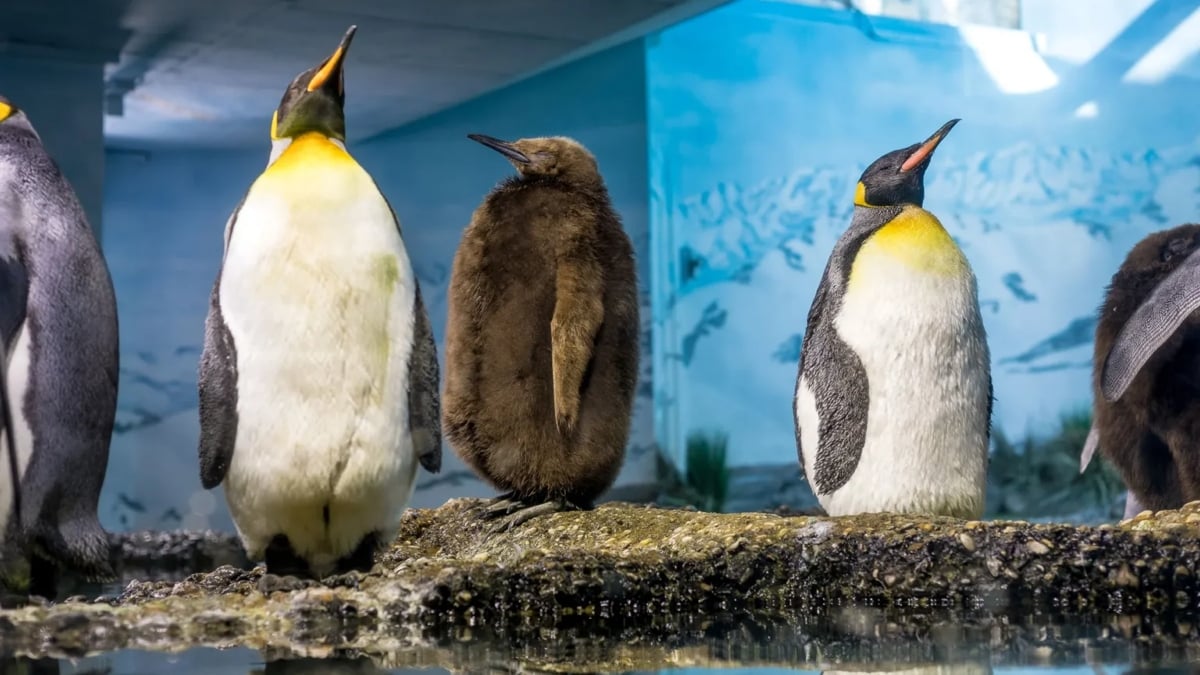
Pampered penguins in zoos escape the elements and feast on fish to their hearts’ content, but care-free living comes at a cost.
Newly published research suggests that zoo penguins age faster than their wild counterparts, biologically speaking, and this offers an invaluable analog for Western lifestyles in humans.
“A 15-year-old penguin in the zoo has the body of a 20-year-old penguin in the wild,” explains study co-author Céline Le Bohec, a scientist at the Monaco Scientific Center, who has studied wild king penguins for over two decades.
“However, the interesting part is that zoo penguins also live longer, overall.”
Penguins in zoos are protected from predators, Antarctic tempests, and the harsh southern seas. They also benefit from free access to fishy treats and veterinary care.
But their free-eating diets and limited physical activity contribute to a disruption of life rhythms, such as circadian cycles and sleeping patterns, that may affect cellular homeostasis and ultimately facilitate accelerated aging – a characteristic common to the Western lifestyle, the researchers suggest.
“The consequences of a sedentary lifestyle are difficult to study in human trials,” researchers say, which may seem ironic because there are so many human examples.
But perhaps that’s the point: human aging is a complex conundrum, encompassing an overwhelming number of factors, including food security, alcohol consumption, economic factors, medicinal habits, and other variables.
So, why not study king penguins (Aptenodytes patagonicus)? Penguins provide an excellent example because their socioeconomic living situation hasn’t changed in centuries.
Plus, with lifespans of up to 40 years, they are exceptionally long-lived animals, especially for their body size. Finally, the increased food intake and reduced activity levels of zoo penguins match a similar human shift in modern times.
In the recently published study, an international research team, led by the University of Helsinki in Finland, analyzed king penguins’ biological aging via blood samples taken from 64 individuals of known chronological ages.
This included 34 wild penguins from Possession Island in the Southern Ocean and 30 zoo-born-and-housed penguins from Zoo Zürich in Switzerland and Loro Parque in Tenerife, Spain.
The researchers determined epigenetic age acceleration (EAA) in penguins by using an epigenetic clock, a biochemical analysis that measures DNA methylation – a process by which methyl groups (a carbon atom connected to three hydrogen atoms) attach to DNA.
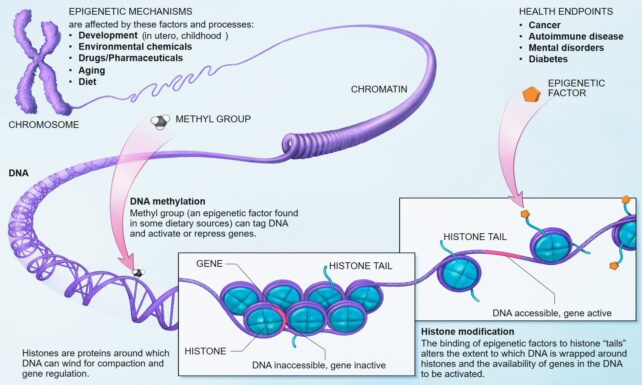 Epigenetic mechanisms influence gene expression without altering DNA. (National Institutes of Health/Wikimedia Commons/public domain)
This is a common test in the field of epigenetics, the study of how environment and behaviors affect the expression of genes without actually changing the sequences within those genes. As a result, an individual’s biological age may differ from their chronological age.
The new study suggests that there are discrepancies between the chronological and biological ages of pampered zoo penguins.

In the wild, king penguins may fast for up to eight weeks and perform incredible feats of fitness, braving the Southern Ocean’s swells on foraging excursions of up to 1,200 kilometers (750 miles).
Yet in zoos, the lack of environmental complexity, psychosocial stress, and altered microbial environments may also affect penguins’ epigenetics, altering the expression of genes associated with nutrient intake, growth, cell death, heart health, and physical activity. These epigenetic changes affect pathways that have also been linked to aging and lifestyle in humans.
Accordingly, to further test their model, the researchers compared it to a human test dataset of similar characteristics, with a known EAA. For aging contrast, the researchers used one of the strongest age-accelerating factors known: smoking.
This human comparison suggested that their penguin-aging models were robust.
Related: Added Sugar in Your Diet May Speed Up Your Body’s Biological Aging
Additionally, the researchers performed a survival analysis that included nearly 1,900 wild penguins and more than 300 zoo-dwellers. This analysis revealed a median survival age of 13.5 years for penguins in the wild, compared to around 21 years for individuals in zoos.
Alas, some of these penguins’ free-feeding days have come to an end, as the researchers are now conducting a study in which they encourage the captive creatures to exercise more and eat less.
The overall anti-aging, inter-species suggestion may be obvious, however inconvenient: more mindful eating and exercise habits may be vital to increase lifespan for humans as well as our feathery, flightless friends.
This research was published in Nature Communications.
Dining and Cooking