
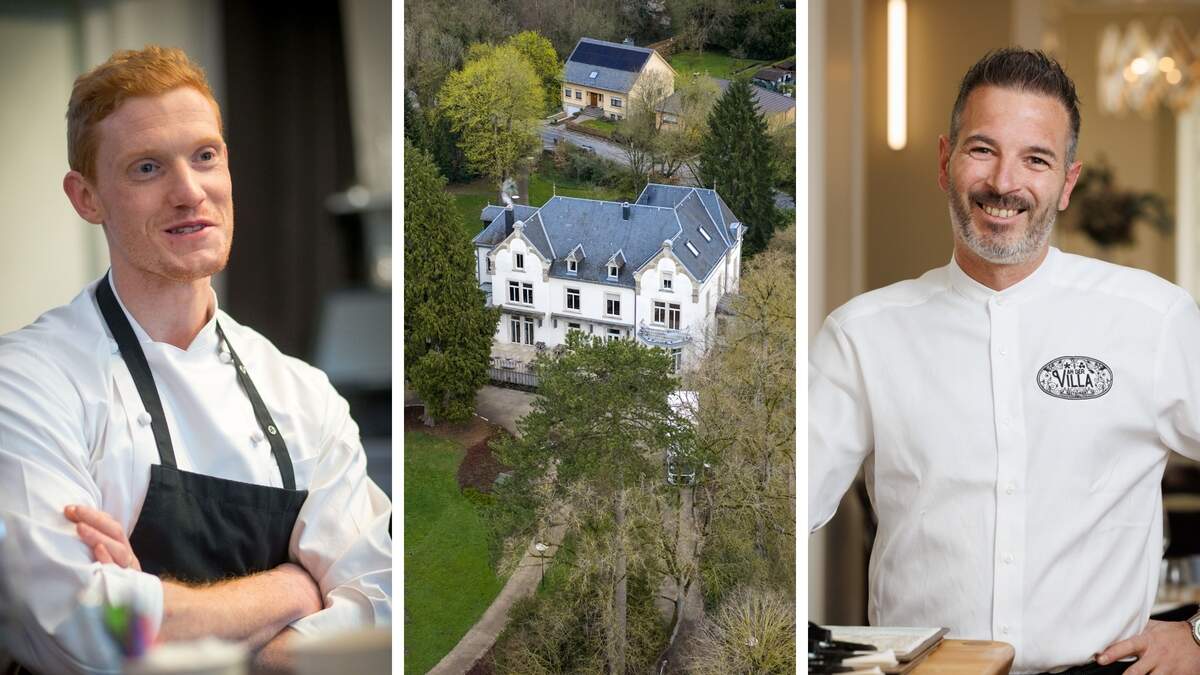
Roughly 15 months since Thomas Murer quietly announced that he would be closing his restaurant An der Villa in Steinfort, a new team is picking up the mantle and reopening the Villa Collart to fine diners.
Murer’s decision to close An der Villa after six successful years came as something of a bombshell in Luxembourg’s gastronomic scene. His successor at the scene, Fabio Zullo, admits to being nervous during his first interview with the media since taking over the restaurant.
“To be honest, I hadn’t expected this,” Zullo said. “I thought one of the big catering groups would win the contract.”
Instead, the municipality placed its trust in a small family business after almost a year of searching for a new tenant for the historic building, with two rounds of applications after a first call for applicants didn’t yield the desired results.
Finally, on 24 March, the first guests were able to take their seats for lunch at the Villa and order the first dishes under the new management but in the same historic setting of the more than 100-year-old house with its high ceilings, stucco ornaments and elegant cream-coloured design offset against modern furniture.
Fabio Zullo does not intend to follow Thomas Murer’s concept, but rather to offer brasserie-style cuisine. © Photo credit: Claude Piscitelli
Unlike Thomas Murer, Fabio Zullo is relatively unknown on the Luxembourg restaurant scene. No big name, no corporate backing, no portfolio of multiple establishments.
The Italian native was born in Switzerland, grew up in Italy and graduated from hotel management school there. After years in the seasonal trade – summer after summer, winter after winter – he decided to move to Luxembourg ten years ago.
At the start, with no knowledge of French, he took a job at Come à la Maison in the capital. He then moved to Brasserie D’Braustuff in Niederkerschen as restaurant manager, where he re-developed the gastronomic concept over three years.
The contact with Steinfort came through an acquaintance who lives in the municipality and drew his attention to the tender. Together with his wife, who has management experience in the catering industry, he drew up a business plan and submitted it.

They’ve put their heart and soul into it
Guy Erpelding
Deputy mayor, Steinfort
It was precisely this family feel that tipped the scales. “It’s their first restaurant of their own,” said Steinfort’s deputy mayor Guy Erpelding. “You can sense it – they’ve put their heart and soul into it.”
The municipality wanted someone who would focus entirely on this one venue instead of dividing their time between multiple projects. The decision is understandable – but it is also a gamble on potential, not on proven experience in running their own business.
“We had built up a reputation there that was known far beyond the municipality,” said Erpelding about the Villa drawing diners from well beyond the town’s borders.
“For us, it was more important to find the right operator than to rush into appointing someone at any cost. We didn’t want a hasty solution,” Erpelding said. A panel including local councillors and Murer himself were charged with the search.
Their criteria were clear: European, traditional cuisine, open at weekends, the use of the terrace in summer and a viable business plan. They also wanted a change and instead of replicating Murer’s cuisine were looking for a fresh taste.
Also read:From Luxembourg to a Michelin star in France
Between Wäinzoossiss and curry
Zullo dishes up European-French cuisine with some Oriental influences, complemented by Mediterranean elements. “But we don’t want to forget the Luxembourg classics either,” he said. The whole thing is intended to come across as a “chic brasserie”: accessible and affordable, but with a certain gastronomic standard.
Zullo has deliberately avoided a purely Italian concept – there are already plenty of good Italian restaurants in the region, he said. Whether the broad menu will pay off or risks diluting the restaurant’s character and identity remains to be seen.
In addition to his wife, Zullo’s younger brother also works in the kitchen. His mother helps with the washing up. Added to this are Antonio, an experienced Portuguese head chef, and a cook whom Zullo says he discovered by chance. “That’s family,” Zullo said proudly.
At the moment, the restaurant is open six days a week – it’s closed on Mondays. In the summer, when the park comes to life again and the terrace is in use, Zullo plans to extend opening hours to seven days a week – provided he can find the right staff. He even has ideas that go beyond the restaurant itself, such as picnics in the park.
The villa was built in 1904 and extensively renovated between 2016 and 2018. The restaurant on the ground floor stood empty for around 15 months. © Photo credit: Claude Piscitelli
The terrace was particularly important to the municipality. The aim is to ensure that people can still come here in the afternoon for a drink and a light bite to eat. © Photo credit: Claude Piscitelli
This is intended to bring the beautiful park, situated between the town centre and the villa, to life. © Photo credit: Claude Piscitelli
Inside, the restaurant looks largely unchanged compared to 15 months ago. © Photo credit: Claude Piscitelli
© Photo credit: Claude Piscitelli
The terrace itself was particularly important to the local council, which wants the restaurant to welcome guests in the afternoons too, to bring the park to life. Aperitifs and sharing plates will feature on the menu when terrace season begins.
Rising to the challenge
“I certainly feel the pressure,” said Zullo about working in the historic and cherished villa. “But I see it above all as an opportunity.” The building embodies the history of Steinfort. The task is to preserve this history whilst at the same time creating something contemporary from it.
The fact that Fabio Zullo, a family business, is taking over the restaurant is seen as a plus by the local council. © Photo credit: Claude Piscitelli
While Murer’s departure made headlines, the reopening has been managed without much fanfare. “The new operators wanted to find their own rhythm without being immediately overrun by guests,” Erpelding said. That was respected. “The restaurant is meant to develop organically.”
If it proves a success for Fabio Zullo and his family, it will automatically be one for the local council too.
Guy Erpelding
Second alderman of the municipality of Steinfort
There are some teething problems to resolve: Zullo is still waiting for deliveries, and some kitchen appliances – fridges and a dishwasher – need repairing.
Expectations are high. “You can tell that people here have been waiting for something,” Zullo said, speaking after the first guests, including many locals from Steinfort, flocked to the opening.
For the deputy mayor, it’s a simple equation: “If it’s a success for Fabio Zullo and his family, then it’s automatically a success for the community too.” But it works both ways: if the project fails, the community faces yet another long search for an operator for one of its most beautiful buildings.
Villa Collart – Industry, Decline and New Dignity
Steinfort’s economic rise is inextricably linked to the name Collart. From the mid-19th century onwards, the Collart family ran the Steinfort steelworks and shaped the municipality for generations. Steel production reached its peak towards the end of the First World War, after which the decline began. The works closed for good in 1932.
In 1904, steelworks owner Jules Collart built the villa for his son Robert. Following the death of his brother Charles in 1910, Robert moved to Dudelange, where he had inherited, among other things, the castle and steelworks. From then on, the villa was let to directors and engineers of the Steinfort steelworks, and later also used as an office. In the 1960s, the municipality of Steinfort purchased the building and until around 2014 it housed the town’s youth centre.
Between 2016 and 2018, the municipality had the villa extensively renovated according to plans by the architectural firm Bruck + Weckerle at a cost of around €3.4 million, with a restaurant on the ground floor and rooms for the tourist office, clubs and exhibitions on the upper floors. The park was redesigned as an English landscape garden at a further cost of €800,000.
The municipality had Villa Collart extensively renovated at a cost of around €3.4 million. © Photo credit: Claude Piscitelli
Today, Collart Park is a popular meeting place and various events take place there throughout the year, from Dag bei der Baach (Day by the Brook) to the Christmas market. The restaurant on the ground floor, however, is the centrepiece: it connects the historic building with the everyday life of the community and gives it back what a monument alone cannot create – life.
(This story was first published in the Luxemburger Wort. Translated using AI, edited by Cordula Schnuer.)
Dining and Cooking