
Demand for Breakfast Takeout in USA Size, Market Forecast and Outlook By FMI
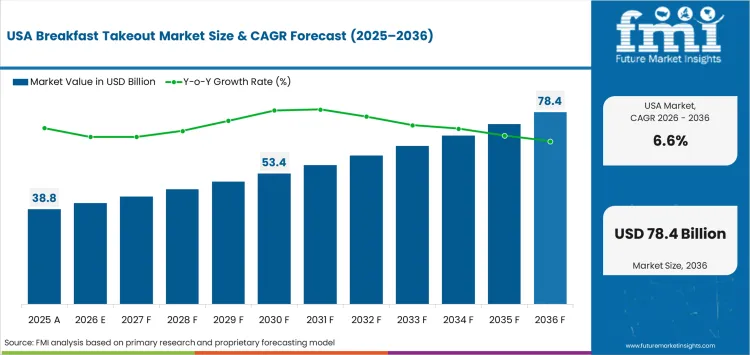
The demand for breakfast takeout in usa was valued at USD 38.8 billion in 2025, projected to reach USD 41.36 billion in 2026, and is forecast to expand to USD 78.37 billion by 2036 at a 6.60% CAGR. FMI projects that the absolute dollar growth of USD 37.01 billion over the forecast period captures a category shaped by measurable consumption and procurement patterns.
Summary of Demand for Breakfast Takeout in USA
Market Overview
The market is valued at USD 38.8 billion in 2025 and is projected to reach USD 78.37 billion by 2036.
The industry is expected to grow at a 6.60% CAGR from 2026 to 2036, creating an incremental opportunity of USD 37.01 billion.
The market is a structurally expanding foodservice category in the United States where the permanent shift from home-prepared to commercial breakfast drives sustained value growth.
Demand and Growth Drivers
Demand is driven by the structural shift of breakfast consumption from home preparation to commercial takeout, accelerated by convenience expectations and mobile ordering adoption.
Quick-service restaurants are investing in drive-through speed, mobile ordering infrastructure, and breakfast-specific menu engineering to defend the morning daypart.
The expansion of breakfast menus at chains historically focused on lunch and dinner dayparts is creating new takeout occasion capture across the competitive field.
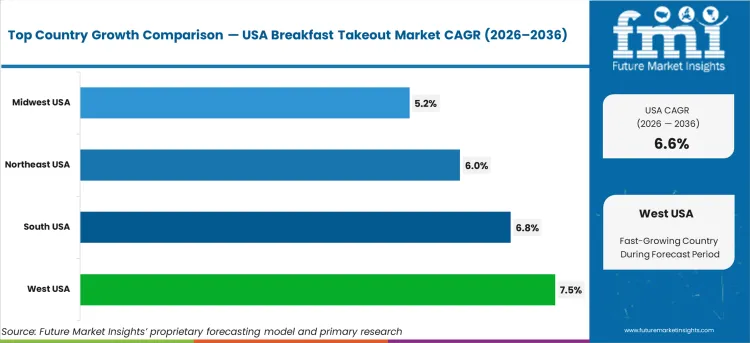
Among key regions, West USA at 7.5%, South USA at 6.8%, Northeast USA at 6%, Midwest USA at 5.2%.
Product and Segment View
The market covers prepared breakfast meals for off-premise consumption across non-vegetarian, vegetarian, and vegan options in multiple cuisine formats.
Channels include quick-service restaurants, fast-casual chains, coffee shops, and independent breakfast outlets across the United States.
Scope includes breakfast takeout revenue; excludes dine-in breakfast, third-party delivery, retail meal kits, and institutional breakfast services.
Continental Breakfast leads by Breakfast Type with 28.7% share in 2026.
Non-Vegetarian commands the largest Nature share at 45.0% in 2026.
Geography and Competitive Outlook
The West and South lead growth, driven by commuter density and QSR infrastructure expansion respectively.
Non-Vegetarian holds 45.0% nature share, with vegetarian and vegan options growing as menu diversification accelerates.
Competition is shaped by product quality, distribution capabilities, and category expertise, with McDonald’s Corporation holding approximately 28.2% market share.
Key companies profiled include McDonald’s Corporation, Starbucks Corporation, Dunkin’ (Inspire Brands), Tim Hortons (Restaurant Brands International), Subway.
Analyst Opinion at FMI
FMI opines that the US breakfast takeout market is structurally expanding as the breakfast occasion permanently shifts from home preparation toward commercial foodservice, with quick-service restaurant operators and coffee chains capturing progressively larger share of morning food spending through speed, mobile ordering, and menu specialization.
Strategic Implications / Executive Takeaways
QSR operators must invest in drive-through speed optimization and mobile ordering to capture the growing share of morning commuter spending.
Coffee chains should expand food menu depth to compete for breakfast takeout occasions that currently default to QSR competitors.
Restaurant groups should evaluate breakfast menu diversification with vegetarian and vegan options to capture the expanding plant-based morning consumer segment.
Demand for Breakfast Takeout in USA Key Takeaways
Metric
Details
Industry Size (2026)
USD 41.36 billion
Industry Value (2036)
USD 78.37 billion
CAGR (2026-2036)
6.60%
Source: Future Market Insights, 2026
Future Market Insights analysis indicates that the US breakfast takeout category is one of the fastest-growing segments within the broader foodservice industry, driven by commuter routines, remote-work morning flexibility, and the expansion of breakfast menus at chains historically focused on lunch and dinner dayparts. FMI analysts observe that the breakfast occasion is the most defended daypart in quick-service restaurant strategy, with operators investing in drive-through speed, mobile ordering infrastructure, and limited-time breakfast promotions. As per FMI, the incremental opportunity of USD 37.01 billion through 2036 reflects the structural shift of breakfast consumption from home preparation to commercial takeout, a trend accelerated by convenience expectations and the proliferation of breakfast-specific menu engineering at national chains.
Based on FMI’s report, regional growth in the United States follows commuter density, QSR infrastructure, and consumer spending patterns. The West leads at 7.5% CAGR, driven by high commuter populations in California and metro areas with established breakfast takeout habits. The South follows at 6.8%, supported by QSR density and population growth creating new breakfast occasion capture opportunities. The Northeast tracks at 6.0% with the New York, Boston, and Philadelphia metro corridors driving morning takeout volumes through dense coffee shop and QSR networks. The Midwest registers 5.2% growth tied to drive-through breakfast adoption in suburban and exurban commuter markets.
Demand for Breakfast Takeout in USA Definition
Breakfast takeout encompasses prepared breakfast meals purchased for off-premise consumption from quick-service restaurants, fast-casual chains, coffee shops, and independent breakfast outlets in the United States. The category covers non-vegetarian, vegetarian, and vegan breakfast options across continental, American, English, Italian, and Indonesian breakfast formats, reflecting the multicultural breakfast preferences of US consumers.
Demand for Breakfast Takeout in USA Inclusions
Market scope covers breakfast takeout revenue generated by foodservice operators in the United States across all nature types and breakfast format categories. The analysis includes market sizes from 2026 to 2036, segmented by nature and breakfast type. Regional breakdown by US census regions (West, South, Northeast, Midwest) is included.
Demand for Breakfast Takeout in USA Exclusions
The scope excludes dine-in breakfast revenue, breakfast delivery through third-party platforms (classified separately where applicable), breakfast meal kits sold through retail channels, and institutional breakfast services in hospitals, schools, and corporate cafeterias.
Demand for Breakfast Takeout in USA Research Methodology
Primary Research: Analysts engaged with industry procurement leads, product development managers, and supply chain directors to map the decision criteria triggering specification changes and supplier qualification cycles.
Desk Research: Data collection phases aggregated regulatory filings, trade body publications, company annual reports, and industry association studies to establish baseline demand and supply parameters.
Market-Sizing and Forecasting: Baseline values derive from a bottom-up aggregation of production and consumption volumes by product type and region, applying adoption curves and penetration rates to project demand through 2036.
Data Validation and Update Cycle: Projections are cross-validated against publicly reported revenue disclosures from leading industry participants and verified through primary interview feedback loops.
What Is Driving the Demand for Breakfast Takeout in the USA?
Demand for breakfast takeout in the USA is growing as consumers seek convenient, ready to eat morning meals amid busy lifestyles and increasing dependency on coffee shops, fast food outlets and delivery services. The breakfast takeout sector was valued at roughly USD 109.6 billion in 2025 and is projected to reach about USD 213.7 billion by 2035, indicating a compound annual growth rate (CAGR) near 6.9 %. This growth reflects heightened demand for mobile ordering, app based pickup, and expanded breakfast menu hours.
Another factor supporting this growth is the shift in consumer preferences toward healthier, protein rich, plant based and portable breakfast options tailored to time pressured professionals and urban households. In addition, innovations in packaging, delivery infrastructure and menu variety (such as breakfast bowls, sandwich wraps and smoothie options) enhance accessibility and impulse purchase appeal. At the same time, challenges include ingredient cost inflation, labour shortages in foodservice operations and competition from at home breakfast consumption. Despite these constraints, the structural trend of increasing takeout demand in morning meal occasions suggests continued robust growth in the breakfast takeout market in the USA.
What Is the Current State of the Demand for Breakfast Takeout in the USA in Terms of Nature and Breakfast Type?
The demand for breakfast takeout in the USA is driven by nature and breakfast type. The leading nature of breakfast takeout is non-vegetarian, accounting for 45% of the market share, while continental breakfast leads in the breakfast type category, capturing 28.7% of the demand. As consumer preferences for convenience and variety continue to rise, breakfast takeout has become a popular option for busy mornings, with diverse offerings to cater to different dietary preferences.
How Is Non-Vegetarian Leading the Demand for Breakfast Takeout in the USA?
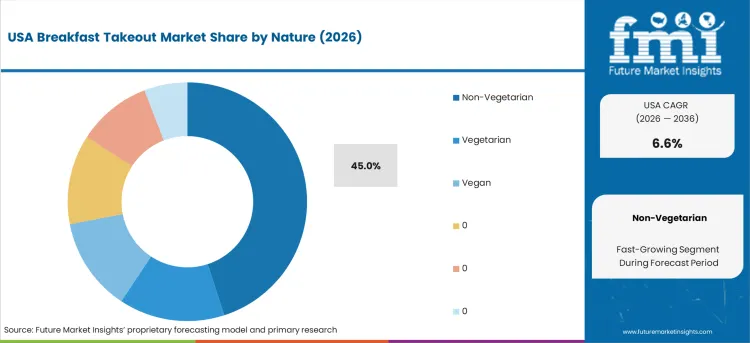
Non-vegetarian breakfasts lead the demand for breakfast takeout in the USA, holding 45% of the market share. Non-vegetarian options such as breakfast sandwiches, egg dishes with bacon or sausage, and breakfast burritos are among the most popular choices for takeout. These dishes offer a combination of protein-rich ingredients that are appealing to a broad customer base, particularly those seeking filling and energizing morning meals.
The demand for non-vegetarian breakfast takeout is driven by the widespread popularity of traditional American breakfast foods, which often include meat-based items. Additionally, non-vegetarian breakfasts tend to have higher levels of consumer satisfaction in terms of taste and variety, making them a top choice for busy individuals who want a satisfying meal on the go. As convenience and speed remain top priorities, non-vegetarian breakfast options are expected to continue to lead in the takeout segment.
How Is Continental Breakfast Leading the Demand for Breakfast Takeout in the USA?
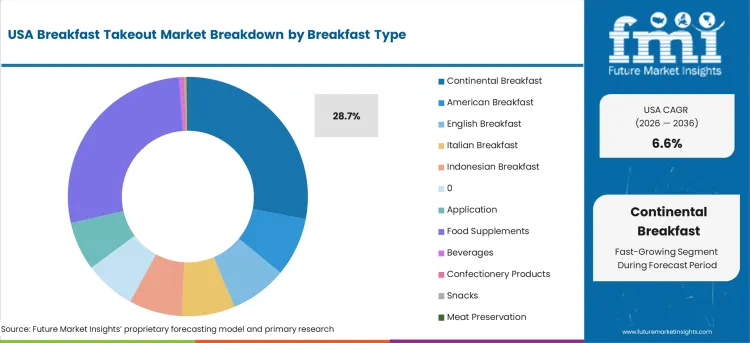
Continental breakfast is the leading breakfast type for takeout in the USA, capturing 28.7% of the demand. Continental breakfasts typically consist of lighter fare such as pastries, breads, fruits, yogurt, and coffee, offering a quick and convenient option for those seeking a lighter start to their day. This type of breakfast is particularly popular in urban areas, where consumers may prefer quick, easy-to-eat options while commuting or running errands.
The demand for continental breakfasts is driven by the growing trend of healthier, lighter meal choices and the increasing preference for quick, easy-to-prepare options that do not require extensive preparation. Continental breakfast takeout appeals to those who want a more balanced and less heavy meal in the morning, especially in contrast to heavier, protein-rich options. With the ongoing focus on health and convenience, continental breakfasts are expected to maintain their popularity in the breakfast takeout market.
What Are the Key Dynamics Influencing Demand for Breakfast Take-out in the United States?
Demand for breakfast take out in the USA is shaped by busy morning routines, increased engagement with digital ordering and the growth of quick service restaurants offering portable breakfast meals. Consumers increasingly seek convenience in early hours, driving take out and delivery options. At the same time, inflationary pressures, higher input costs in ingredients and evolving food service competition moderate growth. These contrasting forces together define how the market for breakfast take out evolves by value and volume.
What Are the Primary Growth Drivers for Breakfast Take out Demand in the United States?
Multiple factors support growth. First, rising participation of mobile ordering and food delivery platforms makes breakfast items more accessible on the go. Second, both full service and quick service chains are expanding breakfast menus and promotional campaigns to capture morning occasions. Third, changing workplace patterns and commuter behaviours elevate demand for ready to eat breakfast meals as consumers start their days outside the home. Fourth, menu innovation such as protein rich bowls, plant based breakfast items and specialty coffees helps broaden appeal beyond traditional breakfast categories.
What Are the Key Restraints Affecting Breakfast Take out Demand in the United States?
Despite encouraging growth, certain constraints apply. Rising food inputs and labour costs reduce margins for breakfast take out providers, which may lead to higher prices or constrained offerings. Consumer hesitation in spending on discretionary meals in the morning may reduce frequency of take out breakfast consumption especially during economic softness. Some households revert to home based breakfast when budgets tighten or time allows, limiting take out growth. Additionally, competition from in store dining, grocery breakfast purchases and meal prep services may reduce incremental uptake of take out meals.
What Are the Key Trends Shaping Breakfast Take out Demand in the United States?
Key trends include stronger integration of technology such as mobile apps and AI based recommendations that improve ordering efficiency for breakfast take out. Drive thru, curb side pickup and delivery focused models are gaining significance for early day meals. Sustainability and health driven menu offerings lower sugar, plant based proteins and recycled packaging are influencing breakfast take out formats. Meanwhile, “day part expansion” strategies by food service operators aim to energise breakfast traffic during slower hours and differentiate via speciality formats and limited time offers.
What is the Regional Demand Outlook for Breakfast Takeout in the USA?
The demand for breakfast takeout in the USA is experiencing steady growth across all regions, with the West leading at a CAGR of 7.5%. The South follows closely with a 6.8% CAGR, driven by an active lifestyle and growing consumer preference for convenient meal options. The Northeast shows moderate growth at 6.0%, supported by its bustling urban centers and demand for on-the-go meals. The Midwest exhibits the slowest growth at 5.2%, reflecting more traditional meal patterns but still showing a steady increase in demand. Overall, the growing trend of convenience, healthier breakfast options, and the evolving foodservice landscape is driving growth in the breakfast takeout market.
.webp.webp "Top Country Growth Comparison Usa Breakfast Takeout Market Cagr (2026 2036)")
Region
CAGR (2026-2036)
West
7.5%
South
6.8%
Northeast
6%
Midwest
5.2%
What factors are driving the demand for breakfast takeout in the West?
The demand for breakfast takeout in the West is projected to grow at a CAGR of 7.5%, fueled by the region’s fast-paced lifestyle and high consumer demand for convenience. The West, particularly in states like California, is known for its strong foodservice industry, with a growing number of restaurants and cafes offering quick breakfast options for on-the-go consumers. The increasing preference for healthier, quick breakfast choices, such as smoothies, bowls, and protein-packed options, also contributes to the rising demand.
Additionally, the West’s population, which often prioritizes work-life balance and convenience, has embraced breakfast takeout as an essential part of their daily routines. As mobile ordering and delivery platforms continue to rise in popularity, more consumers are opting for breakfast takeout, contributing to the strong growth in this sector.
Why is the demand for breakfast takeout increasing in the South?
In the South, the demand for breakfast takeout is expected to grow at a CAGR of 6.8%, driven by changing consumer habits and the region’s growing focus on convenience and healthier meal options. The South’s rapidly expanding urban population and the increasing number of professionals who seek quick and easy breakfast options on their way to work are key drivers of this demand. Additionally, the region’s culinary traditions, which often include hearty breakfasts, are evolving to include more modern, takeout-friendly choices like wraps, sandwiches, and bowls.
The convenience of having breakfast on-the-go, paired with the growing number of foodservice establishments offering takeout options, is contributing to the region’s rising demand for breakfast takeout. The South’s relatively younger, more diverse population is also influencing the growing trend of breakfast takeout, as consumers seek a variety of fast, healthy, and flavorful options.
What influences the demand for breakfast takeout in the Northeast?
In the Northeast, the demand for breakfast takeout is projected to grow at a CAGR of 6.0%, supported by the region’s high population density and fast-paced urban lifestyle. Cities like New York, Boston, and Philadelphia are major hubs for breakfast takeout, where busy professionals and commuters seek convenient meal options that fit into their hectic schedules. The demand for quick, healthy, and portable breakfast choices, such as oatmeal, smoothies, and breakfast burritos, is rising as consumers become more health-conscious and time-conscious.
Furthermore, the Northeast’s established coffee culture, which often pairs with breakfast items, further drives demand for takeout options. As foodservice providers increasingly cater to the busy lifestyles of the Northeast’s population, the market for breakfast takeout is expected to continue growing, particularly as demand for healthier, more varied choices increases.
How is the Midwest contributing to breakfast takeout demand?
The demand for breakfast takeout in the Midwest is expected to grow at a CAGR of 5.2%, reflecting more gradual, but steady, adoption of convenience-based meal options. The Midwest has traditionally placed a stronger emphasis on home-cooked meals and sit-down breakfast options, which results in slower growth compared to other regions. However, as the region’s urban centers continue to expand and consumer habits evolve, breakfast takeout is becoming more popular, particularly in larger cities like Chicago and Minneapolis.
The rising demand for healthier, portable breakfast options is also contributing to the growing market, as more consumers look for convenient and nutritious choices on their way to work or school. Additionally, the increased availability of food delivery services and mobile ordering platforms in the Midwest is helping to drive demand for breakfast takeout. While growth remains moderate, the trend is steadily gaining momentum in the region.
How Are Companies Competing in the Breakfast Takeout Industry in the USA?
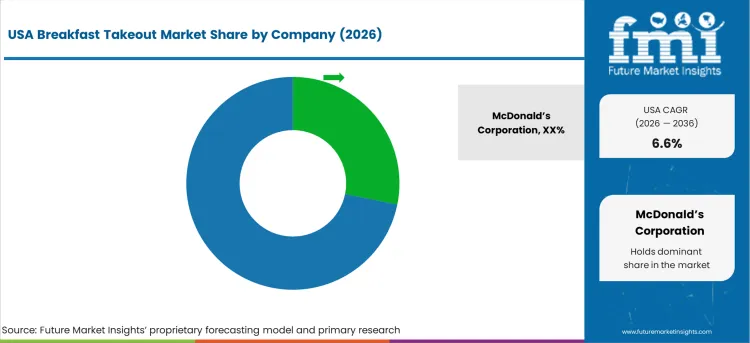
Demand for breakfast takeout in the United States is rising, driven by consumer preference for convenience and mobile ordering. The market is expected to grow with a compound annual growth rate (CAGR) of around 5% or more through the coming years. Leading companies in this segment include McDonald’s Corporation (holding about 28.2% market share), Starbucks Corporation, Dunkin’ (Inspire Brands), Tim Hortons (Restaurant Brands International), and Subway. These firms operate large quick-service restaurant (QSR) networks and digital ordering platforms, which enable them to capture a significant portion of the breakfast takeout market.
Competition among these companies is driven by menu innovation, service convenience, and digital integration. Firms are expanding breakfast menus to include sandwiches, burritos, bowls, and beverages tailored for on-the-go consumption. Features such as smartphone ordering, drive-thru lanes, and early opening hours are key differentiators. Additionally, value pricing and combo offers help attract price-sensitive consumers. Breakfast remains a key growth period for many chains, and companies that align their offerings with convenience, digital access, and competitive pricing aim to maintain or expand their market share in the USA breakfast takeout industry.
Key Players of the Breakfast Takeout Industry in USA
McDonald’s Corporation
Starbucks Corporation
Dunkin’ (Inspire Brands)
Tim Hortons (Restaurant Brands International)
Subway
Scope of the Report
Metric
Value
Quantitative Units
USD 41.36 billion to USD 78.37 billion, at a CAGR of 6.60%
Market Definition
Breakfast takeout encompasses prepared breakfast meals purchased for off-premise consumption from quick-service restaurants, fast-casual chains, coffee shops, and independent breakfast outlets in the United States. The category covers non-vegetarian, vegetarian, and vegan breakfast options across continental, American, English, Italian, and Indonesian breakfast formats, reflecting the multicultural breakfast preferences of US consumers.
Nature Segmentation
Non-Vegetarian, Vegetarian, Vegan
Breakfast Type Segmentation
Continental Breakfast, American Breakfast, English Breakfast, Italian Breakfast, Indonesian Breakfast
Regions Covered
West USA, South USA, Northeast USA, Midwest USA
Key Companies Profiled
McDonald’s Corporation, Starbucks Corporation, Dunkin’ (Inspire Brands), Tim Hortons (Restaurant Brands International), Subway
Forecast Period
2026 to 2036
Approach
Forecasting models apply a bottom-up methodology and cross-validate projections against publicly available industry data and primary research.
Key Segments of the Demand for Breakfast Takeout in USA
Nature
Vegetarian
Non-Vegetarian
Vegan
Breakfast Type
Continental breakfast
American breakfast
English Breakfast
Italian Breakfast
Indonesian Breakfast
Purchase Model
Chained foodservice
Independent foodservice
Payment Type
Cash
Debit cards
Credit cards
Digital Wallets
Electronic bank transfers
Business Type
Direct-to-consumer
Platform-to-consumer
Region
Northeast USA
West USA
Midwest USA
South USA
Bibliography
1. National Restaurant Association. (2024). State of the Restaurant Industry Report 2024. NRA.
2. United States Department of Agriculture. (2024). Economic Research Service, Food Away from Home Expenditure Data. USDA.
3. Bureau of Labor Statistics, US Department of Labor. (2024). Consumer Expenditure Survey, Food Away from Home. BLS.
4. McDonald’s Corporation. (2025). McDonald’s Annual Report 2024. McDonald’s.
5. Starbucks Corporation. (2025). Starbucks Fiscal Year 2024 Annual Report. Starbucks.
This bibliography is provided for reader reference. The full Future Market Insights report contains the complete reference list with primary research documentation.
Frequently Asked Questions
How large is the Breakfast Takeout in USA category in 2026?
The demand for breakfast takeout in usa is estimated at USD 41.36 billion in 2026.
What will be the market size by 2036?
The market is projected to reach USD 78.37 billion by 2036.
What is the expected growth rate between 2026 and 2036?
The market is expected to grow at a CAGR of 6.60% between 2026 and 2036.
Which Breakfast Type is poised to lead by 2026?
Continental Breakfast accounts for 28.7% share in 2026.
Which Nature leads by 2026?
Non-Vegetarian commands 45.0% share in 2026.
What is driving demand in West USA?
The Western United States leads at 7.5% CAGR, driven by high commuter populations and established breakfast takeout habits in California and major metro areas. West USA is projected to grow at a CAGR of 7.5% during 2026 to 2036.
What does this market cover?
Breakfast takeout encompasses prepared breakfast meals purchased for off-premise consumption from quick-service restaurants, fast-casual chains, coffee shops, and independent breakfast outlets in the United States. The category covers non-vegetarian, vegetarian, and vegan breakfast options across continental, American, English, Italian, and Indonesian breakfast formats, reflecting the multicultural breakfast preferences of US consumers.
How does FMI build and validate the forecast?
Forecasting models apply a bottom-up methodology and cross-validate projections against publicly reported industry revenue and primary research data.
Dining and Cooking