
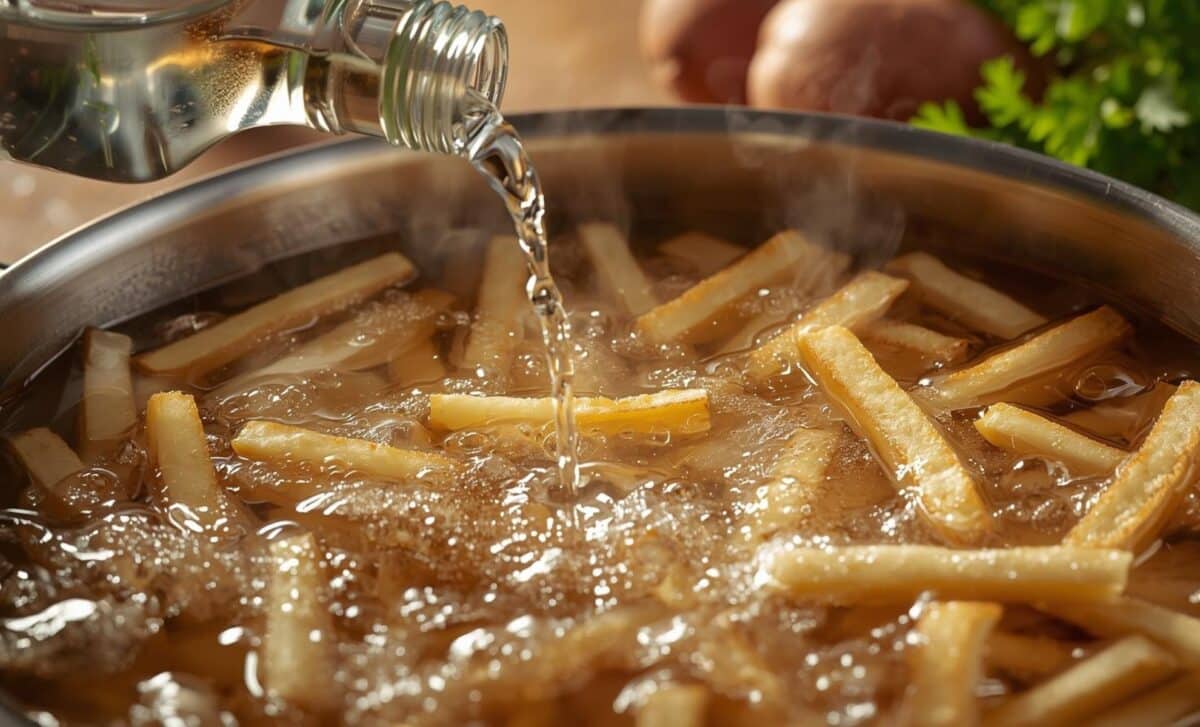
Professional chefs are increasingly recommending a specific chemical intervention to solve the common problem of limp or soggy homemade French fries. Adding a small amount of distilled white vinegar to the water during the initial parboiling stage fundamentally alters the structural integrity of the potato. The technique ensures potato pieces remain intact throughout cooking and eventually develop a superior outer crunch.
The ratio is straightforward. Most culinary experts suggest approximately one tablespoon of vinegar for every liter of water, combined with a generous amount of salt. Testing from Food Republic confirms that two tablespoons of vinegar and two tablespoons of salt per two quarts of water creates the necessary environment. Potatoes boiled in this mixture maintain clean edges and uniform shapes. Without the acid, the same potato strips often crumble or develop ragged surfaces that lead to uneven frying and burnt edges.
The Chemistry of Pectin and Potato Structure
Understanding how vinegar interacts with the potato requires a look at the cellular composition of the vegetable. Potatoes rely on pectin to maintain their physical form. Pectin is the biological glue that holds plant cells together. Under normal boiling conditions, this structural compound weakens significantly around 140 degrees Fahrenheit and dissolves rapidly when exposed to high heat and water.
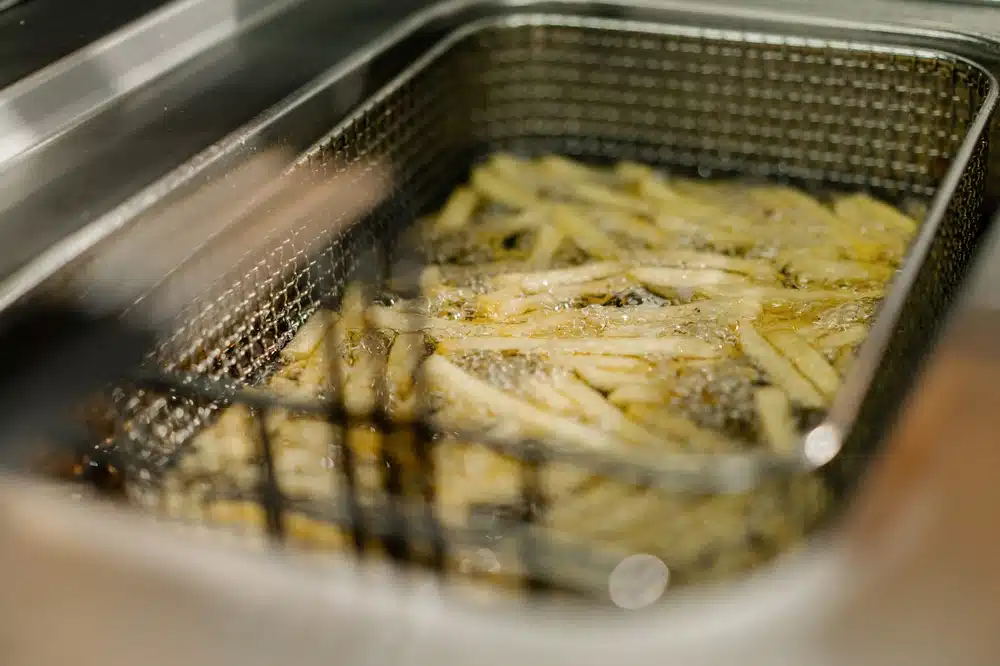 Vinegar lowers water pH to slow pectin breakdown so potato strips hold their shape instead of fraying. Image credit: Shutterstock
If boiling continues until the potato is soft, the exterior often becomes too fragile to survive the transition to a frying basket or a pan of hot oil. Vinegar lowers the water’s pH enough to inhibit this breakdown. The potato exterior firms slightly during the boil rather than turning mealy or eroding. Kitchen testing confirms that unacidulated potatoes show visible fraying after boiling. Vinegar-treated strips emerge with crisp edges intact.
Starch Relocation Creates Shattering Outer Shell
The acid boil does more than preserve geometry. It actively reorganizes starch within the potato matrix. Starch is not an enemy in french fry production. Idaho and russet potatoes remain the preferred varieties specifically because their high starch content produces the coveted crisp exterior and fluffy interior. The goal is not starch removal but starch redistribution.
Boiling in vinegared water draws starch molecules from the dense center of the fry toward the surface. The interior retains a waxy, floury texture that steams and softens during the first fry. The exterior accumulates a concentrated starch layer that dehydrates on the rack and then shatters into a glassy crust when it hits hot oil. The salt in the water seasons the potato internally while the vinegar reinforces the structure.
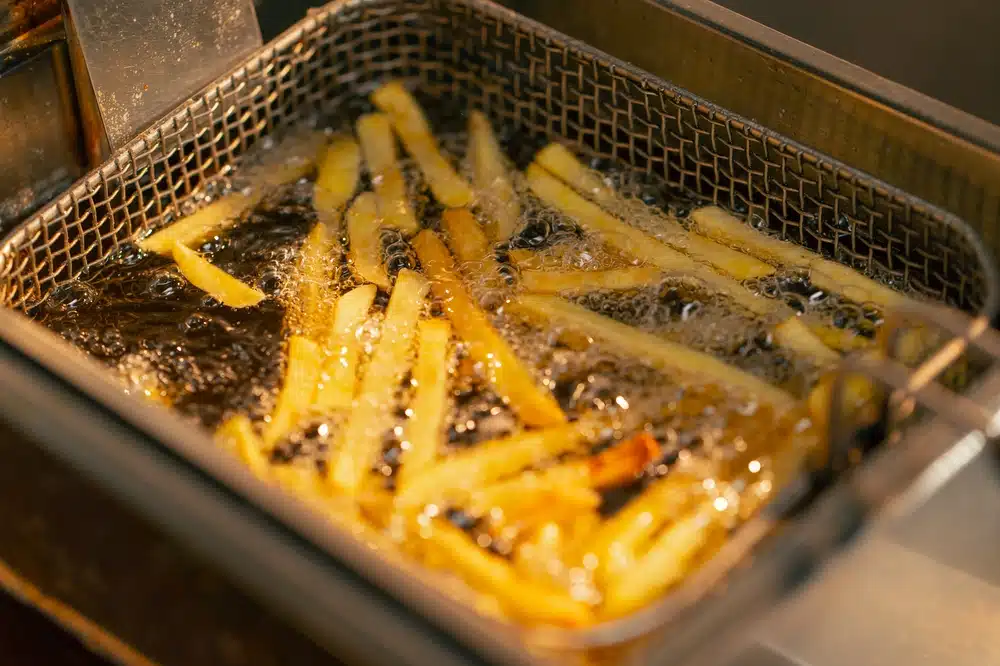 The acid boil draws starch to the surface where it forms a glassy crust while the interior stays fluffy. Image credit: Shutterstock
Without vinegar, a cook might under-boil the potato to keep it from breaking. This results in a French fry that is firm on the outside but potentially waxy or raw in the center. The vinegar treatment removes this compromise, allowing for a complete cook-through while the exterior remains perfectly intact.
Managing Sugar and Surface Browning
Beyond structural integrity, the boiling process washes away excess simple sugars from the surface of the potato. If a potato has too much surface sugar, it will undergo the Maillard reaction too quickly in the frying oil. This leads to fries that look dark brown or burnt on the outside while remaining undercooked on the inside.
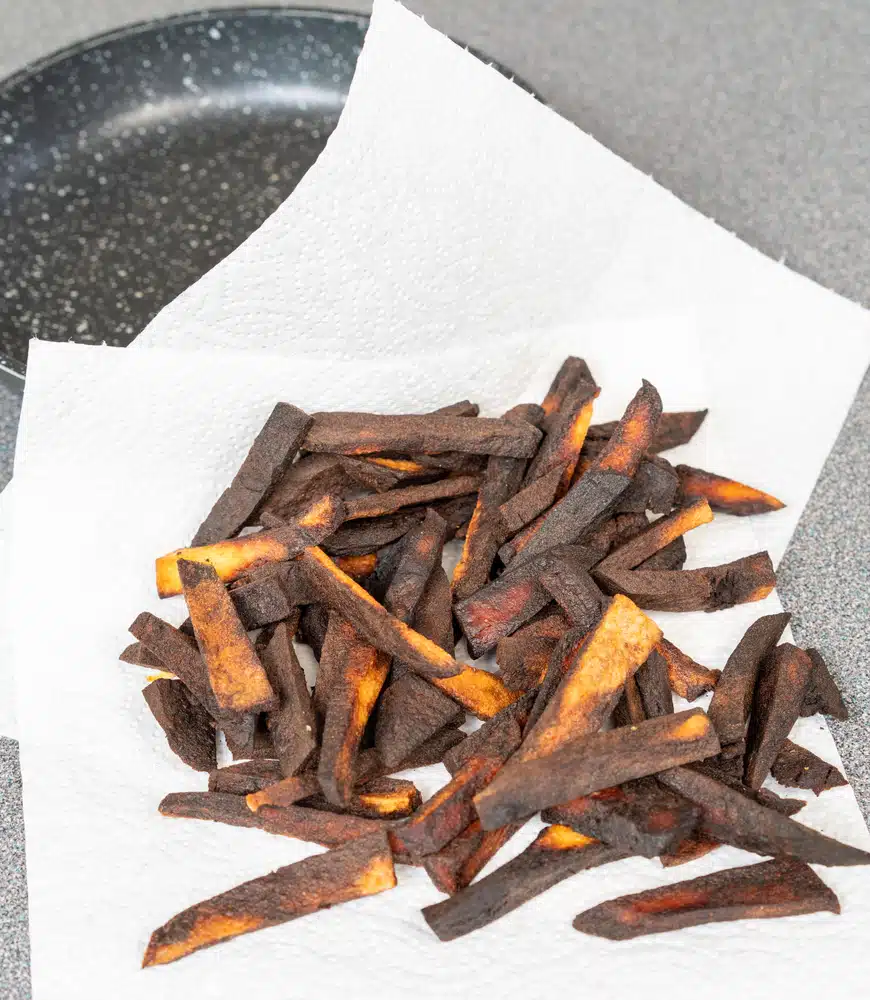 Extended boiling rinses away excess sugars so fries achieve golden color without scorched dark spots. Image credit: Shutterstock
Vinegar does not directly stop browning, but the extended boiling time it allows helps rinse away these problematic sugars more effectively. By the time the potato reaches the hot oil, the surface is primarily composed of starch and reinforced pectin. This composition allows for a slower, more controlled browning process. The final French fry achieves a golden-yellow hue rather than a dark, scorched appearance. The vinegar taste does not survive the double fry.
Practical Steps for the Vinegar Method
To implement this technique, peel and cut the potato into uniform sticks. Uniformity ensures each piece reacts to the vinegar and heat at the same rate. Place the sticks in a pot of cold water and add the vinegar alongside salt. Starting with cold water allows the temperature to rise gradually, which promotes even cooking from edge to core.
Bring the water to a boil and simmer the potato sticks for approximately ten minutes. Work in batches small enough that water returns to a rolling boil within thirty seconds. The target texture is fork-tender, meaning a fork can pierce the potato with little resistance but the stick does not crumble. The edges remain sharp and clean, a visual indicator that the acid has protected the pectin.
After ten minutes, remove the potato sticks and spread them on a wire rack or paper-towel-lined baking sheet. Surface moisture is the enemy of crispiness. Let the steam escape and the surface dry completely. Some cooks use a fan or refrigerate the potatoes to speed moisture loss. Once cool to the touch and matte in appearance, they are ready for frying.
Achieving Triple-Cooked Texture
The use of vinegar is the first step in a triple-cooked method favored by restaurants and science-focused home cooks. After the boil and drying, the potatoes undergo a low-temperature fry around 325 degrees Fahrenheit to create a stable, blanched exterior.
The potatoes are then cooled or frozen before a final high-heat fry at 375 degrees Fahrenheit. During this final stage, the reinforced pectin and pre-gelatinized starch form a thick, bubbled crust. Professional kitchens often freeze the potatoes after the first fry. Ice crystals that form inside rupture the starch cells, leading to an even fluffier interior upon the final cook.
The versatility of the vinegar technique extends to different frying styles, including a dedicated deep fryer, a heavy Dutch oven, or an air fryer. Culinary tests indicate that fries treated with vinegar maintain their crispness up to three times longer than those boiled in plain water. The potato remains a consistent side dish that holds its texture from kitchen to table.
Dining and Cooking