
April 16, 2026
MANILA – Chef Donatello Montrone is clear about one thing: Moderna is not trying to be trendy. It is not a gimmicky fusion concept, and it is not Italian food chasing novelty. Instead, the newly opened restaurant at Uptown Parade feels like the most natural result of how he has lived and cooked in the Philippines.
“Basically, Moderna is an Italian restaurant,” he says. “So we’re using Italian techniques, we’re following Italian recipes, but not ingredient by ingredient.”
“Basically, Moderna is an Italian restaurant,” chef Donatello Montrone says. “So we’re using Italian techniques, we’re following Italian recipes, but not ingredient by ingredient”
That distinction says everything about the restaurant’s philosophy: The foundation is still deeply Italian, but the dishes are shaped by what is fresh, available, and locally sustainable.
For Montrone, that approach is not about compromise. It is about making food better.
“The dishes are not traditional, of course,” he says. “But at the same time, I think we can improve the quality of the dish itself because the fresh and high-quality ingredients found locally are better than the ones you have to import.”

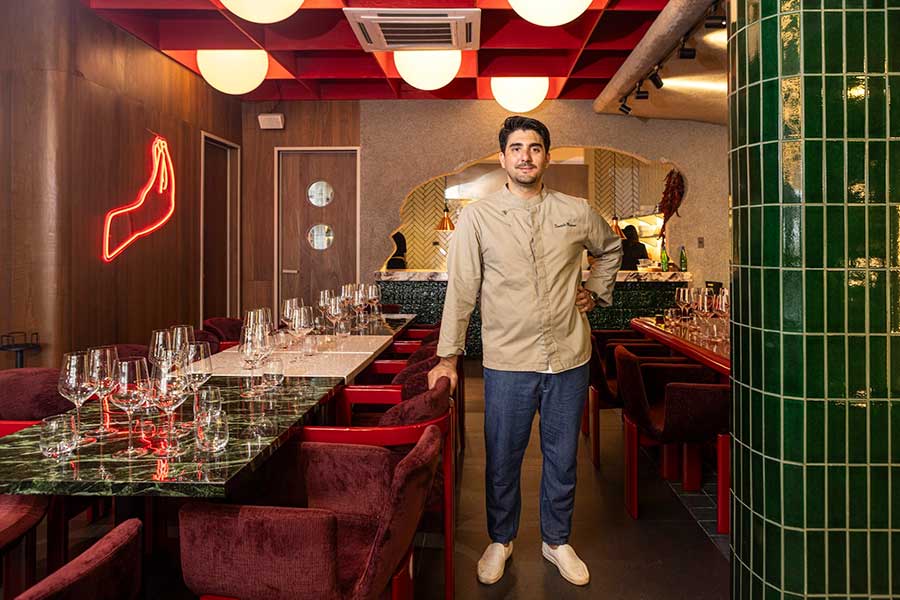
Moderna’s interiors capture the diversity of Filipino and Italian flavors. PHOTO: PHILIPPINE DAILY INQUIRER
That idea runs through the entire menu.
At Moderna, Italian technique is the starting point, but the ingredients often tell a more local story. The result is a restaurant that feels rooted in Italian cooking while still open to Filipino flavors, textures, and ingredients in a way that feels thoughtful rather than forced.
One of the clearest examples is the adobo raviolo, which easily reads like the restaurant’s signature statement. Imagine delicate ravioli filled with pork adobo, then set on silky provolone fondue and finished with an adobo sauce reduction and tuyo crumbs. It is rich, savory, and deeply familiar to the Filipino palate, but still unmistakably Italian in form. It is exactly the kind of dish that explains Moderna’s point of view in a single bite.
Another standout is the risotto with burong hipon, a dish that feels both technical and intuitive. Made with arborio rice and finished with burong hipon and garum butter, it layers the creamy discipline of risotto with a fermented shrimp depth that gives the dish a distinctly local edge.
“This one is my favorite because I think it’s really the perfect combination between what I found locally and our Italian technique,” he says.
Then there is the bracciola, a hearty, slow-cooked meat roll that shows the kitchen can be as comforting as it is inventive. The beef sirloin is cooked for three to five hours, then sliced open and stuffed with pecorino, garlic, and local herbs, served with Lucanian sausages and kamote purée, then finished with some Grana Padano and black olive dust. It has the soul of a rustic Italian main dish, but the details make it unmistakably Moderna.

Risotto with burong hipon. PHOTO: PHILIPPINE DAILY INQUIRER
New renaissance
This is also what sets the restaurant apart in Manila’s crowded Italian dining scene. Montrone is candid about how many places still cater to what diners expect Italian food to be, rather than what it can be.
“Most of them, they are following purely what Filipinos think Italian is,” he says. “That [idea] works well, and I’m happy for them, but at the same time, there’s so much more to Italian cuisine.”
Moderna goes another way, leaning toward regional Italian cuisine for a taste of something new. It is also willing to take risks, and it knows not everyone will immediately understand what it is trying to do.
“Some will see us as the unusual one… We are breaking the rules.” But still, the point is not rebellion for rebellion’s sake. “For me, it’s making a carbonara in my own way, just following what I have in mind and the logic of the available ingredients.”
“Most of them, they are following purely what Filipinos think Italian is,” he says. “That [idea] works well, and I’m happy for them, but at the same time, there’s so much more to Italian cuisine”
That logic depends heavily on sourcing. In the beginning, building the menu was challenging, but Montrone says discovering stronger local suppliers changed everything. Through Slow Food Philippines and his own research, he found producers who helped him cook more precisely and more confidently.
“I found amazing sustainable fish farming in Negros, I found amazing beef in Mindanao… I was able to explore more ingredients.”

Hospitality is just as important as technique, says Donatello Montrone. PHOTO: PHILIPPINE DAILY INQUIRER
Attention on hospitality
Even with all that attention on the plate, Montrone does not separate food from the overall experience. Hospitality is just as important as technique.
“As a chef, the most important part in a restaurant is the service,” he says. “Seventy percent is service, 30 percent is kitchen.” His explanation is simple: “If the dish is so-so, but your service is amazing, probably you will go back. But if the dish is amazing, but the service is so bad, you will not go back.”
Still, the food is what gives Moderna its identity. It is personal, familiar, yet quietly bold. The setting at Uptown Parade, a Megaworld Lifestyle Malls property, gives it a home, but the real story is on the plate: Italian cooking that respects tradition enough to let it evolve.
At Moderna, Montrone is not trying to imitate the Italian classics diners already know. He is doing something more interesting. He is cooking Italian food through the ingredients and flavors of the Philippines, and in the process, creating something that feels original, grounded, and entirely his own.
Dining and Cooking