
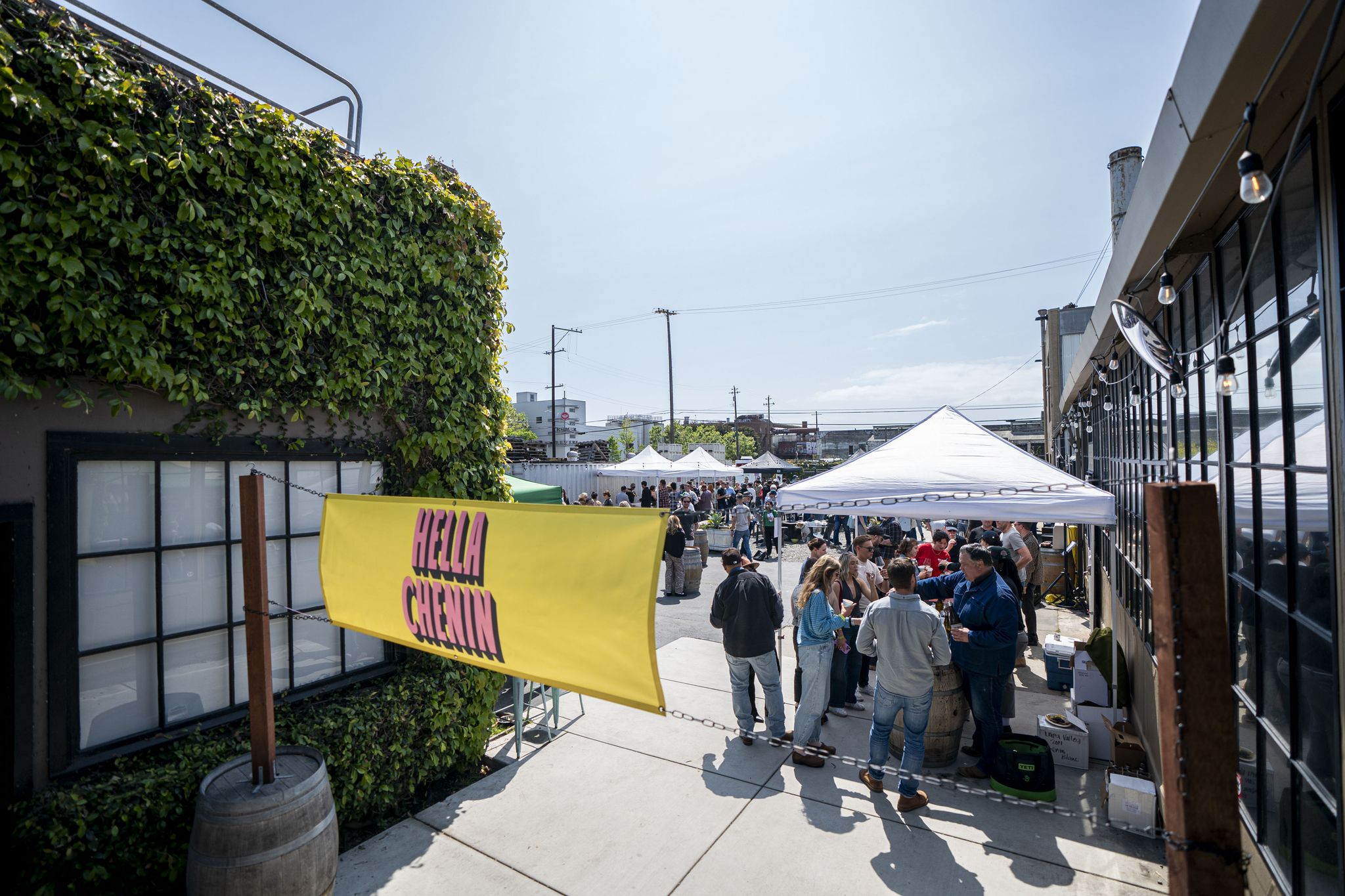
Wine festivals are due for a shakeup and the Hella Chenin wine festival is leading the way.
Provided by Bex Wyant/Hella Chenin
Dozens of wine festivals take place throughout the Bay Area every year, and they’re largely all the same.
They typically go like this: Wine lovers coalesce under big white tents, in barrel rooms or in sterile event spaces, and carry a glass from one table to the next until their teeth are purple. Sometimes they’ll get a pour directly from a winemaker, but more often, it’s a sales or marketing employee with a spiel and a wine club sign-up form. There’s usually a charcuterie table; at the really expensive ones, you might find oysters and caviar, along with auxiliary dinners and parties that cost a few hundred bucks each.
Like wine clubs, festivals are overdue for a shakeup, especially if wineries want to engage younger generations; I’d wager that the average age of attendees is somewhere around 50. A new Bay Area festival — Hella Chenin in Berkeley — is one of a handful of events doing things differently, starting with its neon branding and fun, millennial-coded name that nods to Bay Area culture. A celebration of one of California’s most trendy grapes, Chenin Blanc, the festival launched last year. It sold out, with 450 attendees who “very heavily skewed millennial and Gen Z,” said co-founder Peter Andrews, who also founded Culture Wine Co., which imports South African wine to the U.S.
Article continues below this ad
After last year’s festival, Bay Area wine writer Alder Yarrow wrote that Hella Chenin had “the most enthusiastic crowd of wine drinkers I’ve seen in many a year.”
Younger drinkers are “coming out when the event feels like it speaks to them and is for them,” Andrews said, listing the many ways he believes Hella Chenin achieves this: The branding is “blocky and bright”; it takes place outside, not “in an event hall”; there’s live music and food vendors; and at $75, it’s a “low barrier to entry.” By comparison, tickets for the grand tasting at the upcoming Healdsburg Food + Wine Experience cost $275.
San Francisco Chronicle Logo
Make us a Preferred Source to get more of our news when you search.
Add Preferred Source
Hella Chenin also brings together many of the California wine industry’s cool kids, such as Pax, Sandlands, Matthiasson and Lo-Fi.
Entering its second year, Hella Chenin was founded by Andrews; Josh Hammerling of Berkeley’s Hammerling Wines (the event’s host); and Marty Winters and Alex Pitts of Berkeley’s Maitre de Chai winery. This year, it’s expanding, with a model similar to SF Beer Week: a series of events at restaurants and bars that culminate in a walk-around “grand tasting” on May 16. As of Thursday, the tasting was nearly sold out, with less than 50 tickets left.
Article continues below this ad
Andrews said the festival was inspired by other grassroots wine movements, such as the Summer of Riesling, which sommelier and restaurateur Paul Grieco started in 2008, making Riesling the only white wine available by the glass at his New York City wine bar, Terroir, to raise the profile of one of wine’s most misunderstood grapes. Summer of Riesling grew to include a grand tasting and events throughout the U.S., including a dinner at the famed Blackberry Farms and a booth at Outsidelands’ Winelands, where organizers handed out large temporary tattoos that said, “Riesling.” There’s even been a Summer of Riesling prom and a cruise down New York’s East River.
Hella Chenin sort of has its own Paul Grieco: Craig Haarmeyer, founder of Sacramento’s Haarmeyer Wine Cellars, who produced eight single-vineyard Chenins in 2024 and is arguably the grape’s biggest modern-day advocate in California. Years ago, he was the first to use “Hella Chenin,” as a hashtag on social media.
Chenin was once California’s most widely planted grape, but it faded to relative obscurity as Bordeaux and Burgundian varieties took over. Today, it accounts for less than 1% of California’s grape acreage. The grape is most famously grown in France’s Loire Valley and is most prolific in South Africa, which produces about 60% of the world’s Chenin (hence Andrews’ interest). Chenin has had a few small resurgences in California over the past 25 years, but now that white wines are outperforming reds in U.S. sales, its current ascendence, led by a generation of younger winemakers, feels more likely to stick.
Unlike Riesling, which is often viewed as cheap and overly sweet, Chenin doesn’t have a stigma, Andrews argued, and it’s one of the world’s most versatile grapes, made in dry and sweet styles, or even as a sparkling. “It makes a wine that can be quite full-bodied, or one that can be lean and tart,” Andrews said. “People last year were blown away that they weren’t tired of the variety by the end of the day.”
Article continues below this ad
Chenin is often described as the perfect balance between Sauvignon Blanc and Chardonnay; it can be refreshing and fruity like Sauvignon Blanc, with the added texture, weight and creaminess of a Chardonnay. It’s also relatively affordable, typically between $20-$30. The Hella Chenin tasting will feature more than 100 bottlings from California, Oregon, South Africa, Australia and France, as well as live music, oysters and food from three La Cocina chefs. At least a dozen Bay Area events, including a winemaker dinner at Oakland’s Burdell, will take place between May 11 and 15.
Andrews doesn’t want a “stuffy wine event,” he said. “The feedback last year from people was, ‘I can actually talk to the winemakers. I didn’t have to just throw my glass in front of them.’”
Dining and Cooking