
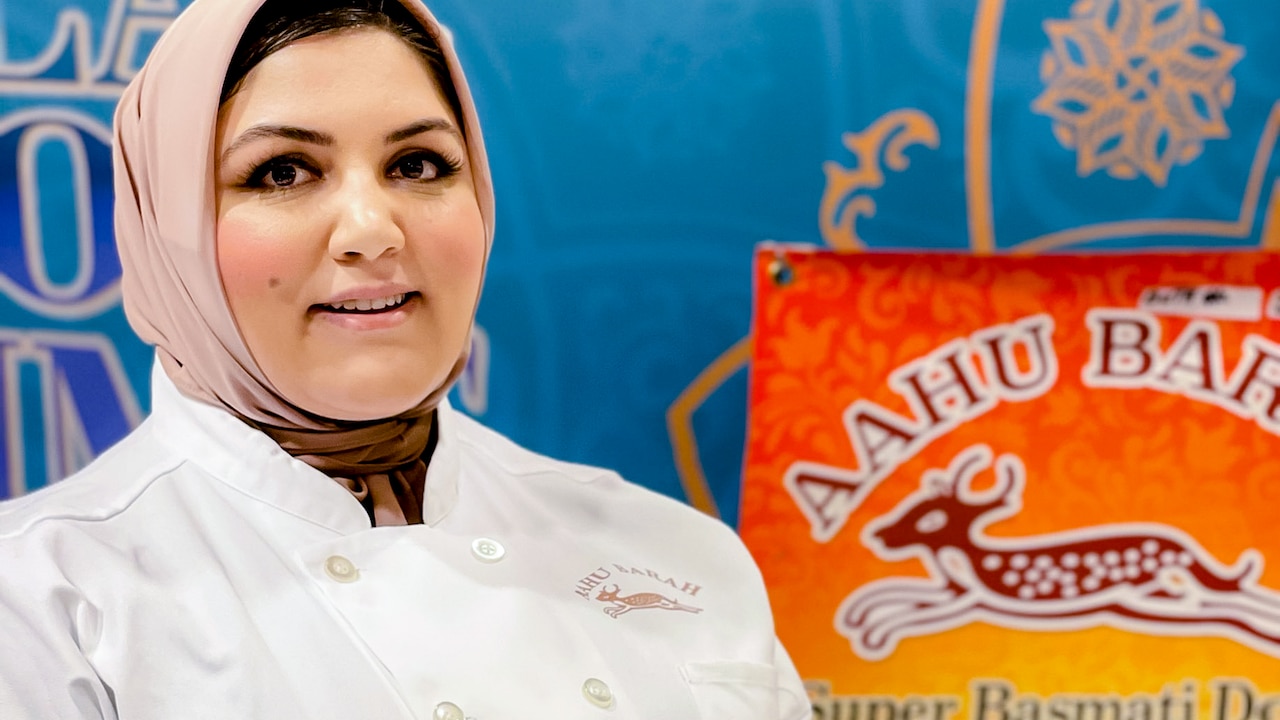
When Maryland resident Iman Sediqe appears on Wednesday night’s episode of “MasterChef,” she hopes viewers will look beyond the show’s comically large shot clock, spotlights and cutting banter with Gordon Ramsay. She’d rather her Kabuli pulao, a dish emblematic of Afghanistan’s culture, take center stage.
Every ingredient holds a story: Dried fruits and nuts are scattered across the plate as a textured replacement for fresh produce, which can’t survive long Afghan winters. Basmati rice is infused with cinnamon, clove and cumin — spices that found a home in Afghanistan when it was still the heart of Silk Road trade. Rich cuts of lamb, specialty meat used to honor esteemed guests, are kept warm under the platter’s starch.
“It’s the most generous I can be with food,” Sediqe said of choosing the dish for her television debut. “And that’s such a hallmark of Afghan culture — being incredibly generous.”
It’s an important message for Sediqe, an amateur chef in Mount Airy, who wants to teach people about Afghan cuisine and the traditions that molded her.
Sediqe grew up around few other Afghans in the ‘90s in Toledo, Ohio. She was raised to cook from a young age and fell in love with ground cardamom and saffron — spices that she, like her father, still carries around in her bag. Learning to recreate her family’s dishes preserved a sense of identity otherwise forgotten in the homogeneity of their Midwest suburbs. Sharing the recipes meant sharing her history and creating space for more people like her to do the same.
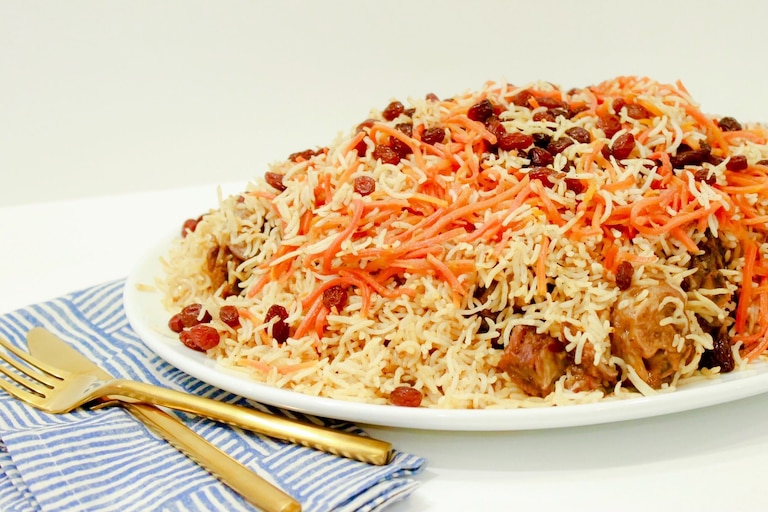 Iman Sediqe’s Kabuli Pulao. (Courtesy of Iman Sediqe)
It all started with the Food Network.
Sediqe’s parents blocked nearly every other channel. “They’re like, ‘MTV is bad. … We don’t know what’s on Nickelodeon, they’re just dumping slime on kids,’” she said. But food was universal. Her mouth watered at the pizzas and lasagnas, meals that in her household only came with Afghan flavorings of sumac and cottage cheese. She wanted to learn about all of it.
Then came Ina Garten, a woman who didn’t look or act like the rest of the network’s hosts. She was an intellectual who spoke of the culture and traditions hidden behind the food, explaining how meals were constructed and why. Every show unpacked a new world for Sediqe to appreciate and understand without having to leave her living room.
“I just related to her in so many ways that I was like, it would be cool if someday my daughter could turn on the TV and see someone who looks like her or come from her background and connect with them,” Sediqe said. But she knew that kind of exposure rarely happened.
“There’s no Emeril Lagasse in Afghanistan,” she said.
So Sediqe instead focused on being the ideal first-generation immigrant daughter: She earned a master’s degree from Harvard University and a Ph.D. in sociology at Northwestern University. It wasn’t until 2020, when she found herself without a job or an academic curriculum that she turned her attention back to food.
Living in Mount Airy with her husband, Sediqe started posting videos teaching staple Afghan dishes and writing recipes that her family had not documented before on her food blog, Imanistan. A video of her making Kabuli pulao now has 56,000 views on her YouTube page.
In December 2025, a casting producer for “MasterChef” contacted Sediqe on social media about auditioning for the newest season, in which chefs representing countries across continents would vie for $250,000 and the eponymous title. Sediqe was skeptical.
“I talked to my husband and I was like, ‘No, no way, I’m not going to do that show,’” she said. She wasn’t sure that she or her traditional Afghan food would be accepted by a national audience.
In Afghanistan, cooking was a hobby or obligation for maids. Her culinary idols largely existed within the family — grandmothers who never wrote recipes down but followed their instincts. Because of a dearth of Afghan cookbooks, Sediqe started teaching others to make her family’s food. “If I don’t do this, then who is going to preserve and pass us on?” she said.
Helmand Karzai, who runs The Helmand, a popular Afghan restaurant in Baltimore, said there are some dishes he has tried to add to his menu that he still can’t find documentation for.
“The funny thing about it is even when you talk about a recipe, no one’s giving you the measurements,” he said. “It would be great if my kids could know these recipes.”
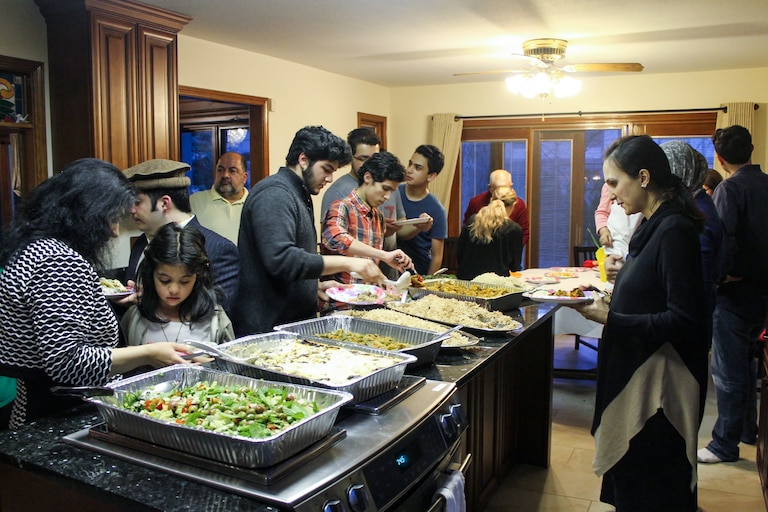 The family gathers in Toledo, Ohio for family dinner, where Iman Sediqe is often tasked with making the coveted borani banjan, a fried eggplant dish in tomato sauce and garlicky yogurt, that has been passed down for generations. (Courtesy of Iman Sediqe)
The restaurateur said Baltimore is lucky to have several Afghan eateries. “A cuisine can become different and creative when it becomes part of their [diners’] weekly and monthly routine.”
Sedique describes the variety of food in Maryland as an “international crossroads” — inspiration she has used in her own cooking.
She’s experimented with fusion dishes, like the traditional Afghan barbecue where she used seafood in addition to lamb and beef, or her Kenyan husband’s favorite Swahili tilapia in coconut sauce with turmeric — and Old Bay. She also recreated her family’s food with American-inspired modifications, like a revani semolina cake made nontraditionally with ricotta.
It was a Garten-like approach, taking what’s familiar and infusing it with lessons from her culture.
“I want to be Afghan Ina Garten,” she said. So after pondering the opportunity to compete on “MasterChef,” she asked, “Who am I to step away from this opportunity that was handed to me?”
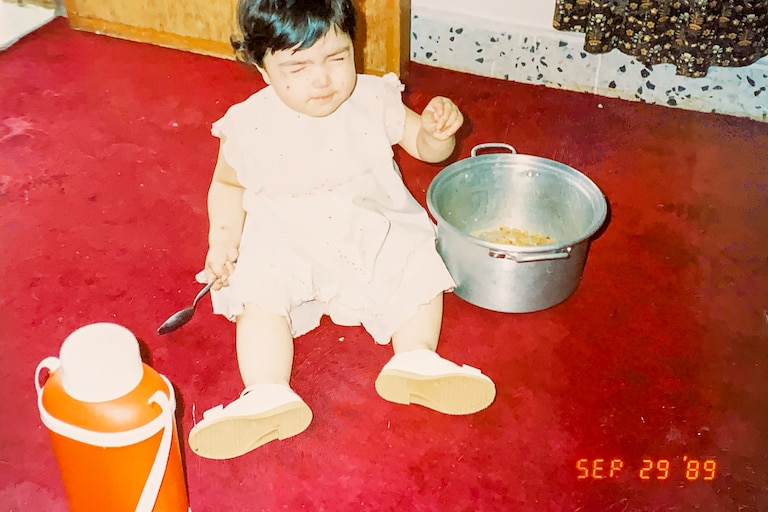 Iman Sediqe as a baby helping cook with relative in Kuwait in 1989. (Courtesy of Iman Sediqe)
She vowed to use her time on the show to inspire and introduce people to traditional Afghan food. Still, Sediqe feared telling her father that she was going to be cooking on TV.
But the moment went deeper than “MasterChef” or the question of whether a culinary path was a suitable career. It was about putting herself in a position to be seen — and potentially understood.
“I thought he’d be disappointed because it wasn’t the job he thought Harvard gave me,” Sediqe said.
But he wasn’t.
“There’s a lot of culture here that could be lost,” she said of her Afghan background.
Her father, she said, understood that her appearance on the show is proof it never will be.
Dining and Cooking