
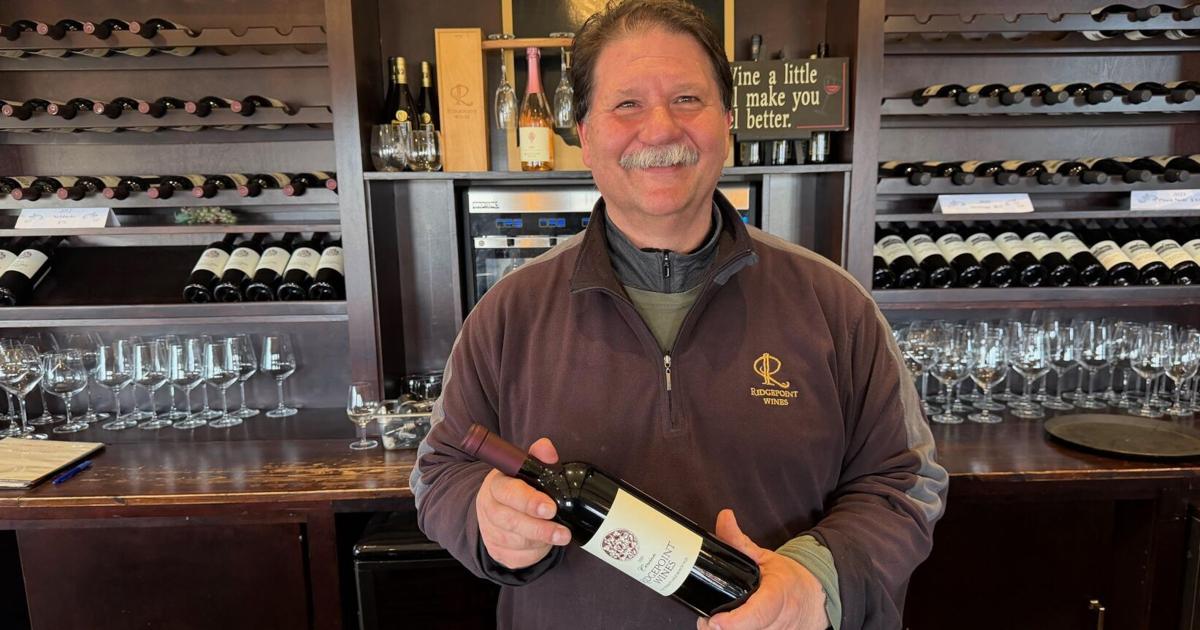
In the heart of Ontario’s Niagara wine region, where rolling vineyards meet the escarpment, one family’s journey into winemaking stands as a testament to passion, risk and resilience.
For Mauro Scarsellone, co-owner of Ridgepoint Wines, the path to viticulture was anything but conventional.
“I traded working in downtown Toronto … for a tractor,” he said with a laugh.
Alongside his sister and business partner, Anna Gottardo, Scarsellone has spent nearly three decades building a winery that blends Italian heritage with Niagara terroir — often learning through trial, error and a deep commitment to doing things their own way.
From Italy to Niagara
The siblings are first-generation Italian Canadians, raised in a family that emigrated from a town just south of Rome in the Lazio region. Their parents came to Canada seeking opportunities beyond agriculture, encouraging them to pursue higher education and professional careers.
Scarsellone followed that path, becoming a chartered accountant and working for a major firm in Toronto. But a chance visit to the Niagara region changed everything.
“I didn’t even know vineyards existed here 30 to 35 years ago,” he recalled. “Then I discovered the wine region and I just fell in love with it.”
That discovery led to a life-altering decision, one that surprised his family and reshaped his future.
Building a vineyard from scratch
This year marks the winery’s 30th anniversary, a milestone that reflects both endurance and evolution. When the family first acquired the 8.1-hectare property on Cherry Avenue in Vineland, it was planted with concord and Niagara grapes — varieties typically used for juice rather than premium wine.
“The first thing we did was remove them,” Scarsellone said.
What followed was a steep learning curve. With limited guidance available at the time, the family relied on experimentation, often making costly mistakes along the way.
“We’ve made thousands of mistakes,” Scarsellone admitted. “But that’s how we’ve learned.”
Today, the vineyard spans approximately 6.5 hectares of planted grapes, primarily focused on red varietals such as cabernet sauvignon, cabernet franc and merlot. True to their roots, however, the family has also pursued Italian grape varieties, an uncommon choice in the Niagara region.
Italian influence
Among the winery’s most distinctive features is its dedication to Italian-style wines, including varietals like Nebbiolo and Corvina. These grapes are traditionally associated with regions like Piedmont and Veneto and are rarely cultivated in Ontario.
As far as Scarsellone knows, Ridgepoint is one of the only wineries in Niagara growing these varieties.
But the decision has not come without challenges.
“The winters here are just too tough,” he said. “The Italian varieties are more susceptible to cold damage.”
To combat this, the vineyard employs strategies such as careful site selection, ensuring proper slope for cold air drainage, and the use of wind machines to protect vines during extreme temperatures.
Even with these measures, survival is not guaranteed.
“A couple of degrees can make the difference between having a crop and having nothing,” he said.
Innovation and experimentation
In addition to traditional varietals, the winery is exploring new, disease-resistant grape hybrids developed in Italy. These experimental vines are designed to retain much DNA of classic grapes like merlot and cabernet sauvignon while offering greater resilience.
“We’re trying to see if they’re more winter-hardy,” Scarsellone said. “So far, it appears they are.”
The potential benefits extend beyond survival. These new varieties could also support more sustainable farming practices and open the door to lower-alcohol wines, an emerging trend in the industry.
“If we can make something that’s 11 or 12 per cent alcohol but still full of flavour, that’s something we’re very interested in,” he said.

The 6.5 hectares of vineyards at Ridgepoint Wines are now primarily focused on red varietals such as cabernet sauvignon, cabernet franc and merlot but had originally concord and Niagara grapes on site.
John McTavish
A hands-on approach
At Ridgepoint, nearly every step of the winemaking process happens on-site, from growing and harvesting grapes to bottling and storage. This hands-on approach reflects the family’s commitment to quality and control.
“We do everything the hard way,” Scarsellone said. “But we want to be involved from the vineyard all the way through.”
That philosophy extends to barrel aging as well. All red wines are aged in oak barrels, with a growing preference for French oak. Higher-end wines, including Nebbiolo, may be aged for several years before release.
“We’ve aged it for you,” he said, referring to a 2012 vintage. “It’s ready to drink.”
Food, wine and hospitality
Drawing on Anna Gottardo’s background in the restaurant industry, the winery also offers a culinary experience. Guests can enjoy tastings, wine flights and casual Italian cuisine in an on-site dining room.
Everything — from pasta to pizza dough — is made by hand.
The dining experience is intentionally relaxed, with a focus on lunch service from Wednesday through Sunday. While reservations are recommended, the atmosphere remains welcoming and unpretentious.
The Ridgepoint Wines dining room draws on the restaurant experience of co-owner Anna Gottardo, offering casual Italian cuisine.
John McTavish
A unique portfolio
Unlike larger wineries, Ridgepoint produces a portfolio that is highly distinctive and sometimes difficult to market through traditional channels.
“Our wines require a hand-sell,” Scarsellone said.
As a result, most sales occur directly at the winery, where staff can guide visitors through tastings and share the stories behind each bottle.
While some wines are available through the LCBO and select restaurants, the on-site experience remains central to the business.
Looking ahead
As the winery enters its fourth decade, the focus remains on innovation and growth. Plans include expanding the sparkling wine program using the Glera grape — the variety used to produce Prosecco — as well as continuing research into resilient grape varieties.
Despite industry trends and market pressures, Scarsellone remains committed to authenticity.
“We’re not interested in mass production,” he said. “Every year is different. We just try to make the best wine we can from that vintage.”
Red wines, surprises and sparkling discoveries
The winery specializes in red wines, and that’s where it shines. The reds are excellent — very well balanced, high quality, with velvety tannins and complexity that comes from barrel aging.
Ridgepoint Wines specializes in red wines but has a few terrific whites including this one called White Cab.
John McTavish
Ridgepoint also has a few whites, including one that really stood out to me called White Cab. It’s a white wine made from cabernet franc, a red grape, but because there’s no skin contact, it comes out as a white.
Ridgepoint also has a lovely line of sparkling wines in a Prosecco style, including a dry one, a rosé and a slightly sweeter sparkling.
Ridgepoint Wines has a line of sparkling wines in a Prosecco style, including a dry, a rosé and a slightly sweeter sparkling.
John McTavish
Invitation to discover
For visitors, Ridgepoint offers more than just wine, it offers a story of heritage, experimentation and passion.
“There’s lots to discover in Niagara,” Scarsellone said. “And if you’d like to explore Italian-style wines with Niagara roots, we think this is a great place to start.”
At its core, the winery’s mission is simple.
“Our whole mission is to share our passion for food and wine,” he said. “And we’d like to share it with as many people as possible.”
In a region known for diversity and innovation, Ridgepoint stands out not just for what it produces, but for how — and why — it does so.
Opinion articles are based on the author’s interpretations and judgments of facts, data and events. More details
Dining and Cooking