
What do you miss most about Rome when you’re over in Texas? As my dad used to say, “morning has gold in its mouth,” so, my favorite thing to do in Rome is to wake up early and walk around some of its sights, like the Castel Sant’Angelo or the Victoriano. You have no idea how many pictures I have of the Victoriano at 6 a.m. It’s also stunning at night, of course, but in the morning, it has a completely different charm. Plus, it’s the quiet before the storm in the city — before people get up, and you can’t see much because you’re distracted by buses and other things. Speaking of distraction, I sometimes think that Rome is a city that can be a little unfocused, gastronomically speaking.”How so?
It falls into that cliché of the cacio e pepe and the carbonara that just makes me want to kill myself. People are always asking me, “Where can I eat the best all’ amatriciana?” I’m like “Nowhere! At home!” It’s easy to scream at the entire world that we’ve got the best pasta. Yet Rome has a lot more to offer. There are some very cool restaurants here providing creative cuisine inspired by Italian tradition, which is much more my style.
Tell us about some of them.
You don’t mind if I mostly talk about women chefs? That’s my thing — I always want to support women. There’s a young woman I’ve taken under my wing named Anastasia Paris, who’s the owner of Futura in the Monti district. She’s an emerging talent with a strong foundation, doing traditional Italian food in a modern way. What does that mean? Like my cuisine, it’s ‘contaminated,’ it has an extra element and is influenced by other cultures, which I think is an unstoppable process. I believe that whether it’s food or architecture, the infiltration of other cultures can’t be stopped; we are too mobile to think we can block ourselves within our little walls or cities and say, ‘You can’t come in.’
Also worth checking out is Pro Loco (translating as “In Favor of Locals”), whose self-taught chef, Elizabeth, uses only products from Lazio. Another restaurant I highly recommend is La Ciambella (“The Donut”), which got that name because it’s on via Arco Bella Ciambella and lies across from an ancient sculpture of Jesus’ mother with a ‘donut’ (i.e. a halo) behind her head. It’s an upscale spot run by a married couple: Francesca Ciucci, who has a casual osteria background, is the chef, and Mirka Guberti, one of Italy’s top sommeliers, curates their very interesting wine list.
Over in Fiumicino, there’s Pascucci al Porticciolo, which is basically by the sea. So, you smell the sea salt as you eat, which takes me home because I grew up in Bari, and it was a one-and-a-half-minute walk to the beach. Chef Gianfranco Pascucci is a very good chef and a very good person, too. I admire the fact that he hasn’t compromised his style to please his customers, as can sadly often happen in this business
Your secret place in Rome to stock up on gourmet treats? Drogheria Innocenzi in Trastevere. It’s a food emporium run by a very old man, Giancarlo Innocenzi, who is married to an Indian woman, Kumsitha. He’s always perfectly dressed every day and has this equally impeccable posture. They sell incredible stuff: the best balsamic vinegar, olive oil, and they’ve got an insane selection of old-fashioned candies from when I was growing up: the honey ones, the little sugar ones, the Sperlari (nougat). I get them for guests at Glass Hostaria, and they grab them by the handful as they’re leaving the restaurant. So, every day I need to go out to Innocenzi and get more, which is a pleasure because they’re so very lovely there.Finally, what does Rome taste like?
Rome tastes like history and memories. Here, you’re surrounded by history — you can walk into a church and see a Velázquez, a Rembrandt, or Michelangelo’s Moses, like the one at San Pietro in Vincoli. When I first moved to Rome 20 years ago, I used to walk to the restaurant and stop at this church to try to memorize every detail of that sculpture. You can’t do that in any other city in the world.
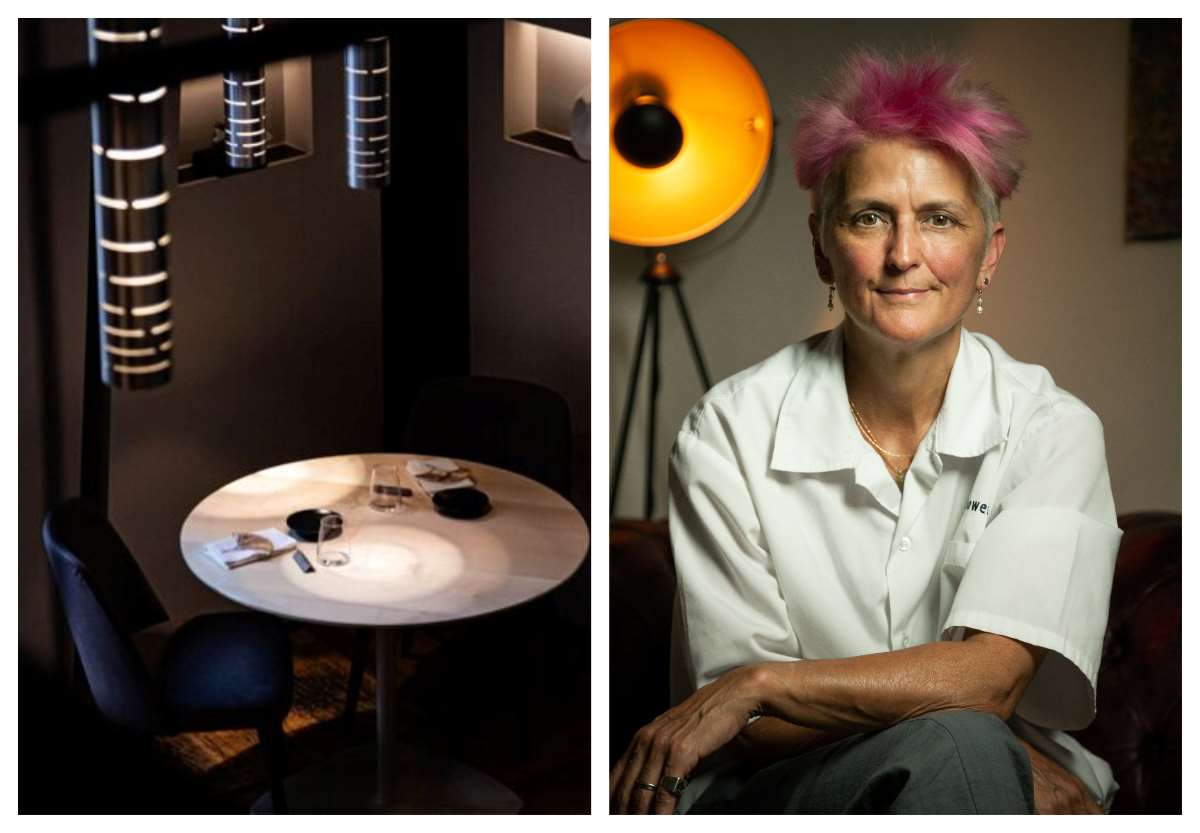
Main image: Cristina Bowerman, chef at Glass Hostaria, has spent her career challenging conventions in Rome’s dining scene, bringing a fiercely personal, innovation-led approach that has helped redefine contemporary Italian cuisine. © Carlo Roberti
Written by
Marie-Noëlle Bauer
Marie-Noëlle is a contributor to The MICHELIN Guide. Despite having a huge kitchen by Paris standards, this Franco-American-Haitian writer prefers the rough-and-tumble vibe of her local izakaya — where the lights often go out mid-meal — over trying to find her own culinary groove at home. As a former magazine editor for Eurostar, The Ritz Paris, and The Dorchester Collection, she enjoys chatting with chefs and other food and wine experts, whose passion she finds truly infectious — although, admittedly, it’s not enough to tempt her to use that big, intimidating kitchen.
Dining and Cooking