
Estimated to Be a Shipwreck From the 2nd to 1st Century BCE
Large Number of ‘Dressel 1A’ Jars for Wine Transport Discovered
An ancient Roman-era shipwreck that had lain submerged for over 2,000 years was discovered off the coast of Sicily, Italy. Around the shipwreck, hundreds of jars, presumed to have been used for transporting wine and other goods, were also found. This discovery is expected to serve as valuable material for studying the ancient Mediterranean trade network.
On August 10, Yonhap News, citing AFP and other foreign media, reported that the shipwreck was found 3 miles (4.8 km) off the coast of Mazara del Vallo, western Sicily, at a depth of 46 meters.
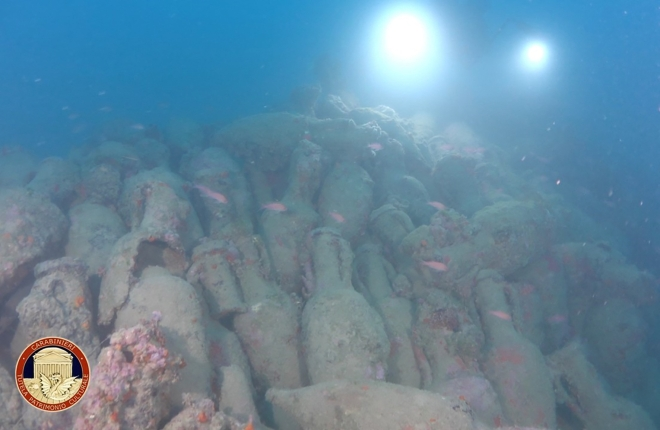
Jar discovered in a shipwreck off the coast of Sicily. Photo by Italian police
View original image
The shipwreck was first discovered by Giacomo De Mollada, a fisherman and freediver. De Mollada, along with his colleague Igor Bisulli, was scanning the sea floor with sonar equipment when they spotted an object that resembled a rock. Upon diving to investigate directly, he found not a rock, but hundreds of ancient jars spread out before his eyes. He later reported the find to the Sicily Regional Marine Cultural Heritage authorities.
De Mollada described the discovery on social media, explaining that in poor visibility, he approached a large dark object and encountered numerous jars. He called this the most astonishing discovery of his life.
Subsequently, the Palermo Carabinieri Cultural Heritage Protection Unit, the Sicily Regional Marine Cultural Heritage Authority, and the Messina Carabinieri Underwater Unit conducted an on-site investigation. The investigation confirmed that, in addition to hundreds of amphorae—transport jars from ancient Greek and Roman times—two large lead anchor parts and another lead structure were identified on the seabed.
Most of the jars were identified as belonging to the “Dressel 1A” type. The Dressel 1 series is a representative Roman transport jar, widely used to carry Italian wine across the Mediterranean during the late Roman Republic. Dressel 1A is known to have been produced roughly from the late 2nd century BCE to the mid-1st century BCE, which matches the estimated age of the shipwreck.
According to local reports and descriptions by the initial discoverer, the layer of jars on the seabed measures about 21 meters in length, 6 meters in width, and nearly 2 meters in height. While most jars are Dressel 1A, amphorae of the Lamboglia 2 type, those believed to originate from North Africa, and new Punic amphorae were also identified. These are drawing attention as materials to shed light on the trade goods and routes that crossed the Mediterranean at that time.
Alessandro Giuli, Italy’s Minister of Culture, described the find as “one of the most important underwater archaeological discoveries in recent years.” He stated that the shipwreck reveals traces of people, routes, and trade that crossed the ancient Mediterranean, and announced plans to uncover the shipwreck’s history through further investigation. Additionally, Italian authorities plan to continue filming, documenting, and archaeological analysis of the shipwreck and surrounding artifacts while implementing protective measures to prevent looting or damage.
Hot Picks Today

“I Thought Weak Hands Were Just a Sign of Aging”… This Was Found in 85% of Seniors
Meanwhile, this is not the first time an ancient Roman shipwreck has been discovered in Italian waters. In 2023, a Roman cargo ship believed to date from the 1st century BCE to the 1st century CE was found at a depth of around 160 meters off Civitavecchia, about 80 kilometers northwest of Rome. At that time, hundreds of mostly intact Dressel 1B amphorae were also identified around the vessel. The jar storage area measured approximately 12 meters in width and 17 meters in length, and authorities estimated the length of the ship to be over 20 meters. Given the depth, remote-operated underwater vehicles (ROVs) and sonar were used for the investigation. In June 2025, another Roman merchant vessel from around the 4th century CE was discovered in the Ionian Sea near Gallipoli, Apulia, southern Italy.
This content was produced with the assistance of AI translation services.
© The Asia Business Daily. All rights reserved. Unauthorized AI training and use prohibited.
Dining and Cooking