
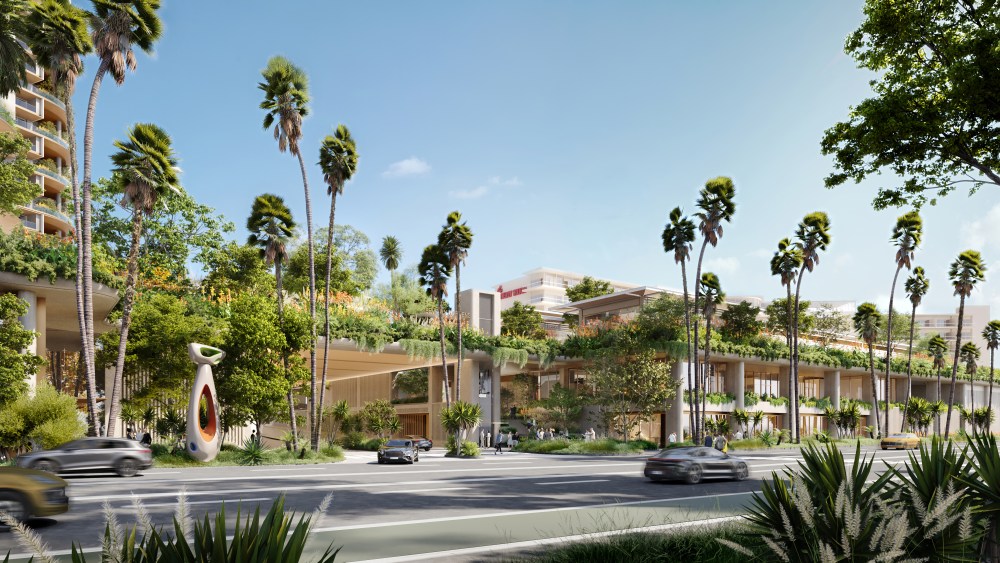
There’s action in Beverly Hills, as luxury brands, developers and restaurant groups expand their footprints and make bigger bets on the city.
Along Rodeo Drive, Hermès has acquired adjacent properties for future expansion, Cartier and Tiffany & Co. are developing larger flagships, and Louis Vuitton is planning a major new project. Then there’s One Beverly Hills, the 17.5-acre development at Wilshire and Santa Monica boulevards that will include a remodeled Beverly Hilton, an Aman hotel, two branded residential towers, a private club, retail, dining and wellness spaces.
“Luxury brands are doubling down on Beverly Hills,” said Larry Green, senior managing director of One Beverly Hills developer Cain. “People that are very shrewd investors see this as a big opportunity right now.”
Green said the current moment reflects a long-term bet on Los Angeles, which has faced shifts in consumer behavior since the pandemic as well as the aftermath of the January 2025 wildfires.
“L.A.’s beat up,” Green said plainly. “But it’s not going anywhere, and we’re believers in it long term.”
That confidence is reflected in the scale of One Beverly Hills. Developed by Cain in partnership with OKO Group, the project is backed by a $4.3 billion financing package from JPMorgan and VICI Properties. Phased openings are set to begin in 2028, with major retail and hospitality openings expected around the Los Angeles Olympics.

A rendering of One Beverly Hills.
Courtesy of One Beverly Hills/Cain
On Rodeo Drive, much of the activity is tied to LVMH Moët Hennessy Louis Vuitton, which has been steadily expanding its Beverly Hills footprint and refreshing key flagships, including Dior, with its Monsieur Dior restaurant by Dominique Crenn; Bulgari, and most recently Celine.
Of the Louis Vuitton project, rumored to include dining and art, Michael Burke, chairman and chief executive officer of LVMH Americas, told WWD last year, “It’s way more than retail.” He described the development as a broader cultural destination, adding, “Everybody’s motivated to make this the most spectacular multicultural space.” Addressing the challenging macroeconomic backdrop, Burke said the group was taking a long-term view, noting that market cycles are temporary.
“Brands are taking bigger, steeper steps, bringing larger storefronts, bigger concepts, major flagships that have experiential elements, architectural elements, expensive art, open space gardens,” said Kathy Gohari, president of the Rodeo Drive Committee, which represents businesses and property owners along the luxury shopping district. “Everything is grander.”
“It’s no longer about just selling a bag or a pair of shoes. It’s about the experience,” she added.
A rendering of One Beverly Hills.
Courtesy of One Beverly Hills/Cain
At One Beverly Hills, Green said roughly 60 percent of the commercial space is already committed. Announced tenants include Dolce & Gabbana, Casa Tua Cucina and Mexican-Japanese restaurant Los Mochis. Dolce & Gabbana will maintain its Rodeo Drive store, while the new location will be geared more toward VICs and local residents.
“We’re going to have a suite of stores here that are serving VIC locals,” Green said. He likened the vision to the community-driven nature of Brentwood Country Mart. “Albeit in a Beverly Hills way,” he added, where residents can grab coffee, walk through the gardens, dine and shop in one place.
It builds on one of Beverly Hills’ existing advantages: it’s one of the few parts of L.A. where shopping, dining and hospitality are concentrated within a walkable stretch. The streets have had a steady buzz in recent months, with locals and tourists dining and strolling between stores throughout the day. Erewhon, which opened on Beverly Drive in 2022, has become a draw in its own right, attracting a steady stream of visitors to the block.
A rendering of a private penthouse pool at the Aman Residences, One Beverly Hills.
Courtesy of One Beverly Hills/Cain
The food scene has been expanding alongside retail, and New York hospitality names have continued to move into Beverly Hills, with Marea and Cipriani already established and Bad Roman among the most recent arrivals. Next is the anticipated Sant Ambroeus, set to open in spring 2027. The Milanese-style restaurant, coffee bar and pasticceria was founded in Milan in 1936 and expanded to the U.S. in 1982.
Managing partner Gaetano Guarducci said Sant Ambroeus had been looking for the right Beverly Hills location for years before securing the former Il Fornaio space at North Beverly Drive and Dayton Way.
“I think it’s a domino effect,” Guarducci said of the investment in the area, pointing to LVMH, One Beverly Hills and the Olympics. “You look at these big companies putting in that amount of investment into it, and you hope that the momentum is going to keep pushing.”
The roughly 8,000-square-foot restaurant, with another 1,500 to 2,000 square feet outdoors, will include a café, bar, multiple dining rooms, private dining and about 55 outdoor seats. The menu will be roughly 80 percent Sant Ambroeus classics and 20 percent L.A.-specific dishes, with an emphasis on local sourcing and health-conscious options, he said.
A rendering of the Sant Ambroeus Beverly Hills facade.
Sant Ambroeus
Guarducci also noted the strength of the market, adding that Beverly Hills restaurants can generate volumes 20 to 30 percent higher than comparable New York locations.
“If you look at restaurants in Beverly Hills, they’re doing big numbers,” he said, attributing the difference in part to the greater competition in New York.
On the residential side, Green said One Beverly Hills buyers to date have predominantly been people with existing ties to L.A., including corporate executives and entertainment industry figures drawn to the privacy, security and convenience of the project.
“They don’t want to leave this place,” he said of L.A. “The weather, their business, the community around it — people want to have a presence here.”
Looking ahead, Gohari expects the next three to five years to be “transformative aesthetically,” bringing “a more seamless and architecturally significant connection with retail, hospitality, dining, wellness, culture and entertainment.”
Dining and Cooking