
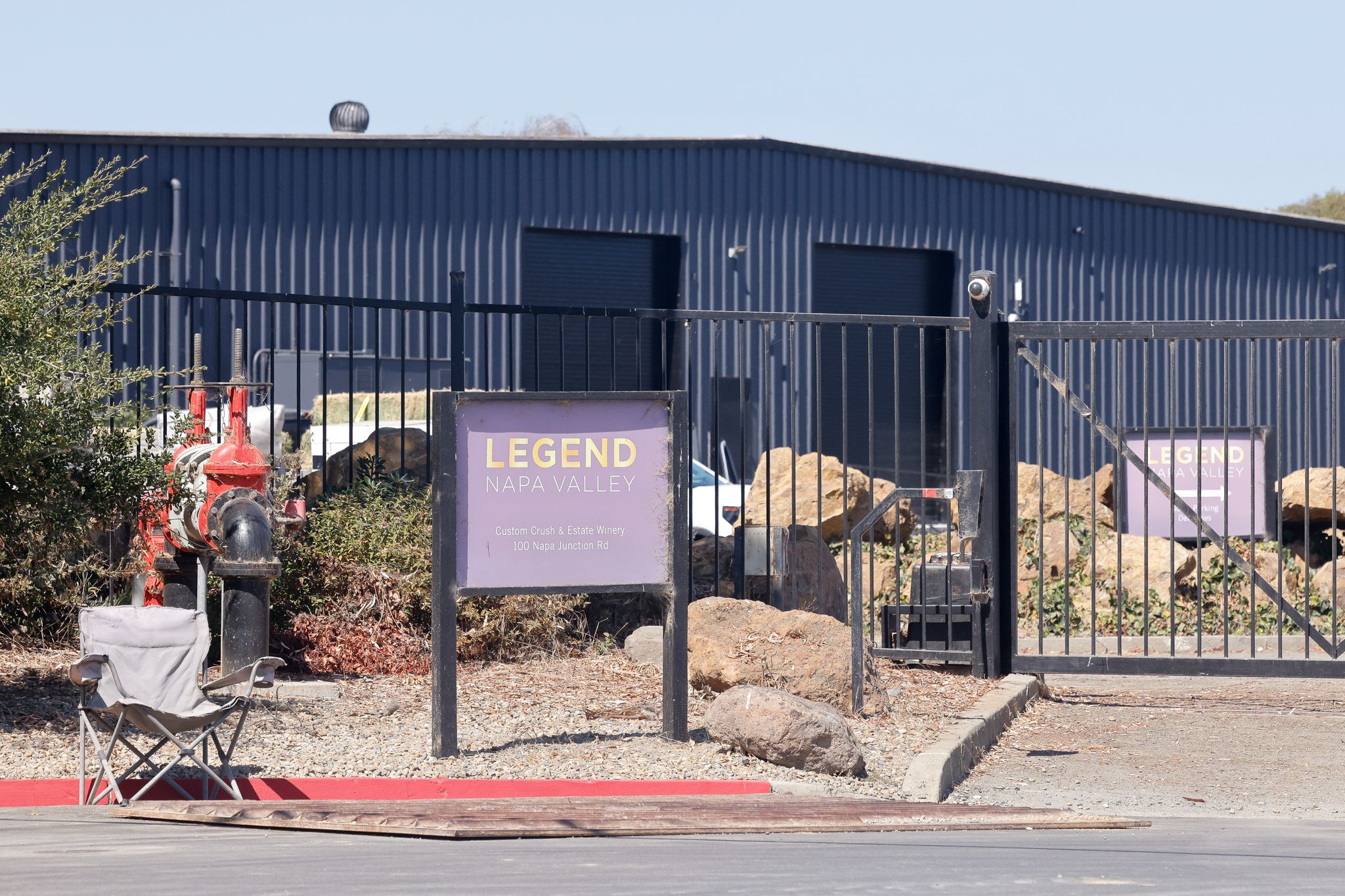
A chair and large metal plate are seen on Napa Junction Road next to a sign for Legend Napa Valley, a custom crush winery that abruptly announced it was closing in the middle of harvest.
Lea Suzuki/S.F. Chronicle
On Aug. 18, John Gibson made his second pick of the 2026 harvest — Vermentino from the Sierra Foothills — and trucked the grapes down to Legend Napa Valley, a custom crush winery set on a hilltop in Napa County’s American Canyon. The crop was significantly smaller than usual — down 50% — due to spring weather conditions, but yields would soon be the least of his problems.
The next day, Gibson received a certified letter notifying him that Legend was ceasing operations “due to extraordinary and sustained conditions affecting the wine industry.” Gibson had ferments underway and in nine days he was scheduled to bring Zinfandel, Syrah and Dolcetto into Legend. But, the letter said, effective immediately, he couldn’t bring any more grapes into the winery. He also had to move all of his wine and equipment out by Sept. 3. “It was a whopping two weeks and 12 hours notice,” Gibson said. “That was a very overwhelming, ‘Oh my God,’ moment.”
Harvest is always chaotic for winemakers, but Legend’s abrupt closure sent Gibson and many others into a tailspin — and cost them thousands of dollars. Custom crush facilities offer wineries, usually smaller ones, a place to make and store their wine; they provide equipment and a cellar team that oversees winemaking. When Legend sent its letter, most of its clients’ grapes were ready, or nearly ready, to be picked, and they suddenly had nowhere to press and ferment them. The news was also surprising because Legend had recently completed renovations, adding a large indoor tasting room — which hadn’t yet opened — patio and offices to the building. “These were all things that made me think that they were moving forward,” Gibson said.
Article continues below this ad
Legend, located at 100 Napa Junction, American Canyon, had a short run. The winery was founded and managed by Andre Crisp, the former president and CEO of Napa’s Luna Vineyards. Crisp also owns Global Wine Brands, a portfolio of brands sold through grocery stores and wine shops, which also produces private labels. Crisp purchased the 20-acre American Canyon property, along with the 20,000-square-foot winery, in December 2021. In 2023, on a wine podcast called Barrels Ahead, he boasted about Legend’s 12,000-square-foot visitor center with “360-degree views,” along with his plans to build a commercial kitchen and create a food program. His vision was ambitious for custom crush facilities, which don’t typically do hospitality. Crisp also said he was building his family home on the land.
Equipment on trailers is seen beyond the gates of Legend Napa Valley. Winemaking clients received roughly two weeks’ notice that the winery was shutting down.
Lea Suzuki/S.F. Chronicle
Crisp did not respond to the Chronicle’s requests for comment.
Napa County property records show that Legend Napa Valley sold the property in August 2025 to a company called JSP Domaine 3 LLC for $5.5 million. None of the former Legend clients the Chronicle spoke with knew about the sale. JSP Domaine 3 LLC is connected to Jackson Square Properties, a real estate investment management company headquartered in San Francisco. The firm focuses on the acquisition, development and management of multifamily apartment communities across the country. It recently developed a 291-unit apartment complex next door to Legend called the Domaine. Suzann Cabling, CFO of Jackson Square Properties, said the company “has had a positive and collaborative relationship with Andre Crisp and Legend Napa Valley,” and that the 2025 sale “was not intended to cause, and did not require, the closure of Legend’s custom crush operations.”
“Our understanding is that Legend’s decision to discontinue offering custom crush services was driven by business conditions,” she said, “including insufficient contracted grape volume in a difficult environment for the Napa Valley wine industry.” Cabling confirmed that Jackson Square Properties currently has no plans to build apartments on the site and said the company hopes Legend will “reimagine its hospitality offering and be a great addition to the neighborhood.”
Article continues below this ad
When Gibson received Legend’s letter, he had just begun processing his third harvest there, and was making wine for four different brands: His personal brand, Salexis; Four Winds, in which he’s a 50% partner; and Andrew Goeffrey Vineyards and Eagle Eye Wines, for which he’s the consulting winemaker. The news forced him to delay three of his picks, then scramble to find a new home for his wine. He visited seven facilities in four days, and in the end, had to split his wine between three wineries.
Gibson had a lot of winery equipment at Legend, and moving it proved to be “a heroic and herculean task,” he said. Moving two 3,000-gallon tanks required procuring a crane that had to “reach over part of the building to get them out,” and cost several thousand dollars. He moved them to a temporary spot next to a friend’s barn, knowing he’ll have to move them again later. Trucking his wine barrels to a new facility cost him at least another $5,000. For three weeks, he was unable to sleep. “It’s my 47th harvest in Napa Valley,” he said, “and I’ve never seen or heard of anything like this.”
For winemaker Patrick Mc Evoy of Forthright Winery, it was the third time in three years that a custom crush facility had closed on him. The other two places, however, gave several months’ notice, he said, and did not shutter in the middle of harvest. When he received the certified letter from Legend, Mc Evoy calculated that he had just nine business days to move out, so he requested a couple more weeks. “The answer was ‘no,’” he said. “They said, ’Power and lights go out on the 3rd and the gate gets locked.’”
Moving “cost us quite a bit of money,” Mc Evoy said, adding that finding a new home and scheduling moving trucks in the middle of harvest was “quite a lot of work to organize in such a short period of time.” He said he never got to use the new permit he’d received this spring from the California Department of Alcoholic Beverage Control to produce wine at Legend, which cost him $1,000.
The winemakers the Chronicle spoke with all said they chose to work with Legend because of management’s willingness to let them be hands-on with their work. At most custom crush facilities, winemakers give up control and rely on the facility’s winemaking team to physically carry out their vision. “You’re locked into one way of doing things,” Rachel Novak, co-founder of Novak & Mason Cellars and a client of Legend’s since 2023, said. In her experience, when custom crush facilities learn that she’s an especially experimental winemaker, “people tend to start edging out of the room sideways.”
Article continues below this ad
But Legend was different. Gibson said that while he found its location, south of Napa Valley, to be inconvenient, it “was one of the few facilities that would allow us to do our own work.” He was even given his own key so he could tend to his wines outside of business hours. (Once the letter went out, Legend took the key back, Gibson said.)
Gibson said he saw no major warning signs that Legend was in trouble, though he suspected that business had slowed significantly for the facility over the past two years amid the wine industry downturn and that this vintage “was going to be worse.”
Jay Nuñez, founder of Napa’s No Love Lost Wine Co., said he saw the closing coming a couple of weeks before the letter went out. Like Mc Evoy, it was Nuñez’s third move in three years due to other custom crush closures, but he had issues with Legend from the start, he said. When he received his first invoice, it contained charges for “things I’ve never seen in my career in wine,” Nuñez said, and his inclusive monthly fee had more than doubled, from $4,000 to $9,200. This happened repeatedly with his invoices, he said, and while he always contested the charges, he ended up paying for many of them because pursuing legal action would have cost even more.
Cobwebs are seen on the gate entry keypad outside Legend Napa Valley, a few weeks after it ceased operations.
Lea Suzuki/S.F. Chronicle
In early August, Nuñez was offered some extra Cabernet Sauvignon for free. It would have roughly doubled the tonnage he planned to crush at Legend, and he called Crisp to work out pricing. During that call, Crisp “had a meltdown,” “started yelling” at him and accused him of “always looking for a discount,” he said.
Article continues below this ad
“We had 15 tons (of grapes) scheduled to come in the next day,” but Crisp wouldn’t let him crush any more grapes at Legend, told him to move out, and he had to cancel his picks, Nuñez said. Less than two weeks later, the letter went out.
Nuñez said that he saw many red flags during his time at Legend. There were several months where Nuñez said that Legend tried to get him to pay his invoice the day it was sent out — even sending an employee to meet him in person to collect the check. And Nuñez found quality issues with the winemaking, too, he said, which he was “thankfully, able to correct.”
Nuñez said it cost him upward of $50,000 to move out of Legend. Outside of moving expenses, he said, Crisp “held my wine hostage” until he paid nearly $20,000 in outstanding invoices, which included many charges he disagreed with. The move forced him to significantly cut his production for the year.
Legend’s letter, which the Chronicle reviewed, demanded that outstanding balances and final charges were paid “prior to release of customer wine and property.” Gibson felt the winery was in breach of his contract and should cover some of his moving costs, but said that on a phone call, Crisp “loosely threatened” him with legal action if he didn’t pay up. “We chose to pay our bills, chose to absorb all of these costs that we didn’t want to,” he said. “It would have gotten ugly.”
Article continues below this ad
Gibson and several other winemakers said they may consider taking legal action later, once harvest is wrapped up. “(Crisp) should have known that something was going to go down months ago,” Gibson said. “What he chose to do — wait until August to throw this out there — is not done in this industry. I believe that what comes around goes around. We’ll see what happens.”
Dining and Cooking