I am a beer nerd getting into wine. A fellow redditor recommended with my background in whiskey that I try some Chardonnay, so I tried one New and one Old World one! Thoughts/analysis in the comments.
I am a beer nerd getting into wine. A fellow redditor recommended with my background in whiskey that I try some Chardonnay, so I tried one New and one Old World one! Thoughts/analysis in the comments.
by SheogorathWaldo
2 Comments
SheogorathWaldo
Hey all! It’s been a little bit — I’ve been traveling for work, had a nice vacation, and then was back to work so opening two bottles of wine alone for myself was not really convenient for a bit. Anyway, your local beer, whiskey, fragrance, coffee, and general nerd here that is rather quickly getting into wine! I started being enthralled with wine lately due to my fascination with the traditions of winemaking and the effects of terroir, things we see a lot with coffee but less so with beers and whiskeys which are usually very defined by locality but not necessarily accompanied with the terroir of their brewery locations (at least not anymore). Plus, wine seems to have a whole plethora of flavor profiles I am not accustomed to which makes me excited!
Today I venture into a comparison of white wines, specifically Chardonnay/Chardonnay forward specimens from different regions in the globe. This was recommended a while back by u/Captain_Gekyumme as he said they may appeal to my whiskey-loving side taking on lots of barrel flavor. Let’s get into it1
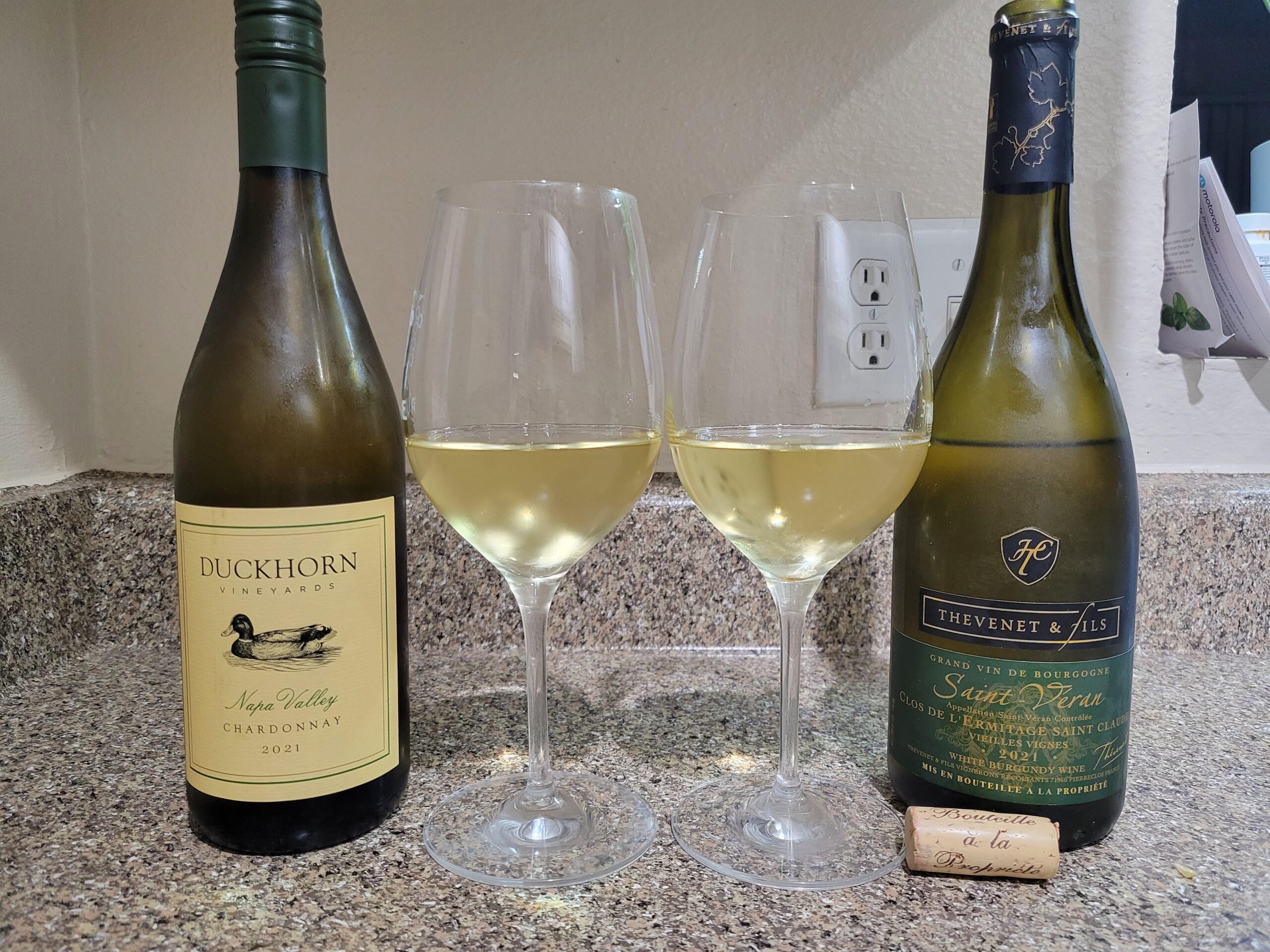
**Duckhorn Napa Valley Chardonnay 2021**
Everyone knows Duckhorn and Decoy, but I have never had a proper Duckhorn wine. I enjoyed the Decoy Merlot I had a while back so I decided it was probably safe to assume this Chardonnay would, while far from rare or exclusive, may be a fine example of a Napa Valley and New World approach on the grape. Clocking in at 14.1% ABV, it is not to be scoffed at, especially after a couple Irish Coffees today (they go great with gaming).
*Nose:* Immediately I am struck with a similarity I’ve detected in, of all wines, Kirkland Champagne — a strong pear aroma. Certainly fruity, certainly fresh, and very clean. The pear is accompanied by florals with the forward note being jasmine. It’s a white floral with a hint of green to it, a smooth and creamy feel. Perhaps the note is more of a tuberose as it lacks the musky heft of jasmine, but that’s grasping at straws. There is a cool, misty sensation as well, like lilacs. I say this as it reminds me strongly of a perfume from the Frederic Malle line called “En Passant” by Olivia Giacobetti (which I have not smelled in years) where the perfumer attempted to recreate an aroa from her childhood: driving through the French countryside early in the morning with dew still on the lilac fields. That aside, this is pleasant, fruity, fresh, and floral on the nose.
*Palate:* Lovely if I do say so. The pear is apparent, perhaps with a bit of a yellow delicious apple, and lemon. Near the mid a buttery note I understand is to be expected with this grape takes hold, commanding attention, translating that jasmine/tuberose aroma to flavor. There’s a crisp acidity, a wet minerality, and a smooth transition to a vanilla and oak finish. The finish really does remind me of that of a well aged, less aggressive bourbon: it’s full of a rich vanilla and soft woodiness with staying power. Throughout the evolution of the palate the constant is not pear, but lemon juice. Very nice!
…
This next name is a doozie
…
**Thevenet & Fils Cuvee Vieelles Vignes Clos de l’Ermitage Saint Claude Saint-Veran 2021**
This is a white from Burgundy, France (and my first Burgundy wine), specifically from the Saint-Veran appellation known for Chardonnay. The soil is rocky and limestone dominant and located in the far south of the Burgundy region. If anyone can find or knows more about this wine specifically I’m all ears! A tad softer on the ABV, this wine comes in at 13.0%.
*Nose*: I can tell immediately this is the same grape as the Duckhorn, though the dominant notes differ (as expected between the New and Old world wines). While pear is present, the nose is dominated by more earthy notes and the florals are sharper. I smell cold, wet stone, rosemary, orchid, orris root (a creamy, powdery, and earthy floral fragrance note). It smells… more proper? Like this is intended to be drank while dressed in a blazer while the Duckhorn was good for a polo. Deep down there is a dusty note, like dust kicked up by a broom in a dry shed — only available at the tail of a long inhale.
*Palate*: I can say right away I doubted it after the nose but I prefer this over the Duckhorn. The palate starts of very bright and crisp, like that of a Pinot Grigio almost, with green apple and Asian pear. The acidity is assertive and noticeable immediately. The evolution is sudden and drastic to an extremely creamy, buttery, vanilla and white chocolate dream. Oak swirls about the palate in all manifestations — sweets, woods, hints of spices. It tastes (on the finish) almost like you licked the spatula covered in creamed butter, sugar, and vanilla while baking (minus some sweetness). Fantastic!
**All-in-all** the French have won me over again. Don’t get me wrong, I enjoyed the Duckhorn, but the -insert long name- Burgundy wine was far superior in my opinion. More nuance and a stronger, more captivating evolution of flavor.
More reccs and feedback? What should I be looking for in a Burgundy white? Did my notes follow expectations (not that I care what I “should” detect; I’m just curious) Again, thank you all who have supported me in this wine journey. Look forward to checking in again soon. Peace!
arm2610
OP you should try some high quality skin contact whites aka orange wines. There’s a million natty juice ones that aren’t great because of the trend for them but the good ones can be amazingly complex and aromatic. There are some ones that are almost like a whisky. Gravner from Slovenia for example, or Radikon from just over the border in Italy. Quite pricey in the US but so worth it. I recommend serving them at a temperature in between what you’d typically serve a red and white. They don’t express well when fully cold like a white wine

2 Comments
Hey all! It’s been a little bit — I’ve been traveling for work, had a nice vacation, and then was back to work so opening two bottles of wine alone for myself was not really convenient for a bit. Anyway, your local beer, whiskey, fragrance, coffee, and general nerd here that is rather quickly getting into wine! I started being enthralled with wine lately due to my fascination with the traditions of winemaking and the effects of terroir, things we see a lot with coffee but less so with beers and whiskeys which are usually very defined by locality but not necessarily accompanied with the terroir of their brewery locations (at least not anymore). Plus, wine seems to have a whole plethora of flavor profiles I am not accustomed to which makes me excited!
Today I venture into a comparison of white wines, specifically Chardonnay/Chardonnay forward specimens from different regions in the globe. This was recommended a while back by u/Captain_Gekyumme as he said they may appeal to my whiskey-loving side taking on lots of barrel flavor. Let’s get into it1
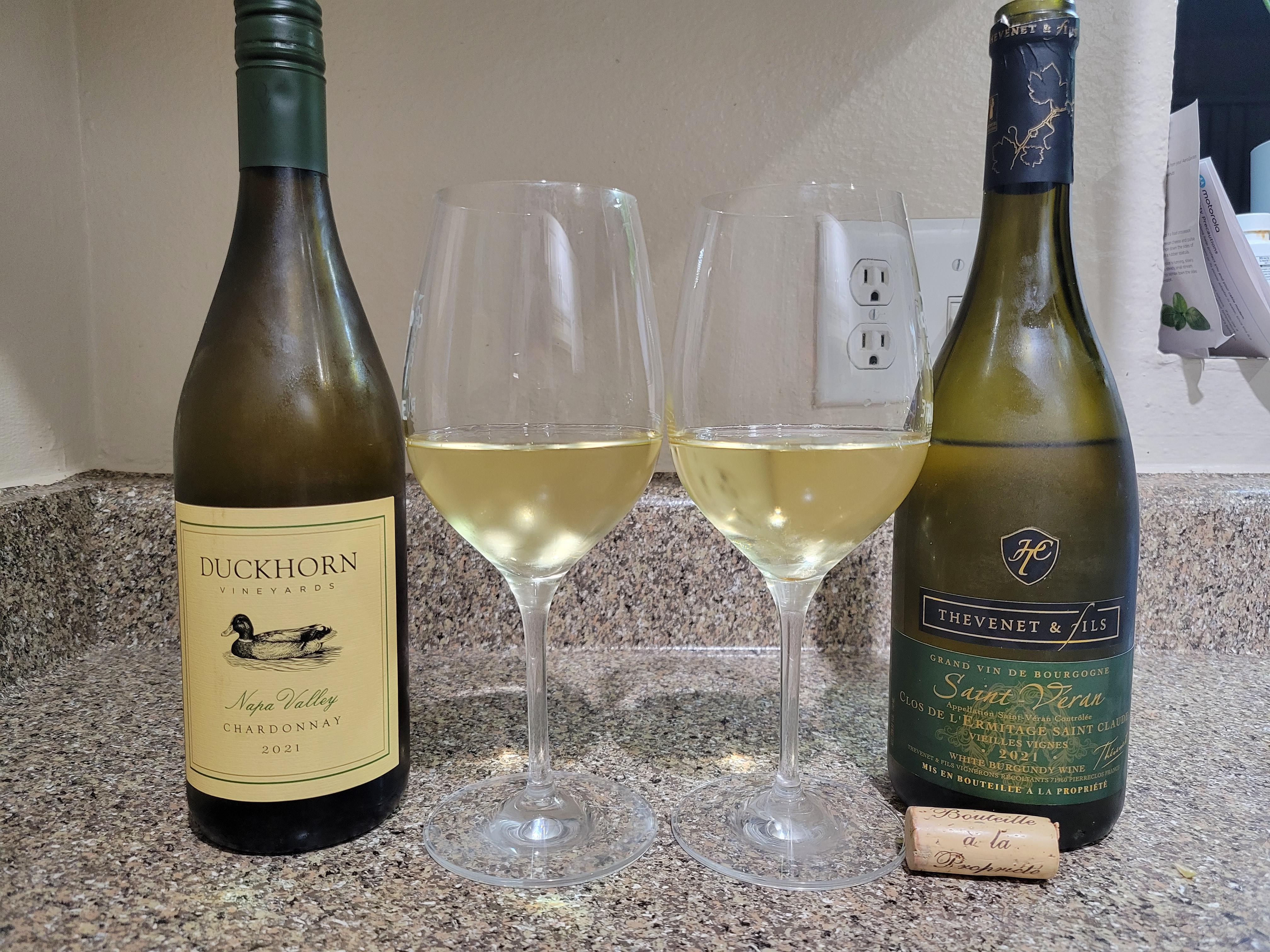
**Duckhorn Napa Valley Chardonnay 2021**
Everyone knows Duckhorn and Decoy, but I have never had a proper Duckhorn wine. I enjoyed the Decoy Merlot I had a while back so I decided it was probably safe to assume this Chardonnay would, while far from rare or exclusive, may be a fine example of a Napa Valley and New World approach on the grape. Clocking in at 14.1% ABV, it is not to be scoffed at, especially after a couple Irish Coffees today (they go great with gaming).
*Nose:* Immediately I am struck with a similarity I’ve detected in, of all wines, Kirkland Champagne — a strong pear aroma. Certainly fruity, certainly fresh, and very clean. The pear is accompanied by florals with the forward note being jasmine. It’s a white floral with a hint of green to it, a smooth and creamy feel. Perhaps the note is more of a tuberose as it lacks the musky heft of jasmine, but that’s grasping at straws. There is a cool, misty sensation as well, like lilacs. I say this as it reminds me strongly of a perfume from the Frederic Malle line called “En Passant” by Olivia Giacobetti (which I have not smelled in years) where the perfumer attempted to recreate an aroa from her childhood: driving through the French countryside early in the morning with dew still on the lilac fields. That aside, this is pleasant, fruity, fresh, and floral on the nose.
*Palate:* Lovely if I do say so. The pear is apparent, perhaps with a bit of a yellow delicious apple, and lemon. Near the mid a buttery note I understand is to be expected with this grape takes hold, commanding attention, translating that jasmine/tuberose aroma to flavor. There’s a crisp acidity, a wet minerality, and a smooth transition to a vanilla and oak finish. The finish really does remind me of that of a well aged, less aggressive bourbon: it’s full of a rich vanilla and soft woodiness with staying power. Throughout the evolution of the palate the constant is not pear, but lemon juice. Very nice!
…
This next name is a doozie
…
**Thevenet & Fils Cuvee Vieelles Vignes Clos de l’Ermitage Saint Claude Saint-Veran 2021**
This is a white from Burgundy, France (and my first Burgundy wine), specifically from the Saint-Veran appellation known for Chardonnay. The soil is rocky and limestone dominant and located in the far south of the Burgundy region. If anyone can find or knows more about this wine specifically I’m all ears! A tad softer on the ABV, this wine comes in at 13.0%.
*Nose*: I can tell immediately this is the same grape as the Duckhorn, though the dominant notes differ (as expected between the New and Old world wines). While pear is present, the nose is dominated by more earthy notes and the florals are sharper. I smell cold, wet stone, rosemary, orchid, orris root (a creamy, powdery, and earthy floral fragrance note). It smells… more proper? Like this is intended to be drank while dressed in a blazer while the Duckhorn was good for a polo. Deep down there is a dusty note, like dust kicked up by a broom in a dry shed — only available at the tail of a long inhale.
*Palate*: I can say right away I doubted it after the nose but I prefer this over the Duckhorn. The palate starts of very bright and crisp, like that of a Pinot Grigio almost, with green apple and Asian pear. The acidity is assertive and noticeable immediately. The evolution is sudden and drastic to an extremely creamy, buttery, vanilla and white chocolate dream. Oak swirls about the palate in all manifestations — sweets, woods, hints of spices. It tastes (on the finish) almost like you licked the spatula covered in creamed butter, sugar, and vanilla while baking (minus some sweetness). Fantastic!
**All-in-all** the French have won me over again. Don’t get me wrong, I enjoyed the Duckhorn, but the -insert long name- Burgundy wine was far superior in my opinion. More nuance and a stronger, more captivating evolution of flavor.
More reccs and feedback? What should I be looking for in a Burgundy white? Did my notes follow expectations (not that I care what I “should” detect; I’m just curious) Again, thank you all who have supported me in this wine journey. Look forward to checking in again soon. Peace!
OP you should try some high quality skin contact whites aka orange wines. There’s a million natty juice ones that aren’t great because of the trend for them but the good ones can be amazingly complex and aromatic. There are some ones that are almost like a whisky. Gravner from Slovenia for example, or Radikon from just over the border in Italy. Quite pricey in the US but so worth it. I recommend serving them at a temperature in between what you’d typically serve a red and white. They don’t express well when fully cold like a white wine