At one point in 2021, Jasmine Sharma was so exasperated with her low tips at the Jon & Vinny’s restaurant in Fairfax that she learned to approach almost every diner with what she dubbed her “monologue.”
“Hi, all. Here is the check. Take your time, no rush at all.” She said she’d seek to explain an 18% service fee added to the check to each customer. “If you do want to leave an additional tip, it is more than appreciated, not required,” she would say.
Sometimes people would hear Sharma out. Other times they were too tipsy to listen. Often, she got a question: “What do you mean you’re not getting the tip?”
Sharma started her table-side performance when she noticed diners were leaving her less in tips for her service. The confusion about the 18% service fee, she said, generated an uproar among the servers, some of whom sent angry emails to upper management and agitated to meet with them for an explanation as to how the service fee was being allocated.
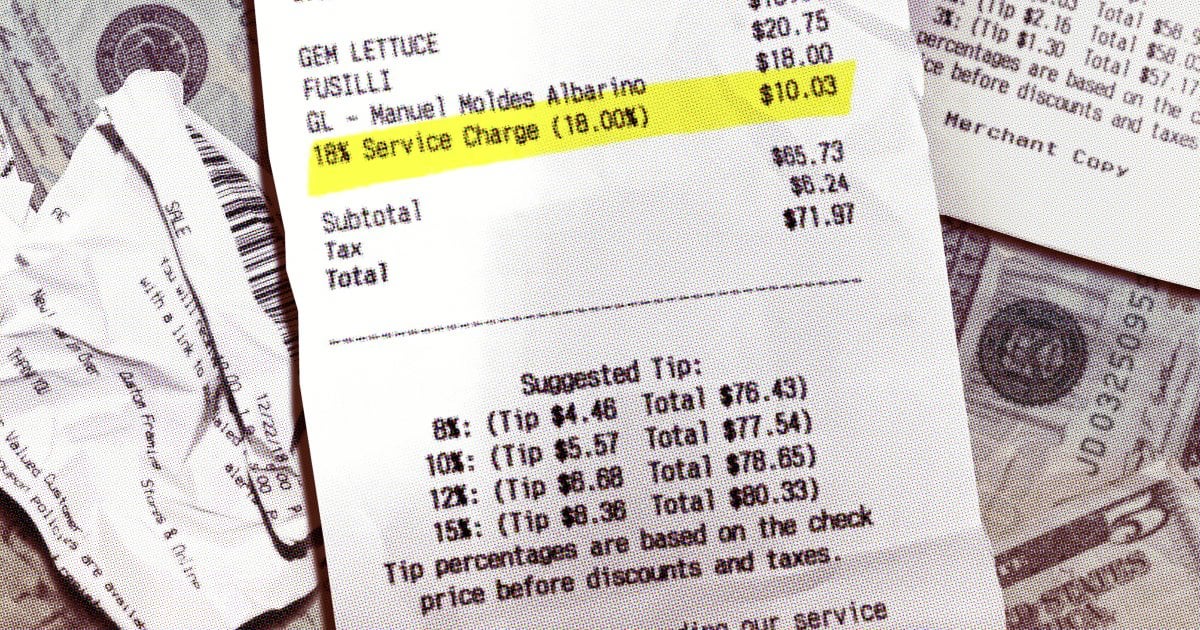
Sharma is part of a class-action lawsuit filed Tuesday in Los Angeles Superior Court against Joint Venture Restaurant Group, Inc., which owns Jon & Vinny’s. The workers claim that the company denied them tips and therefore shortchanged them on their take-home pay because of confusion resulting from the 18% service fee.
The practice of adding service charges to restaurant checks has grown in Southern California in recent years, and debates over how it should be treated by customers and workers gets to a fundamental question: Should every employee of a restaurant share in what customers pay for being served?
Tuesday’s lawsuit alleges that Jon & Vinny’s is in violation of California’s gratuity law, which requires that tips to be remitted in full to non-managerial service staff.
Through a spokesperson, the restaurant group — including However, she said, the QR code was an effort to be more transparent about the fee. She said they don’t mention it specifically on the receipt because customers had complained about how long the receipts had become with language about the service fee.
High service fees — north of 15% — aren’t unusual and are normally used as an automatic gratuity, said Janet Lowder, president of Restaurant Management Services in Rancho Palos Verdes. But Lowder and other experts said it was unusual for such high service fees to supplement base hourly wages.
“That just doesn’t seem right,” Lowder said. “It’s bizarre that it’s used to offset the hourly wages, which is the cost of doing business.”
Lowder, who has worked in the restaurant industry for more than 30 years, said she can see how tension would build in a restaurant, where servers would feel aggrieved by a new business model that disrupts the amount of tips they take home.
Johannesen said she strongly believes and stands by the service-fee model. She said that it can be hard for some to understand it because it is different from the classic restaurant setup where servers work mostly for tips. “It’s a different way of thinking of the ecosystem and health of a restaurant,” she said.
Most former Jon & Vinny’s employees who complained about the restaurant’s high service fee were people who worked as servers to supplement their livelihood in the entertainment industry. Several didn’t want to give their names, fearful of repercussions.
Kara Jobe, a former server at the Beverly Hills location who also is an actor, said normally diners didn’t ask about the fee and didn’t leave a tip. Every so often, a diner would ask about it.
“Does this go to you?” diners asked.
“I don’t really know,” she’d respond. “I’m told it goes to my hourly wage.”
Often, she said, diners became upset.
“I mean, how do you tell someone: I need you to pay my hourly wage but then I need you to tip on top of that because we don’t get enough money from our hourly wage. As a guest at Jon & Vinny’s, I need you to basically have all the responsibility for paying me,” Jobe said.
Jobe left her job in late May because she said the resentment built to an intolerable level.
Gary Alleyne, a line cook at Jon & Vinny’s in Beverly Hills, spoke with The Times at the suggestion of Jon & Vinny’s management. He said the 18% service fee helps him make a few dollars above minimum wage. The 32-year-old said he’s worked for the company for most of the last seven years and is happy with his compensation.
The 18% service fee, Alleyne said, “helps us get paid more than we usually get paid like at any other type of restaurant. A little bit higher wages.”
He said he makes $20 base hourly wage an hour and about $21 to $22 gross an hour after tips and delivery fees.
Alleyne said he works about 34 hours a week and gets paid about $50,000 a year. Between his main job as a line cook at Jon & Vinny’s and other side jobs, Alleyne said he’s doing all right. “I’m able to sustain myself,” Alleyne said. “You always got to hustle in L.A., you feel me?”
Alleyne said he wasn’t told about the 18% service fee when he was first hired in 2016. He said he found out about the fee a few months after working there when he saw it on a bill.
He said he thought the money from the fee went to the servers but later discovered it went to him too. Alleyne later added that the 18% service fee was in an employee handbook that he hadn’t looked at closely.
Jordan Slaffey, a former server who worked at the Slauson and Beverly Hills locations of Jon & Vinny’s for a year and a half, said she would observe that customers were confused about the service fee on their check and left very little tip or nothing.
Slaffey, who is also part of the lawsuit, said on several occasions she asked for a manager to show her where all the 18% was going to. “It doesn’t add up,” she said of the fee. “It doesn’t make sense.”
Slaffey stayed as long as she did because she needed the job. She said she was living paycheck-to-paycheck. “I really believed in Jon & Vinny’s,” Slaffey said recently, shaking her head with disappointment.
About a week before her last day, she said she served Shook at Jon & Vinny’s in Beverly Hills. He showed up with a man and ordered zucchini spaghetti and pizza. It appeared to be a business meeting, she said.
After the meal, she said, Shook didn’t leave a tip.
In response, the restaurant group provided multiple checks showing Jon and Vinny’s partners leaving tips for service. “When Jon, Vinny and Helen are there in a personal capacity they always tip,” a spokesperson said.
Times staff writer Sam Dean contributed to this report.
praithdawg
Fuck them dude. I like their food but that is inexcusable greed. Sucks too they have a few great spots
Mak_daddy623
This sure sounds like servers complaining that it’s unfair that their compensation is more in line with their coworkers instead of their usual hookup of near six figure income on 20 hours/week at LA fine dining. But also wouldn’t be shocked if the owners were pocketing some of the fee somehow.
detentionbarn
On the one hand, I don’t envy restaurant owners, and how they have to navigate inflation, labor issues, COVID ripple effects, landlords, delivery apps, etc. I mean, i would never want to own or run a restaurant ever ever.
But this service charge issue and the massive obfuscation around it seems to be a self-inflicted problem.
As I see it, these should be the legal options (putting aside other labor issues like PT/FT):
1. owners pay all hourly staff an hourly, non-tipped wage, charge a service fee in LIEU OF tipping, and make that clear on the check 2. owners raise prices, up the pay for non-tipped employees from the margin on those prices (and make that clear on the menu), and let tipped employees get tipped
VIVI69VIVI
Any idea which firm is handling the suit for the workers? I have some info that will help them and need to pass it along.
Caltuxpebbles
However you feel about tipping, it’s ridiculous that management did not adequately explain to their staff, front or BOH, how the 18% was being paid out. As a server, you have an expectation of how you will be paid, so it’s not ok when anyone’s compensation is murky. As well, guests have an expectation of what a service charge means, so it’s unlikely people are going to add much more than a few additional percentage points to a bill that already has 18% on it.
However if a restaurant business wants to tackle this evolving conversation on tipping, they need to keep their employees in the loop on how their take home pay is going to be affected.
Edit typo
slazey27
I’ve pointed this issue out a couple of times over the past few years; I’m happy something is being done about it.
my_little_shumai
A line cook, the person responsible for producing all of that food, makes $50,000 a year. How does a person survive on this? He is being such a good sport, and clearly has positive thoughts about his job, but this compensation seems absurd for such a large business group.
atubofsake
So at our restaurant, everyone makes 25/hr + tips, albeit 70/30 service split. We haven’t had a single turnover in 2 years.
Higher wages = happy employees, it’s really not that hard.
orangefreshy
I’m not really sure what to think about this.
on the one side, it seems everyone is getting paid more fairly, but the servers seem to want to double dip, get a higher hourly wage, and still max out their tips. Which I get… you always want to maximize your earning potential. But it feels a bit disingenuous as a customer. If you find you are not making as much tips under this new model where the customer just pays a fixed % for all wages to be higher, maybe go work for a company that just does straight tips and take the risk?
I find this model is so confusing. I would honestly just rather pay a higher price and have the restaurant pay a fair wage to everyone – whatever that is. IF they have to offer $50-100 an hour to get servers in there, then that’s what they should do. OR have them add a fee and call it something different like a “back of house” fee or something, that is clear it goes to everyone but the servers, because I feel like the term “service” fee seems to imply it is for the person who is directly giving you the service and thus no grat is needed. The practice of servers tipping out to ensure everyone gets a piece is not sustainable or fair, having us have to tip 20% on top of another 18% is insane… idk it all sucks. I wish we could get away from tipping culture altogether.
As long as there’s no standardization of these fees or w/e where we can’t even guarantee who or where the money goes and if it’s actually going to the employees, I don’t really want to see them on checks.
checkerspot
It doesn’t seem fair to the diners. So they pay 18% service fee and then the servers are asking for an additional 18 or 20 (or whatever) on top of that? That’s really expensive. If you raise prices to what it honestly costs to produce food and pay workers and pay the overhead, then restaurant dining will admittedly be really expensive. And maybe only a select few will be able to dine out, but maybe that’s the way it has to be.
Calm-Ad-9710
In my opinion there’s a bit of truth in both sides.
The service charge is allocated to labor costs, I believe to be true. Jon & Vinny’s staff is compensated above most similar jobs in the area as a result, at least when it comes to base pay.
Yes, the service charge blocks a good amount of tips, but you are getting paid a higher hourly rate than you can make elsewhere which is guaranteed income.
Additionally, there are a lot of affluent customers eating at these restaurants who will tip blindly, generously, and almost daily.
However, it is likely that the service charge is being used to cover the bulk or all of labor costs. If that’s the case, and JVRG were to adjust and dedicate part of their operating budget to labor costs and supplement employee pay with the service fee, it’s likely those hourly wages would be even higher.
In the end, shaking my head at both the servers and Jon and Vinny, but happy for BOH staff like Gary who seem to do alright in this situation.
RollMurky373
The service charge theft there has been an open secret for years. Maybe this will get other spots to stop doing it too.
brainchili
I’m just pissed I didn’t start the lawsuit myself. The fee is bullshit.
I don’t need to know the ingredients of your french fries just like I don’t need to know what it costs you for health insurance. Bake the 18% into your prices and if it’s competitive, you will do well. If it’s not, you have a pricing problem.
This has left a bad taste in every diners mouth that’s eaten there and is a reason many of us don’t go again.
I hope this leads to it’s removal for all restaurants, not just J&V.
NotDeadYet57
Why not just raise the menu prices?
Party-Problem
Doesn’t tu madres do this too? Not sure the percentage of their service charge but it’s there. And they don’t even have servers it’s all app based.
Australiaaa
So like the SugarFish group does an 18% surcharge, which is pooled just like J&V is, and SugarFish does not allow for tipping because they pay a higher wage overall, with that 18% going towards it. Seems to work.
I’m overall a bit confused. J&V seems to want to get rid of the tipping model. Servers in the class action want the 18% of distribution, 0% service charge, and tipping which can range from 15%-25% in some cases. It all sucks.
Why can’t the $16 salad be $19? No surcharge? Restaurant uses that profit margin for employees?
cathartic-chaos
J&V always gave me the ick. I went there once, wasn’t impressed and never went back.
LobsterStretches
Orsa and Winston has a 20% service fee. Idk how anyone could last there.
Salty_Wedding3960
At the start of the pandemic, watching restaurant workers suffer (especially FOH) made me think that was going to be the turning point for strongly considering changing the compensation and tipping structures in the US, to mimic the systems in the EU and Asia (menu prices that factored in not just food costs but livable wages for all employees, that were all inclusive of tax and some % of estimated service or a fixed service fee % like in Japan). This would provide full transparency to diners of what they’re expected to pay, and a system where workers wouldn’t be so dependent on additional gratuities. Never happened. Sigh.
I don’t understand why Europe by and large can implement a restaurant system that bakes in livable wages AND VAT taxes AND service charges into their quoted menu prices and the US can’t. It’s honestly the joys of eating while traveling in Europe – I know exactly what I’ll be paying at the end of the meal, without an expectation to pay more in gratuity (which is obviously still appreciated if done). Sadly, I feel tipping culture is infiltrating Europe, not on the basis that it’s needed to properly compensate their employees (because their menu pricing already does that) but because US customers are used to it, and are easy to take advantage of for some additional $$$
littlerosepose
Yeah I experienced the server shpiel “the 18% didn’t go to us” first hand. Found it incredibly uncomfortable. I’m not going to tip over an auto gratuity, that’s between the server and management. The food was already expensive, and the whole interaction was enough to put me off entirely. I don’t want to be begged for a tip at the end of a meal.

21 Comments
At one point in 2021, Jasmine Sharma was so exasperated with her low tips at the Jon & Vinny’s restaurant in Fairfax that she learned to approach almost every diner with what she dubbed her “monologue.”
“Hi, all. Here is the check. Take your time, no rush at all.” She said she’d seek to explain an 18% service fee added to the check to each customer. “If you do want to leave an additional tip, it is more than appreciated, not required,” she would say.
Sometimes people would hear Sharma out. Other times they were too tipsy to listen. Often, she got a question: “What do you mean you’re not getting the tip?”
Sharma started her table-side performance when she noticed diners were leaving her less in tips for her service. The confusion about the 18% service fee, she said, generated an uproar among the servers, some of whom sent angry emails to upper management and agitated to meet with them for an explanation as to how the service fee was being allocated.
Sharma is part of a class-action lawsuit filed Tuesday in Los Angeles Superior Court against Joint Venture Restaurant Group, Inc., which owns Jon & Vinny’s. The workers claim that the company denied them tips and therefore shortchanged them on their take-home pay because of confusion resulting from the 18% service fee.
The practice of adding service charges to restaurant checks has grown in Southern California in recent years, and debates over how it should be treated by customers and workers gets to a fundamental question: Should every employee of a restaurant share in what customers pay for being served?
Tuesday’s lawsuit alleges that Jon & Vinny’s is in violation of California’s gratuity law, which requires that tips to be remitted in full to non-managerial service staff.
Through a spokesperson, the restaurant group — including
However, she said, the QR code was an effort to be more transparent about the fee. She said they don’t mention it specifically on the receipt because customers had complained about how long the receipts had become with language about the service fee.
High service fees — north of 15% — aren’t unusual and are normally used as an automatic gratuity, said Janet Lowder, president of Restaurant Management Services in Rancho Palos Verdes. But Lowder and other experts said it was unusual for such high service fees to supplement base hourly wages.
“That just doesn’t seem right,” Lowder said. “It’s bizarre that it’s used to offset the hourly wages, which is the cost of doing business.”
Lowder, who has worked in the restaurant industry for more than 30 years, said she can see how tension would build in a restaurant, where servers would feel aggrieved by a new business model that disrupts the amount of tips they take home.
Johannesen said she strongly believes and stands by the service-fee model. She said that it can be hard for some to understand it because it is different from the classic restaurant setup where servers work mostly for tips. “It’s a different way of thinking of the ecosystem and health of a restaurant,” she said.
Most former Jon & Vinny’s employees who complained about the restaurant’s high service fee were people who worked as servers to supplement their livelihood in the entertainment industry. Several didn’t want to give their names, fearful of repercussions.
Kara Jobe, a former server at the Beverly Hills location who also is an actor, said normally diners didn’t ask about the fee and didn’t leave a tip. Every so often, a diner would ask about it.
“Does this go to you?” diners asked.
“I don’t really know,” she’d respond. “I’m told it goes to my hourly wage.”
Often, she said, diners became upset.
“I mean, how do you tell someone: I need you to pay my hourly wage but then I need you to tip on top of that because we don’t get enough money from our hourly wage. As a guest at Jon & Vinny’s, I need you to basically have all the responsibility for paying me,” Jobe said.
Jobe left her job in late May because she said the resentment built to an intolerable level.
Gary Alleyne, a line cook at Jon & Vinny’s in Beverly Hills, spoke with The Times at the suggestion of Jon & Vinny’s management. He said the 18% service fee helps him make a few dollars above minimum wage. The 32-year-old said he’s worked for the company for most of the last seven years and is happy with his compensation.
The 18% service fee, Alleyne said, “helps us get paid more than we usually get paid like at any other type of restaurant. A little bit higher wages.”
He said he makes $20 base hourly wage an hour and about $21 to $22 gross an hour after tips and delivery fees.
Alleyne said he works about 34 hours a week and gets paid about $50,000 a year. Between his main job as a line cook at Jon & Vinny’s and other side jobs, Alleyne said he’s doing all right. “I’m able to sustain myself,” Alleyne said. “You always got to hustle in L.A., you feel me?”
Alleyne said he wasn’t told about the 18% service fee when he was first hired in 2016. He said he found out about the fee a few months after working there when he saw it on a bill.
He said he thought the money from the fee went to the servers but later discovered it went to him too. Alleyne later added that the 18% service fee was in an employee handbook that he hadn’t looked at closely.
Jordan Slaffey, a former server who worked at the Slauson and Beverly Hills locations of Jon & Vinny’s for a year and a half, said she would observe that customers were confused about the service fee on their check and left very little tip or nothing.
Slaffey, who is also part of the lawsuit, said on several occasions she asked for a manager to show her where all the 18% was going to. “It doesn’t add up,” she said of the fee. “It doesn’t make sense.”
Slaffey stayed as long as she did because she needed the job. She said she was living paycheck-to-paycheck. “I really believed in Jon & Vinny’s,” Slaffey said recently, shaking her head with disappointment.
About a week before her last day, she said she served Shook at Jon & Vinny’s in Beverly Hills. He showed up with a man and ordered zucchini spaghetti and pizza. It appeared to be a business meeting, she said.
After the meal, she said, Shook didn’t leave a tip.
In response, the restaurant group provided multiple checks showing Jon and Vinny’s partners leaving tips for service. “When Jon, Vinny and Helen are there in a personal capacity they always tip,” a spokesperson said.
Times staff writer Sam Dean contributed to this report.
Fuck them dude. I like their food but that is inexcusable greed. Sucks too they have a few great spots
This sure sounds like servers complaining that it’s unfair that their compensation is more in line with their coworkers instead of their usual hookup of near six figure income on 20 hours/week at LA fine dining. But also wouldn’t be shocked if the owners were pocketing some of the fee somehow.
On the one hand, I don’t envy restaurant owners, and how they have to navigate inflation, labor issues, COVID ripple effects, landlords, delivery apps, etc. I mean, i would never want to own or run a restaurant ever ever.
But this service charge issue and the massive obfuscation around it seems to be a self-inflicted problem.
As I see it, these should be the legal options (putting aside other labor issues like PT/FT):
1. owners pay all hourly staff an hourly, non-tipped wage, charge a service fee in LIEU OF tipping, and make that clear on the check
2. owners raise prices, up the pay for non-tipped employees from the margin on those prices (and make that clear on the menu), and let tipped employees get tipped
Any idea which firm is handling the suit for the workers? I have some info that will help them and need to pass it along.
However you feel about tipping, it’s ridiculous that management did not adequately explain to their staff, front or BOH, how the 18% was being paid out. As a server, you have an expectation of how you will be paid, so it’s not ok when anyone’s compensation is murky. As well, guests have an expectation of what a service charge means, so it’s unlikely people are going to add much more than a few additional percentage points to a bill that already has 18% on it.
However if a restaurant business wants to tackle this evolving conversation on tipping, they need to keep their employees in the loop on how their take home pay is going to be affected.
Edit typo
I’ve pointed this issue out a couple of times over the past few years; I’m happy something is being done about it.
A line cook, the person responsible for producing all of that food, makes $50,000 a year. How does a person survive on this? He is being such a good sport, and clearly has positive thoughts about his job, but this compensation seems absurd for such a large business group.
So at our restaurant, everyone makes 25/hr + tips, albeit 70/30 service split. We haven’t had a single turnover in 2 years.
Higher wages = happy employees, it’s really not that hard.
I’m not really sure what to think about this.
on the one side, it seems everyone is getting paid more fairly, but the servers seem to want to double dip, get a higher hourly wage, and still max out their tips. Which I get… you always want to maximize your earning potential. But it feels a bit disingenuous as a customer. If you find you are not making as much tips under this new model where the customer just pays a fixed % for all wages to be higher, maybe go work for a company that just does straight tips and take the risk?
I find this model is so confusing. I would honestly just rather pay a higher price and have the restaurant pay a fair wage to everyone – whatever that is. IF they have to offer $50-100 an hour to get servers in there, then that’s what they should do. OR have them add a fee and call it something different like a “back of house” fee or something, that is clear it goes to everyone but the servers, because I feel like the term “service” fee seems to imply it is for the person who is directly giving you the service and thus no grat is needed. The practice of servers tipping out to ensure everyone gets a piece is not sustainable or fair, having us have to tip 20% on top of another 18% is insane… idk it all sucks. I wish we could get away from tipping culture altogether.
As long as there’s no standardization of these fees or w/e where we can’t even guarantee who or where the money goes and if it’s actually going to the employees, I don’t really want to see them on checks.
It doesn’t seem fair to the diners. So they pay 18% service fee and then the servers are asking for an additional 18 or 20 (or whatever) on top of that? That’s really expensive. If you raise prices to what it honestly costs to produce food and pay workers and pay the overhead, then restaurant dining will admittedly be really expensive. And maybe only a select few will be able to dine out, but maybe that’s the way it has to be.
In my opinion there’s a bit of truth in both sides.
The service charge is allocated to labor costs, I believe to be true. Jon & Vinny’s staff is compensated above most similar jobs in the area as a result, at least when it comes to base pay.
Yes, the service charge blocks a good amount of tips, but you are getting paid a higher hourly rate than you can make elsewhere which is guaranteed income.
Additionally, there are a lot of affluent customers eating at these restaurants who will tip blindly, generously, and almost daily.
However, it is likely that the service charge is being used to cover the bulk or all of labor costs. If that’s the case, and JVRG were to adjust and dedicate part of their operating budget to labor costs and supplement employee pay with the service fee, it’s likely those hourly wages would be even higher.
In the end, shaking my head at both the servers and Jon and Vinny, but happy for BOH staff like Gary who seem to do alright in this situation.
The service charge theft there has been an open secret for years. Maybe this will get other spots to stop doing it too.
I’m just pissed I didn’t start the lawsuit myself. The fee is bullshit.
I don’t need to know the ingredients of your french fries just like I don’t need to know what it costs you for health insurance. Bake the 18% into your prices and if it’s competitive, you will do well. If it’s not, you have a pricing problem.
This has left a bad taste in every diners mouth that’s eaten there and is a reason many of us don’t go again.
I hope this leads to it’s removal for all restaurants, not just J&V.
Why not just raise the menu prices?
Doesn’t tu madres do this too? Not sure the percentage of their service charge but it’s there. And they don’t even have servers it’s all app based.
So like the SugarFish group does an 18% surcharge, which is pooled just like J&V is, and SugarFish does not allow for tipping because they pay a higher wage overall, with that 18% going towards it. Seems to work.
I’m overall a bit confused. J&V seems to want to get rid of the tipping model. Servers in the class action want the 18% of distribution, 0% service charge, and tipping which can range from 15%-25% in some cases. It all sucks.
Why can’t the $16 salad be $19? No surcharge? Restaurant uses that profit margin for employees?
J&V always gave me the ick. I went there once, wasn’t impressed and never went back.
Orsa and Winston has a 20% service fee. Idk how anyone could last there.
At the start of the pandemic, watching restaurant workers suffer (especially FOH) made me think that was going to be the turning point for strongly considering changing the compensation and tipping structures in the US, to mimic the systems in the EU and Asia (menu prices that factored in not just food costs but livable wages for all employees, that were all inclusive of tax and some % of estimated service or a fixed service fee % like in Japan). This would provide full transparency to diners of what they’re expected to pay, and a system where workers wouldn’t be so dependent on additional gratuities. Never happened. Sigh.
I don’t understand why Europe by and large can implement a restaurant system that bakes in livable wages AND VAT taxes AND service charges into their quoted menu prices and the US can’t. It’s honestly the joys of eating while traveling in Europe – I know exactly what I’ll be paying at the end of the meal, without an expectation to pay more in gratuity (which is obviously still appreciated if done). Sadly, I feel tipping culture is infiltrating Europe, not on the basis that it’s needed to properly compensate their employees (because their menu pricing already does that) but because US customers are used to it, and are easy to take advantage of for some additional $$$
Yeah I experienced the server shpiel “the 18% didn’t go to us” first hand. Found it incredibly uncomfortable. I’m not going to tip over an auto gratuity, that’s between the server and management. The food was already expensive, and the whole interaction was enough to put me off entirely. I don’t want to be begged for a tip at the end of a meal.