
To watch every episode of America’s Test Kitchen commercial free, join our All Access membership program: https://cooks.io/47JdG9j
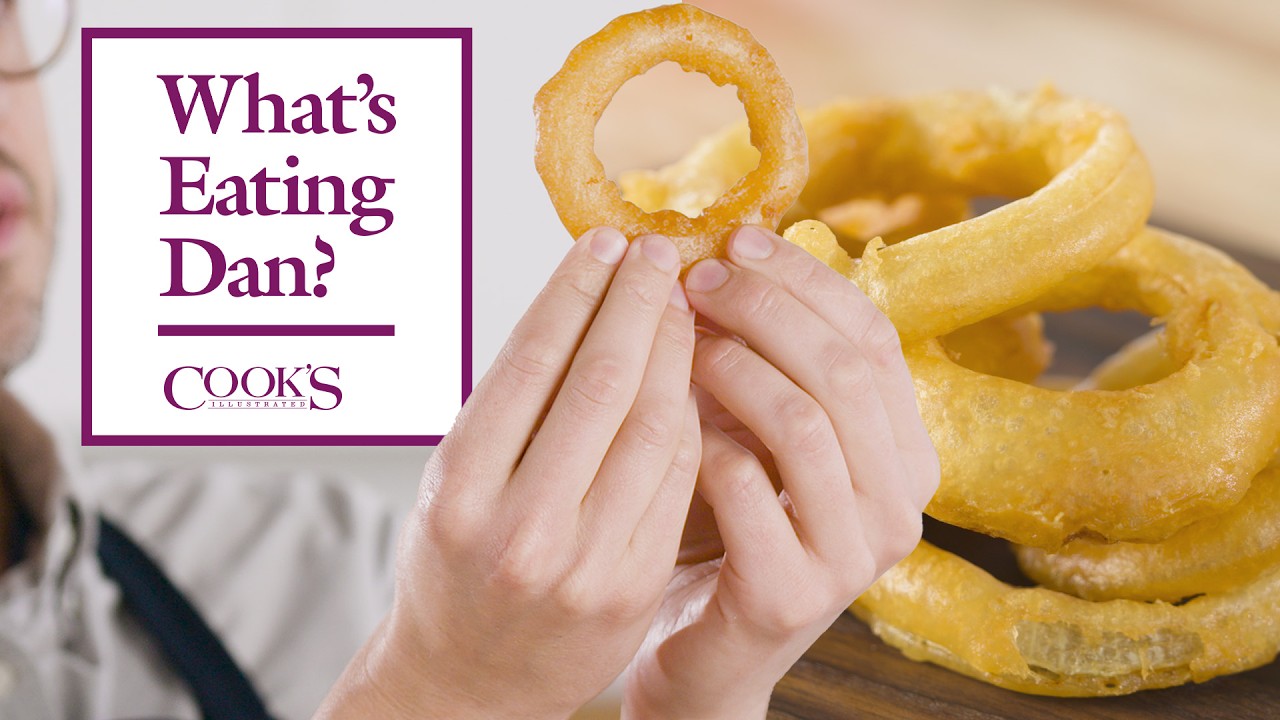
Dan shows you how to fry up delicately crisp, golden onion rings that run circles around restaurant versions.
Get our recipe for Beer-Battered Onion Rings: https://cooks.io/3NAGPvw
Learn more: https://cooks.io/3v4wrFL
Buy our winning Dutch oven: https://cooks.io/3DzBbCw
Buy our winning whisk: https://cooks.io/3QA6RPh
Buy the winning spider skimmer: https://cooks.io/3GNZoZg
Buy the ChefAlarm Thermometer: https://alnk.to/5Q3Vjou
Buy our winning measuring cup: https://cooks.io/486gTQn
Buy our winning chefs knife: https://cooks.io/3WZ7Kof
Buy our winning baking sheet: https://cooks.io/2OTFRd8
Buy our winning instant-read thermometer: https://cooks.io/3RT7nLo
Browse all WED content: https://cooks.io/3WUr8mf
Follow Dan on Instagram: https://www.instagram.com/testcook
Follow Dan on Twitter: https://twitter.com/testcook
ABOUT US: The mission of America’s Test Kitchen (ATK) is to empower and inspire confidence, community, and creativity in the kitchen. Founded in 1992, the company is the leading multimedia cooking resource serving millions of fans with TV shows (America’s Test Kitchen, Cook’s Country, and America’s Test Kitchen: The Next Generation), magazines (Cook’s Illustrated and Cook’s Country), cookbooks, a podcast (Proof), FAST channels, short-form video series, and the ATK All-Access subscription for digital content. Based in a state-of-the-art 15,000-square-foot test kitchen in Boston’s Seaport District, ATK has earned the trust of home cooks and culinary experts alike thanks to its one-of-a-kind processes and best-in-class techniques. Fifty full-time (admittedly very meticulous) test cooks, editors, and product testers spend their days tweaking every variable to find the very best recipes, equipment, ingredients, and techniques. Learn more at https://www.americastestkitchen.com/.
If you like us, follow us:
http://cooksillustrated.com
http://facebook.com/cooksillustrated
Tweets by TestKitchen
http://instagram.com/cooksillustrated
http://pinterest.com/testkitchen
– I’m the kind of guy who, when given the opportunity, will always substitute onion rings for French fries. And it’s not because onion rings are consistently better than French fries. Because let’s be honest, we know they aren’t. I’ve eaten so many disappointing rings over the years.
No, it’s because when an onion ring is great, it is sublime. So you can chase after the perfect onion ring all over town or you can try to make them right at home. Today, we are in pursuit of the ultimate onion ring. Let’s look at some ugly onion rings so we know what we don’t want. We have soggy, greasy rings, rings where the coating is falling off, specimens where the onion stays intact and only the coating comes off. Ugh, that one makes me shudder. There are rings where the coating has separated
And the onion inside is then burned. And there are countless other sad situations that I don’t need to scare you guys with. My perfect onion ring is batter fried, golden brown, and well-seasoned with rich onion flavor, it’s crispy on the outside with a tender ring on the inside.
To get there, we’ve got a lotta testing to do. First off, let’s start with the onions. You can make onion rings from any type of onion, but that doesn’t mean it won’t pay to be choosy. Many onion rings at restaurants are made with a sweet variety of onion, such as Vidalia.
That sweetness is a nice counterbalance to the savory crust. But it also comes at a price. And I don’t just mean more expensive, which the sweet ones usually are. I mean the cost of less oniony flavor. Check this out. This is how onions line up on a pungency scale.
We have our sweet guys, like Vidalia and Walla Walla, white onions, like those used extensively in Mexican cooking, red onions, which tend to be both sweet and relatively pungent, and finally, yellow or Spanish onions. Onion pungency is created when cell walls are damaged, and an enzyme called allinase catalyzes reactions
Between sulfur-containing compounds called thiosulfinates to produce volatile, flavorful new compounds. The more pungent varieties of onion contain more of those initial thiosulfinates due to both their genetics and the growing conditions. Varieties like Vidalia, on the other hand, are bred to develop much more sugar. And also, since they are grown in low-sulfur soils,
They develop less of the thiosulfinate compounds. So they taste both sweeter and less pungently oniony. Now, if you’re saying to yourself, “I don’t really notice that much difference among onions,” try each raw side by side. You’ll see a huge difference. Yellow onions pack a sharpness that will stick with you.
Now, if you were doing this onion side by side taste test on a date, which I highly recommend because it is a good time, don’t worry, because you’ll both have onion breath. So it’s not even like a thing. The cool thing is, we don’t really have to choose
Between the lovely, nice sweetness of a Vidalia and the real pungent richness of a yellow onion. Because we can season the onions directly. So we’ll choose yellow onions for their big flavor and add some balancing sweetness with confectioners’ sugar. Didn’t see that one coming huh?
The sugar’s super fine grind means it dissolves instantly and blends right in. But we can do even more. And by even more, I mean even more onion flavor. By reaching for our second unusual ingredient, onion powder. Dehydrated and dried forms of ingredients sometimes get a bad rap. But ignoring them means ignoring
An incredible source of flavor. Here’s an example. I have a recipe for a strawberry sauce that contains both freeze dried strawberries and fresh strawberries. The freeze dried strawberries absorb the water from the fresh strawberries and essentially double the intensity of the strawberry flavor, because they bring no water to the mix.
In our case today, I can also double down on onion flavor with just a few sprinkles of onion powder. Okay, are you thinking what I’m thinking? Let’s batter these up. Batters are fabulous for fried food because they contain everything that is needed for a perfect crust. Here’s what I mean.
For starches to form a crispy coating, a few things need to happen. The starch needs to hydrate, gel, and then dry out. Check out this experiment. I have a pot of oil at 350 degrees Fahrenheit. Watch what happens when I sprinkle in dry flour. It foams up and simply disperses into the oil.
Now look at what happens when I take flour that has been mixed with enough water to form a batter. You can see how the hydrated starch forms a gel when it gets exposed to heat. We get little clumps that stay together. As the water is driven out of that gel,
It leaves empty pockets in its wake. Once the water is gone, the starch hardens around that porous structure. And we get something that is crispy and delightful. Now, you can dredge onion rings in seasoned flour, but then you are relying solely on the moisture on the surface of the onions to hydrate it.
So what you end up with is a thin coating that is only vaguely crispy and often, there are patches of flour that never hydrate and they come off as dusty in your mouth. Boo to that. Boo to that? I wrote that? I am a diehard batter boy, but that still leaves lots of choices. Should you use flour, cornstarch? What about the liquid? Water, beer? You all know where this is going, right? Okay, say it with me. Check out this experiment. First off, let’s look at cornstarch versus all-purpose flour.
I’m gonna use water as my liquid for now. I have one batter that is 100% all-purpose flour and another that is 100% cornstarch. I have a third that is 50/50 cornstarch and flour. Now look what happens when I dip an onion in each. The cornstarch has almost zero cling.
As we increase the ratio of flour, we get better cling, which will lead to a thicker coating. Okay, let’s take a look and a bite. The all-flour one has a slight toughness, which is thanks to the gluten formed in the batter. The cornstarch batter contains no gluten, so it’s definitely not tough,
But it didn’t stick well at all. That being said, the little bits that actually stayed on the onion are super crispy. The 50/50 batch is nicer than either, but it’s still not perfect. After playing around with ratios, we find the sweet spot with two cups of all-purpose flour and three tablespoons of cornstarch.
The cornstarch limits the amount of gluten that can form, so the crust is never tough. And it increases crispiness, perfect. Next up, let’s test the liquid component. I’ll just come out and say it, beer batters are awesome. But like, why? We’re gonna look at water versus carbonated water versus beer.
This will help us figure out whether beer is great because it’s carbonated or beer is great because it contains things like proteins and sugars that you don’t find in seltzer or water. The water-only batter produces rings that are light in color and have the least amount of microbubbles in the crust.
And remember, the porous structure of the crust is what makes it shatter when we bite into it. The seltzer is loaded with bubbles, but it’s still pale. This suggests that having some carbonation in the batter is valuable, but not sufficient. The beer sample is also loaded with bubbles,
But has richer flavor and better browning than the seltzer sample. The color and flavor improvement is thanks to sugars and proteins in the beer undergoing the Maillard reactions in the hot oil. I would rank these in order of preference from favorite to least favorite as beer, seltzer, plain water.
Beer, man, it just wins every time. Okay, let’s put this all together. We whisk confectioners’ sugar, cornstarch, salt, and onion powder together. I’ll take a tablespoon of this to season our sliced onions. For the batter, we simply whisk together flour, baking powder, cornstarch, and the remaining sugar-onion powder mixture.
As it does in baking recipes, the baking powder here produces carbon dioxide that will expand small bubbles in the batter. And now, in goes our beer, which will provide us with those lovely small bubbles. Okay, time to fry. Now, deep frying can feel intimidating,
But it really is just all about nailing the temperature. We’re gonna go with 360 degrees here, which is a little bit lower than most onion ring recipes. This allows the rings to spend a bit more time cooking so that the onion inside fully softens. Why does that matter?
Because fully softened onion means you don’t end up with that dreaded onion pull. Ugh. Oh my god, look at these beauties. In my mind, these are the Platonic ideal. Super bubbly, crispy, golden crust, tons of great onion flavor, and a tender ring of sweet onion inside. These are, they’re, I mean, they’re like,
Whoa, I think for the first time in over 80 episodes, I think I’m actually speechless. Eat ’em plain, dip ’em in ketchup, or whip up this creamy jalapeno dip. Whatever you do, do you, and just do it. Because this is how to eat onion rings. Big thanks to “Cook’s Illustrated” deputy food editor,
Andrea Geary, for her incredible recipe for onion rings. Now, if you enjoyed this video, hit the Like and Subscribe buttons and that little bell icon. Now, if you didn’t like the video, hit Like and Subscribe and that little bell icon. So I wanna know: Do you share my passion for onion rings?
Do you prefer French fries? Do you always get both? I showed you what my ideal onion ring is, and now I wanna hear about yours. Let me know in the comments and I look forward to talking to you down under. Why did I do that? You can grab today’s recipes at CooksIllustrated.com/WhatsEatingDan,
Which is also linked below. Thanks for watching and see you next time.
37 Comments
Couldn't you get the same effect as beer by adding some sugar/starch to carbonated water?
Shirtless eating Funyuns in my underwear
Beer “Spotted Cow” IYKYK. If you wouldn’t drink it, don’t cook with it. Add “Chica Licka Bam Bam” seasoning to flour mix.
Thank you for this video. Fantastic.
Burger King's were #1
I liked and subscribed
Make great onion rings. She used Aunt Jemima pancake batter, but used more water to make it about the same consistency as yours. She passed away three years ago just short of her 102nd birthday. Thank you for your post.
Dan:
Presentation superb. AMTK brilliant production and content.
Thanks
Lorde this one's for you
Gutted there was no mention of removing the membrane between layers to keep the onion pull from happening
Not me watching this while eating onion rings from jack in the box 😂
what's eating dan is the best. More Dan please. he's the best
My mind went immediately to vodka or better yet everclear. Alcohol drives off faster than water, which is partly why beer lends to a great product. I'll have to experiment with an everclear/beer batter
Thank you Dan!
Both, always both.
All I'm saying is….Funyuns
Panko >>>
That was passionate yo
What I wouldn't give for an onion tasting date with Dan swoon Either way, I can't wait to try this!
agree…..the perfect onion ring is heaven!! 💯🏆⭐🥰
would using an unfiltered wheat beer provide any difference in taste to the batter vs something like a generic lager? You've also now made me wonder if adding cornstarch to pancake batter would help prevent gluten from forming and making pancakes that are tough… hmm…
There is something wrong with your mouth
Sadly, most pre-made battered or beer battered onion rings will unnecessarily have milk (whey) in them! I LOVE beer battered onion rings, so I always have to make them myself, but it is a lot of work. This recipe looks well worth it! I wonder how they reheat in the air fryer? If I'm going to do it, I'd do a big batch and freeze them for my future lazy self 😂
Marry me, Dan ❤
5:00 I think you're wrong here. You can limit gluten formation by 1) alcohol such as beer, 2) adding an oil, 3) minimizing mixing, 4) JUST USING SOMETHING BESIDES WHEAT FLOUR, such as rice flour.
5:35 beer has not only proteins and sugars but also taste such as malt. So guess what: there's malt powder we use in baking. Just a small amount (1% of flour weight) suffices to give you pizza dough that's just faintly beery. If you want more of that taste add malt powder.
6:20 You forgot to do a test: is there any point in putting the onions in this powder first? I detect zero difference–in fact I can't even get it to stick to my raw onion rings.
As far as fast-food onion rings: Culvers and Sonic have the best. Once upon a time [the 70's] Burger king had good rings. Now they are these foul, chopped processed onion mush encased in bread crumbs.
Anybody else have a favorite burger-joint recommendation?
I cook at 175C/350F. You don't even need 360F I don't think.
In my experiments, the main thing is to nail the amount of beer to the gram. Even a 3-4% difference in amount makes a difference between too runny/thin and too thick. That said, I get best results when it's really quite thick.
Mate, this video put you on the top of my food youtuber list. This video needed to happen and I'm glad you took it on. Love Onion Rings but this has more often than not been, like you, the quest towards a memory, or utopian ideal, of what an onion ring was, or perhaps never was but always should have been.I'm not even through the video but will restart and take notes. Fight the good fight buddy! Update: Yes.
I would like to eat a few onion rings off Dan's personal wooden rolling pin, if you know what I mean.
Sonic Drive-In used to use the same vanilla ice-cream liquid that they chilled into their soft serve ice cream as the primary liquid in their onion ring batter. Their onion rings were unbelievably good back then in the 1970s and 80s. They have since ruined their onion ring recipe into the yuck they sell now. But their onion rings made with ice cream in the batter were fantastic.
i never thought to add onion powder. diabolical genius…
I feel like this video is missing a much debated approach of whether to freeze the onion slices and then thaw them to remove the inner membrane from each slice to ensure you get a clean bite and the onion doesn't pull out. In the video they reference getting the temp right on the fry to prevent this, but I have not found that to be as effective as removing the membrane. What have others found?
Ingredients:
Powdered Sugar – 1 tbsp
Cornstarch, divided – 2tsp, 3 tbsp
Table salt – 1.5 tsp
Onion Powder – 1tsp
Yellow Onions, Lg – x2
APF – 2 cups
Baking Powder – 2 tsp
Lager or Beer of choice – 2 cups
Method:
– combine sugar, 2 teaspoons cornstarch, salt, and onion powder in small bowl.
– cut onions into 1/2” thick ring, discarding unusable small layers
– Put rings in bowl and sprinkle with 1 tablespoon of the confectioners' sugar
mixture we made, tossing to coat
– In another mixing bowl, whisk together the flour, baking powder, the 3 tablespoons cornstarch, and the unused 11⁄2 tablespoons confectioners' sugar mixture in medium bowl to combine. Whisk in the beer, and mix until it is like pancake batter with small lumps.
– coat onion rings and fry in 375º oil for ≈ 4 minutes.
There's nothing more disappointing than ordering onion rings expecting a beer batter only to find that the rings are breaded instead.