
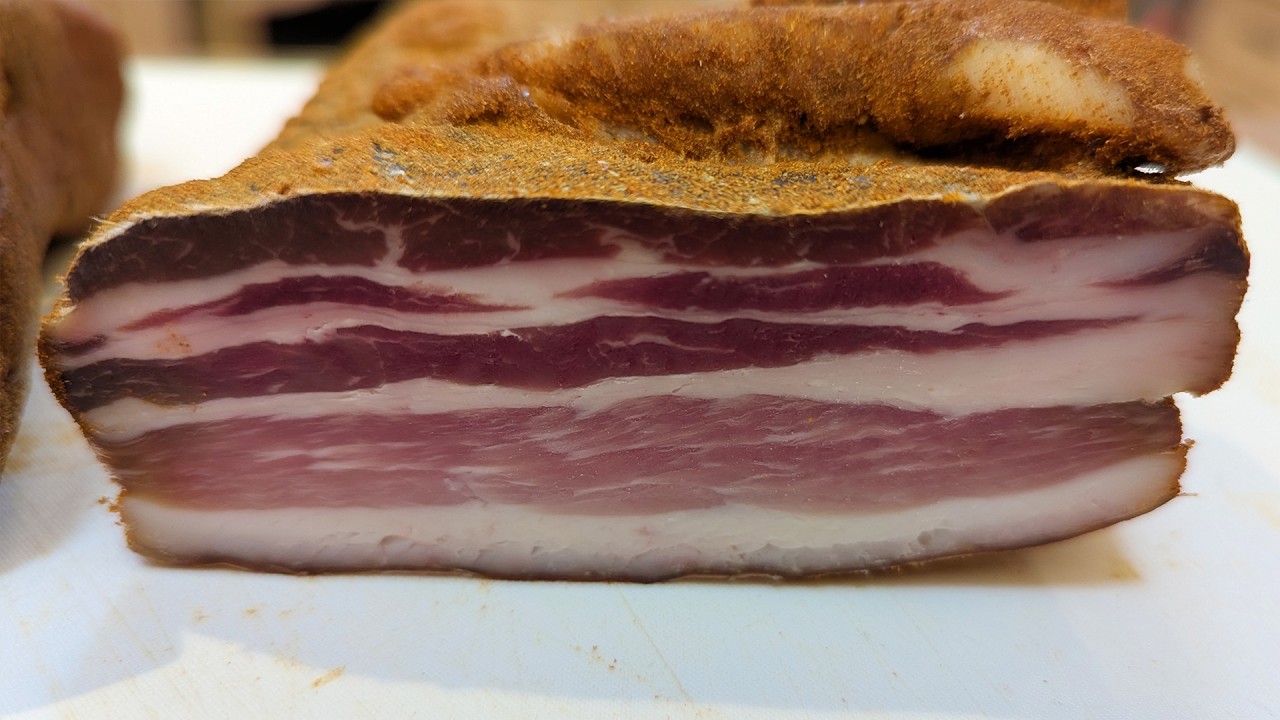
Pancetta is so easy to make right at home – really! This is our traditional family way to make pancetta from scratch. As we know, pancetta makes a fantastic addition to any sauce. It’s also great on pizzas and let’s not forget how great it is when fried with eggs. Besides, homemade is always best.
00:00 Intro
01:03 Salting the pork
03:31 16 hours later, curing the pancetta
06:54 Hanging the pancetta
08:30 5 weeks later, squeeze test
10:09 First look
10:36 Taste test
12:26 Vacuum seal
12:45 Outro
Making Pancetta from scratch – old fashioned way
Prep Time: 10 minutes + 16 hr. rest
Cure Time: 5 – 6 weeks
Makes: 3 lbs.
Ingredients
• 1 cup (290 grams) (10 oz) fine table salt or fine sea salt
• 1 pork belly, 3 lbs. (1.36 kg)
• Spices: Paprika, hot chili flakes, black pepper – use 1, 2 or all 3 spices, to taste
Process
• Put pork belly in a container and completely cover it in salt, all around. Place in fridge for 16 hours (15 hour minimum – 16 hours ideal, no longer)
• Remove from fridge and wash off all the salt. Pat the belly dry with paper towel
• Sprinkle spices all around the pork belly.
• Poke a small hole in one of the corners, leaving about 2 inches (5 cm) from the edge
• Run a string through the hole, enough to hang the pork belly, and then hang it in your cantina (cold room – fruit cellar) or in your fridge. Just make sure it hangs freely with nothing touching it. (optimal temperature range is 34 deg. F to 40 Deg. F) (1 C to 4 C) (optimal humidity range is 65 – 75%)
• Let hang anywhere from 5 – 6 weeks – when cured, it should be firm once you squeeze it
• With a brush, you can now remove any excess spices by brushing them off
• You can now slice and enjoy fresh or use for cooking. A good practice is to cut the pancetta into smaller sizes and then vacuum seal them (i.e. with a food saver type vacuum) for later use. Once vacuum sealed, they will last up to 2 years, best if stored in the fridge.
NOTE: The skin on the
My Kitchen Gear
Here are a few things I mentioned in the video. Please shop and support your local shops! If you cannot find them there, here are some links to help out.
“My Bread Book” by Jim Lahey
► USA https://amzn.to/2JLwbEe
► Canada https://amzn.to/3baKEF0
Lagostina Tuscan Collection Orange Oval Casserole Dish / Dutch Oven, 5 Quarts
► Canada https://amzn.to/3s0sU5a
► USA (similar) https://amzn.to/2XbpcYo
We are a participant in the Amazon Services LLC Associates Program, an affiliate advertising program designed to provide a means for us to earn fees by linking to Amazon.com and affiliated sites. The prices are not higher, this just makes it easier for you to find the product. Hope these links help.
Thank you!
Hello, everyone. My name is Ivo and welcome to Cooking with the Coias. You know, I have been fortunate enough to grow up in an Italian household. Both my parents were born and raised in Abruzzo, Italy, and in fact, my older brother was born in Italy as well. And then, like many others, they immigrated into Canada during the 50s. And with them, they brought all their traditions. And I grew up with these traditions. And today, folks, I want to share one of those traditions with you, because, after all, we want to keep those traditions going. Okay. So today I’m going to show you how we make power and chatter or in North America and chatter. But it’s fun chatter and it’s so easy to make. After this video, you’re going to say to yourself, my goodness, I didn’t realize it was that easy to make. I can do it. And yes, you can. And yes, it’s easy. Let me show you how we did it. So it starts off with a pork belly. And the last time, I mean, chatter, I ended up using almost the whole pork belly. Fortunately, they sell them now in pieces. So I have here a 3 pound piece of pork belly. And that’s that’s a nice size to make for pancetta and has the skin on the back and that’s perfectly fine. So I have here is some regular household table salt. Okay. So again, now some people might say, I use curing salts and I’m just sharing with you how we do it in our family. And I can tell you this, our pinch hitter has always turned out absolutely amazing. And we have never, ever, ever lost a punch. They go bad on us. It’s always been good. So please keep that in mind. There are other ways of of doing this. This is our way. Okay. So let’s take some salt. And you want to heavily salt this pork belly and you want to heavily salt it all around. Okay, so I have it in this held in this container and happens to be stainless, but you can use a plastic in a whole whatever, whatever container you have that’s going to hold your pork belly and all the stuff. So put it all around. And now someone asks, So how much salt do you use? Do you use a lot? So the reason I actually poured it in this one cup container is so that this time I’m actually measuring how much I’m going to use in one cup. You know what? Four, 3 pounds. That’s enough. So take the salt. Make sure it’s sitting on the salt. That’s it. Step one is done, folks. Step one is so easy and the next steps are just as easy. So all we have to do now is let this sit for 16 hours. That’s the key. Not longer, Not less. Well, you can go maybe as less as 15. But 16 is the key number. And at that point, we’re going to take it out of the salt and I’ll show you how. So let’s let this sit for 16 hours in a refrigerator or in my case, it’s going to go in my container, which is also known as a cold room or referred to as a fruit seller. It’s nice and cold in there. It’s going to sit there for 16 hours. And we’ll be right back at you. So our 16 hours are now up and our pork belly has been sitting patiently in that salt, just sitting and waiting. And that now needs to be rinsed off. We need to get all that salt rinsed off. And I want you to notice here, there’s a little bit of liquid in this pan, and that’s normal. There you go. So that’s why you need to put it in some sort of container that’s kind of leakproof. Okay. So with some cold water, very simply, we just want to rinse off all that salt because that salt has done its job. We don’t need any more salt. And in fact, that’s 16 hours, folks. Just a comment on that. That’s really, really key, because what happens is that’s enough time to help cure our pancetta, number one. And number two, it doesn’t make it overly salty. Sometimes if you let it sit in the salt for two too long, all you taste is salt when you cut into your pancetta. So that’s nice and clean. All the salt is removed. So give me a minute. I’m going to clean this tray right now. All right. And once you’ve got it, pat dry. Now, folks, it’s time to spice it. So paprika, chili pepper, black pepper. You could use all of them, or you could use one of them. If you don’t want it hot, don’t add the Chili Peppers. But I’m going to make this slightly hot. I’m going to add a little bit of chili. Just a bit. Okay. Just a bit of chili. I’m not going to add black pepper because I’ve been avoiding it lately, but I am going to use lots of paprika. Don’t be shy with the paprika. This is not smoky paprika. It’s just your regular sweet. You could use Spanish or Hungarian paprika. I mean, if you like the smoked flavor, by all means, use the smoked. But you can see I’m putting a good layer of paprika on because you want the spice on the outside. It’s going to it’s going to flavor and it’s also going to help cure. So those two things. And there we go. That looks pretty good. Me a little more here. Okay. How easy was that? All right. And now this, folks is ready to be hung up. Almost. We got to put a hole in it, so I’m going to take a knife and it’s going to poke a hole right through here. Okay. And then let’s take a string. You could use a string. You could put a hook through there. Whatever. Whatever you want to use to hang with. I’m just going to use a string if I can talk it through. Most. Okay. I’m just going to use a string. Right. This now, folks, is ready to be hung. So I see. I removed a little bit of fabric there. Okay. Let’s go hang up our pancetta. So here I am in my cantina. And let’s take our our pancetta, which is going to be pancetta. You take a closer look at it there. See how it’s all covered nicely with the with the paprika. And I did use a little bit a little bit of, as you saw there, chili peppers. Okay. So all we do now is we’re just going to hang that up. There we go. That’s about as hard as it gets, folks, right there. Now, a couple of things. If you don’t have a container, you can still make pancetta. You can use your refrigerator. Do exactly what we did now. Hang it up in your refrigerator. Just make sure that there’s nothing touching it. It has to be free all the way around, all the time so that you have the airflow oc the ideal temperature in your container right now, -40 degrees, ideally 34 to 39. That’s the ideal range. Humidity ideally between 65 and 75% with 70 B in prime. If it’s too low humidity, if you’ve got 30, 40% humidity, very dry, what happens is the outside gets dried and the inside doesn’t get a chance to dry. So humidity is very important. If it’s too humid, you’re going to create a lot of mold. So aim for that 65 to 75%. Keep it in that 34 to 40 degree Fahrenheit temperature range and that’s it. We just leave it now. Let it hang and let it cure. Here we are, January 19th. It’s been five weeks. And honestly, folks, after four weeks, it was ready. But the thing is, with our pancetta, you want to do what I call the squeeze test? Squeeze it here. It’s firm. In fact, it’s very firm. And in here it’s firm with just a little bit of resistance or a little bit of softness. I could feel just a slight bit. But here it’s like solid. And the reason is because they’re pancetta. If you look here, it’s much thicker here and it’s much thinner down here. So what happened? Is this part dried and was ready after four weeks, this kind of needed one more week. But basically it doesn’t matter because even if it’s hard and firm, it’s still perfectly fine. So let’s go take this now, slice into it and do the taste test. Let’s take a closer look at our beautiful pancetta, you know, in dialect. My and my mother would call this vente Alaska. That’s an average sage dialect. But there we go. Beautiful. Beautiful. Now, what I want to do is I used a lot of paprika, as you know, and I’m just going to brush off some of that excess. So I like to have it for the flavor, of course, and I like to have it on there while the French is curing. So now I don’t have to remove all of it, but I just remove the excess. So with the brush, just kind of simply remove the excess. Okay. And there we go. Nice and clean. Now, we don’t use any water because we don’t want to get it wet. Let’s cut into this right now and do the taste test. We can remove our string now. Okay. And I’m going to cut this right in half so you can get a really good look at this and chatter. Let’s give a good slice right through the middle. Wow. Take a look, folks. Take a look at that beautiful, beautiful home. Cured pancetta right there. Now we’re going to do the taste test. Always my favorite part, the taste test. Okay, let’s slice this up. Here’s a nice one right here. Let’s just take a nice. Right down to the. Isn’t not nice. I think that’s nice and thin. Beautiful. Now, if you find the outside to be a bit hard, you can just trim that little bit off. Right. Just like that. Absolutely amazing. Just the right amount of saltiness that salt cure that amount of time on under salt is key. That’s absolutely delicious. Now, I also want to show you. See the amount of fat there on the on the outside? Well, first of all, that’s fantastic for cooking. You want to make your sausage and soups, whatever you want to add that pancetta to it really elevate your dish to the next level. But if you’re going to eat it like I just did, you could easily just remove a little bit of that fat and enjoy it nice and fresh just the way it is. Folks, you saw how easy that was to make. You also saw how quick that was to make. Four weeks. Five weeks. You have fresh, homemade pancetta. Can’t beat that, folks. You really can’t. You’ve got to give it a try. And now what I’m going to do, I’m going to vacuum seal this. And that’s how I store my. And I just vacuum pack it. I leave it in the fridge or in the container. It can stay on the shelf. It’s good for one two years. Once it’s vacuum sealed, you’re good to go. And I like to vacuum the smaller pieces. That way I take out what I need when they need it. Hope you give this Italian tradition a try. I want to thank you for spending time with me on today’s episode of Cooking with the Coias. And as always, folks, until next time, buying a potato and enjoy some Italian tradition. Absolutely beautiful.
44 Comments
Whoever put them kitchen cabinets over your sink and countertop, so low should be put in jail
appetissant
Hola puede porfavor , poner traductor en español . Gracias
You lost me at Canada
16 hours in the fridge with what temp? Is it ok 2-4 C? Or temp must be higher?
da panceta sazrije potrebno je još koji mjesec kad bjeli dio postane rozi tad je zrela i ukus je fenomenalan i ne rasteže se kao žvaka
That's great I thought there was so much more to it. Thank you!
Thank you for sharing sir!
I will be trying this. I just have to figure out how to hand it in the fridge?
Looks like prosciutto.
Support from JAPAN!
Duuuude Canadian, WWWHHHYYY
Hi IVO love your channel I’m planing on making a speck ham over the weekend , how would you go about curing it , would you do a salt box cure ? And if so how long to leave in cure thank you
I monitored the time..mine took 6 weeks..i followed the 15 hour rule…it turned out amazing!!! Thank you!!!
Great video, eh. Going to try it!
Großartig!!!! Vielen Dank für das tolle Rezept und alles Gute aus Hamburg Germany ❤
This man has got carbonara for weeks now!
i am currently smoking a cured pork belly here in the netherlands! im curing mine with a ''wet cure'' salt, sugar and herbs and spices! in about an hour i will be drying it in my basement for a few week. we call it ''spek''
edit: im definetly going to try your recipe!
Hi Ivo. Great channel. I love that you are meticulous. I made pancetta and it is very good. I am a fellow Abbruzzese living in Ottawa but born in Roccamorice in the foothills of the Maiella mountain. My parents made prosciutto and pancetta. This brought back memories. Question for you. How long will the pancetta keep in a freezer bag in the fridge vs vacuum sealing system ? Thank you
Hello Ivo,
I tried this too. I am very happy! I followed the recipe and made a paprika and black pepper version.
I died it to about 35% weightloss in my dry ager (with adjusted settings), it took exacly 2 months (- 2 days).
They are now in a vacuumbag to equalize and rest some more, it will be a long wait 🙂🙂
The salt with your method was spot on, if you ask me!
Thanks for sharing and greeting from the Netherlands
Michael
So delicious 😋
as always great video, thanks for sharing
Can I use flake salt?
Its easy hes Italian and Canadian i sub ❤✌️
Wow!… like you said, so easy to make. Just hope that I can find the right conditions to properly age it, as, unfortunately, all that most people have is a refrigerator that is Not conducive to hanging a pork belly.
Just did mine for the first time. Hung up in the fridge, now the wait!
Can I use a dehydrator to cut the time down hanging?
I used your recipe and when I tell you it’s delicious, that’s an understatement. My husband and I are enjoying some with some cheese at this very moment. I vacuum sealed it in smaller portions. Thanks for this easy and fool proof recipe 👌🏻👌🏻👌🏻
You can also slice it on the bias (diagonal) to have wider slices,
Can you cold smoke the pancetta
i agree regular salt is all you need, its been used for thousand of years and everyone was just fine….i wouldnt mine the curing salt per say its just not needed and the cancer risk,,, just good old salt
the true italian man cure meat while wearing his wedding ring! =P lol
When is the best time to coid smoke the pancetta can you fry it like bacon i think your channel is brilliant
I have just cured a pork tender loin how long will it keeping the fridge please
Can I dry my pancetta in a food dehydrator
Delicious. My cholesterol is happy 😊. I’m northern Italian and do it slightly different.
Great Tutorial. Problem How to keep 60% humidity in my refrigerator???
I'm going to try making Pancetta with beef belly as i'm a Muslim but wanting to have the halal pancetta.
I’ve put a pan of water in the fridge but I’m only getting 50% humidity… Will it fail? Any tips on increasing it?
After a week in the fridge, my pork belly is almost hard already. It's an old fridge in the basement, so I have no idea the exact temp. Do I just need to be patient, or is there a way to know for sure? Many thanks for the video!!!
Hello, can this be made without the skin?
I thought pancetta had to be cooked after curing like bacon?
So awesome! Homemade pancetta is a lot less complicated than I had imagined. I do have two questions, if you don't mind:
the description cuts off here "Once vacuum sealed, they will last up to 2 years, best if stored in the fridge.
NOTE: The skin on the "
And my "must follow the written instructions!!" OCD is insisting that I ask: what skin? Is this important?
And 2: does it matter if you have more than 3lb of pork belly? I'm guessing not, but again my OCD is bugging me to ask. Thanks!
A hundred ways to prepare this affirms you can't screw up bacon.