
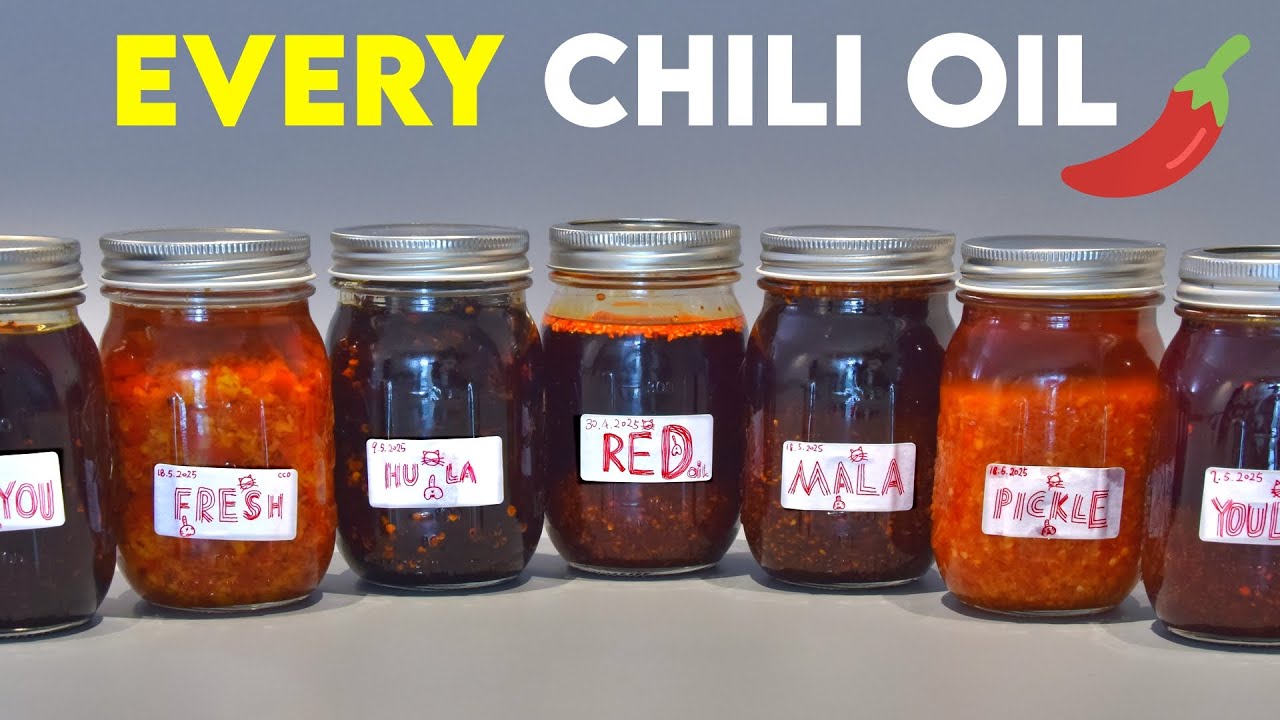
There’s not just one Sichuan Chili oil! In this video, we’ll teach you the diversity of chili oils that are employed in a Sichuan restaurant context.
0:00 – Why bother with great chili oil?
2:26 – How to make Sichuan chili oil OUTSIDE Sichuan
9:40 – Red Oil
15:50 – Mala Oil
19:20 – Homestyle Chili Oil
22:05 – Old Oil
25:37 – Scorched Chili Oil
27:45 – Pickled Chili Oil
30:37 – Fresh Chili Oil
33:07 – Seasoned Chili Oils
FULL, WRITTEN RECIPES
… are in the Substack! Free as always, if it had to be said:
https://chinesecookingdemystified.substack.com/p/sichuan-food-like-the-restaurants
______
And check out our Patreon if you’d like to support the project!
https://www.patreon.com/ChineseCookingDemystified
Outro Music: คิดถึงคุณจัง by ธานินทร์ อินทรเทพ
Found via My Analog Journal (great channel): https://www.youtube.com/watch?v=GHaL5H-VYRg&t=896s
So French cuisine it has its mother sauces, and
Sichuan cuisine it has… chili oils. They’re in the dipping sauces, they’re the base of a most
of their cold salads, they’re used as a finishing oil, as instant stir fry base, and can really be
seen everywhere from noodles to soups to noodle in soup. But something you might not know is
that there’s not just one Sichuan chili oil, there’s more than one, and today what we
wanted to do was teach you all of them. But I guess before we do that, I should be
upfront that a lot like Escoffier’s mother sauces, some of these are definitely more of a restaurant
thing. Like… just like how of these six you probably only make a bechamel, a Sichuan home cook
would likely only make one of these, maybe two, or I mean equally just buy some from
their local market. So some of these, they can get a little intense and maybe they
might not make sense in the end for your kitchen, but the reason to at least try is that really,
if you use one of these very good homemade chili oils, especially combined with some very good
homemade Chinese stock… you will make the best Sichuan food you’ve ever cooked in your life.
Like… together with this, we penned a bunch of written recipes for how you can use them of all
up, and testing those I was frankly blown away again and again by the sheer quality of food
that was coming out of my wok. And because most of these also keep really quite well, if you
love Sichuan food, I think it’s worth exploring. So, in this video, we’ll cover – first, the basic materials and how to source proper
ingredients for this internationally… because, a wild stab in the dark, I’m gunna guess that
you probably don’t exactly live in Chengdu. Then, we’ll show you seven oils: six seen in a
restaurant setting, and one little jog to show you how a homecook might make theirs. For each
one, we’ll teach you the basics of how its used, and then finally finish it all with how they can
be seasoned and combined to form dips and sauces. Now… the core of any chili oil is, chilis and oil.
Like historical recipes for chili oil in Sichuan, a lot of them are basically chili flakes, oil,
and… that’s pretty much it. Nowadays you see a lot of aromatics in the mix, spices in the
mix… but if your chilis aren’t delicious, if your oil isn’t delicious, it’s
not going to be a good chili oil. Now for the peppers, a lot of Sichuan
chefs lean on a blend. Generally speaking, this is gunna be Zidantou bullet chili for
fragrance, Erjingtiao two vixen chili for color, and Xiaomila millet chili for heat. These three
are local cultivars that’re really quite difficult to find outside of China, but that’s okay.
You don’t need this specific chili pepper, you need to understand the logic of why it was
selected – so let’s start with ‘fragrance’. Now ‘fragrant’ I think can be kind of abstract
in English, and in American English is often associated with subtle flavors, the sort that you
find in wine, fine dining, that kind of thing. So like, pop quiz – is this chili pepper a
‘fragrant’ one? What about this one? If you’re not sure, if ‘chili fragrance’ is something a
little confusing to you.. smell is obviously connected to taste, so think in terms of taste.
At the base of your chili oil, you want the best tasting, best quality dried red chili that
you have available to you – this will be your workhorse chili pepper. Ideally, your dried chili
should be fresh enough that it’s still somewhat pliable. For me, personally, I really like using
the aforementioned Erjingtiao Two Vixen chili – I think that it’s a great chili, and when we lived
in Thailand, we’d actually ship batches down to Bangkok. Now, that’s obviously not exactly not
feasible when I’m in the USA, but that’s also okay because America has access to some fantastic
chilis in the form of Mexican peppers. You don’t need to import from the other side of the world,
Guajillo is an excellent chili and I think it works perfectly great for Sichuan food. And while
I’ve never been to Europe, the same logic applies – maybe it’s from Hungary, or Turkey, or Korea,
or Calabria… start with quality. Some of these chilis might be milder than Sichuan chilis, but
that’s also completely fine, you can compensate. Because… making a chili oil spicier,
it really isn’t rocket science. You cut your blend with enough of a spicy chili
to get the oil up to your personal tolerance level – the oil should be spicy enough to be
uncomfortable if you ate it directly with a spoon. Sichuan chefs use Xiaomila millet chili
for this function, and that’s what we’ll use today as well. In Thailand, I would
use Dried Thai Bird’s eye, in the US, I might reach for something like this… but like,
I dunno… worst comes to worst, they do sell dried Carolina Reapers online, you can make this work.
Your quality demands will be much, much lower here than with your workhorse chili – just don’t
be gross and add something like an extract. And then… for color? It’s also not rocket science.
There are certain cultivars of chili out there that are extremely extremely red, some of them
practically neon. Often, these ones tend to be pretty mild… you maybe can think of something like
a Korean gochugaru. In Sichuan they’re spoiled, they actually use Erjingtiao for this function…
for ease of internation replication… today we’re using a Kashmiri chili from Xinjiang. In
Thailand, what I’d do is use something that they call big chili, it’s the stuff that makes
their Nam Prik Pao chili jam… and in the US, I like gochugaru. For this function, you might even
get away with using a good quality sweet paprika, just don’t be gross and use food coloring.
Which then brings us to the oil. Now in Sichuan for a good chili oil there is no
choice but… caiziyou – an unprocessed, expeller pressed rapeseed oil made from a
Chinese cultivar called semi-winter rape. The oil has a number of advantages – first, it’s
not a processed neutral oil, the stuff actually tastes really good; second, it’s still liquid
at room temperature, but third, at the same time it’s also quite viscous. The thickness of it
is perfect for cold dishes and other applications where you really want the oil to cling to
both the ingredient and, also, your mouth. Unfortunately however, Caiziyou is infamously
brutally difficult to find outside of China, even if you’re in Vancouver. So internationally,
the very best substitute would be an Indian Mustard Seed oil. When buying, in the US, that
oil is sold with the label ‘for external use only’… it’s a long story, the FDA slapped it on
because of “health concerns” from back in the 50s, so… don’t narc on your Indian grocer, if anyone
asks it’s all for your traditional Bengali massage. Besides that, at Chinese grocers
in the west you can often find something like this – this an unprocessed peanut oil, it’s
common in Cantonese cooking, smells like peanuts, tastes great, the flavor really works
with chili but it unfortunately doesn’t have that same caiziyou thickness.
So… because of that, for this video something that we also tried testing, and surprisingly
really worked, was the thick unprocessed oil that is traditional to the west: we tried this bottle
of olive. my nose and brain was really confused when making it, but interestingly it does actually
work in the end. I should emphasize though that olive would not be appropriate as a general
Sichuan cooking oil – this only works because we’re getting it up past smoke point,
infusing it with these really strong flavors, and importantly – importantly – letting that sit
for at least overnight, which we’ll get to later. So scout out your specialty grocers, see what’s online, and make your selections.
And then now, let’s make some chili oil. Hongyou First up, the mainstay, the classic – hongyou,
red Sichuan chili oil. Our mix today was 60 grams erjingtiao chili as our workhorse, 10 grams
xiaomila millet chili for heat, and 30 grams of Xinjiang Kashmiri chili. Our Xinjiang today is in
powder form, it’s not ideal but it will be okay, and it gives us a chance to show you how to handle
powders a bit later on. But… the erjingtiao and the spicy chili we’ll first snip into sections,
and of course toss the stems. Then, in a wok, over a medium-low flame add in about a tablespoon of
oil and begin to fry your dried chilis. How long this will take will depend on how fresh your dried
chilis are – what you’re looking for is for the chilis to’ve deepened in color, and feel obviously
hard and solid if you poured them against something like a spider. To get to that point, for
me today, this was about four minutes of frying. Then just jiggle out some of the excess
seeds, let the chilis cool down a touch and then transfer over to a mortar. We’ll then pound
this into a fine flake – you can use a blender or food processor for this if you want, but I
personally prefer the mortar. Because sometimes with processors, the rapidity of the movement of
the blades can risk continuing to cook the chili past done, so be careful not to overdo
it if going that route. But either way, once you’re looking at a flake that’s roughly the
same size as a sesame seed, remove and reserve. Then, aromatics. Now we should say again that not
all cooks reach for these, and historically less so, but today we’ll be infusing practically
all of our chili oils with a half an onion, finely sliced; 2-3 inches of ginger, good and
smashed, and 5 scallions, roughly sliced. For the spices then, again, also optional so really
any of these that you can’t find just skip them. Ours was two star anise, one tablespoon Sichuan
peppercorn, three dried bay leaves, one peeled Chinese black cardamom, 3 slices sand ginger, a
third a cinnamon stick, and a half teaspoon fennel seed. Wet it with a little baijiu liquor or vodka
to avoid scorching, and now we can make our oil. So. To a wok or pot toss in two cups of caiziyou
or whatever your delicious oil of choice was. Then, add in the aromatics and swap your flame
to medium/medium high. Let the aromatics fry and infuse into the oil, and after about ten minutes
of that, add in your spice mix. Once your onion is beginning to get nice and golden brown, about
five to eight minutes more… strain, and of course press that all really well to get every last drop.
Then, add a tablespoon half of sesame seeds in with your chili flake, and heat your strained
flavored oil up until it’s beginning to smoke, or about 190 celcius. Then just shut off the heat,
and the scoop about a third of a cup of oil from the wok into the flake, and mix that well. At
this point, we can add our colorful powder in, reason being that with very hot oils
fine powders sometimes kinda like to scorch on you. Then wait until the oil
hits about 150-ish, and half of it in, stirring well. And then finally, wait until it
cools down to about 80C, mix that in, and cover. This three stage process is sometimes referred to
as ‘yi xiang, er hong, san la’, and in my opinion the primary benefit of it is that the very hot 190
degree oil really can bring out the fragrance of the chili… but you do have to be super careful
with the quantity and stir immediately, so that things don’t scorch. Then as to why then 150, then
80, uh… frankly I don’t have a fantastic mental model for you… but this all has been a little bit
of work already, and the move seems to work, and I’m personally a believer that if the tradition’s
not broke there’s no need to overthink it. But either way then this oil will need to sit,
covered for at least 24 hours and up to 48 before you use it. Because at first if you taste it
it might taste a touch scorched, don’t panic, check back on it the next day. For whatever reason
time seems to really paper over and mellow out any bitter notes these oils have. And so after that
time you can jar it up, and then this jar should last you about three months – just be really
careful not to get any drops of water inside, and storing in the fridge can also help.
Now as to how to use the stuff, the question might be a little more how you can’t use it
– I mean, you see it in liangban cold dishes, noodle dishes, wontons, soaked dishes like
boboji, again, even as a finishing oil for a stir fry. So I think this one is pretty
self explanatory, just find some Sichuan recipes online that you want to make and then
use the thing. If you do happen to be stuck, we will also have a little Sichuan cold dish formula
for you down though in the linked Substack post. But when you’re using it, you will have
two options – just chili oil or chili oil with sediment. The way I learned this
was that if you were just using the oil it was called ‘hongyou’ or ‘red oil’ and that
if you included the chili sediment it was called ‘youlazi’ or ‘cooked oil chili’.
I’ve since learned that I was wrong, linguistically in Sichuan dialect it’s not that
clear, people use both words to refer to both, and youlazi’s maybe just a little more
colloquial. But the framework I think can still be helpful. I personally associate the
sediment a lot with things like street food, homecooking… and if you use just the oil,
it’s going to be a little more smooth, a little less spicy, a little more elegant.
Now if you’ll notice, our previous chili oil didn’t really include Sichuan peppercorns.
Like, it did a little bit in the spice mix, but it was just to infuse a little floralness…
definitely would not be enough to constitute one of the most famous flavors around the world
for Sichuan cuisine: Mala, or numbing spicy. So… to incorporate Sichuan peppercorn in
a chili oil you have a couple options. One route is just to deep fry a whole
bunch of peppercorns in the oil, and then keep them in said the chili
oil to continue to infuse over time. And that’s probably what I personally prefer,
but downside of that approach is that if you’re using the sediment of the oil it is going to
have a bunch of whole Sichuan peppercorns in it… and given that ‘surprise Sichuan peppercorn’
is probably one of the most common food related complaints among expats and travelers
to China, today we decided on powder. And so to make some, we’ll first toast a
mix of red and green Sichuan peppercorn, 12 grams red for flavor, 8 grams green for
numbing… and just use all red if you can’t get green. Then just toast those in a dry wok
over a medium-low flame for about three minutes, or until the peppercorns can leave little
oil splotches on the side of the wok. Then, we’ll pound those in our mortar… again, you
can totally use a spice grinder for this, I just personally like to keep
mine a little on the coarse side. Then for the chilis, we’ll also adjust our mix.
We’ll cut the Xinjiang chili, and instead use 70 grams of our workhorse erjingtiao and 30 grams
of our spicy xiaomila. Fry them just like before, pound or grind them just like before, and then
infuse two cups oil with aromatics and spices just like before. But then, after you strain,
add about a half shot of baijiu liquor or vodka in with the Sichuan pepper powder to wet it well
– this helps prevent the powder from scorching. Then just do the same move – 1/3 of a cup of
smoking hot oil, mixed very well… and then after that you can transfer the Sichuan pepper.
Then again, do half the oil at 150, the remaining at 80… and then cover and wait at least 24 hours.
The end result after that time should be an oil that’s very spicy and very numbing. Now for me,
personally, I usually wouldn’t make something like this at home because personally I prefer
controlling the chili oil and the numbingness separately. For me, I would rather have a
batch of red oil that can be used across a number of different flavors and then toast
and grind Sichuan peppercorn for when I want something Mala. But this oil can undeniably
be extremely useful in a restaurant context, as if you have a lot of Mala dishes, it’s
much easier to reach for a Mala chili oil. One of the most obvious examples might be
something like Malatang, which is a concept you see across China these days. What you do is
you grab whatever ingredients you want, they’ll cook it in a thin soup, season, and top with
this kind of Mala chili oil. In Sichuan proper, at the liangban cold dish stands they’ll
often have two oils that they reach for, blending a red chili oil with a mala chili oil to
arrive at the spicy level that the customer wants. So… this brings us to what would
actually be different if this you were looking at something produced by a Sichuan
family instead of a Sichuan restaurant. Now first, a family probably isn’t going to be
frying and grinding their own chilis – instead, getting flakes from the market is often the
move. But before you throw that previous recipe in the dustbin, you do need to understand
that chili flakes at a Sichuan market are going to be much fresher, much higher quality than
that random bag that’s been sitting on your supermarket shelf for months. At some markets
in Southwest China they even have these really cool steampunk-looking contraptions and the
chilis are literally pounded right there in front of you. And further, most shops also tend
to have different chili flakes with different profiles from different cultivars, and then
people mix and match to their own tastes. So if you have something similar where
you live, starting with flakes is a no brainer. But in my personal experience…
and this isn’t shade on western food, there’s some great ingredients in North
America too… but supermarket available chili flakes for me at least, don’t get me
where I want to go. So I would personally still recommend frying and grinding
that workhorse pepper at the very least. Then second, while different families are
different, usually you see a much more limited selection of aromatics and spices than
you do in profession kitchens – reason being that home kitchens are usually affording much better
caiziyou than they use outside. Restaurant oil in China tends to be a lower grade than what’s
at the supermarket, and some restaurants also cut their caiziyou with a cheap neutral or
even just use a cheap neutral straight up. And the less flavorful your oil is, the heavier
with aromatics and spices you’ll want to go. So especially if you can source
Caiziyou or Indian Mustard Seed oil, I think you can feel to totally free cut back.
In this batch my infusion was with one dacong, English name Welsh Onion, and three inches
of ginger… together with solely a tablespoon of red Sichuan peppercorn spice wise. But if you
were working off of a peanut oil, or an olive oil, or a neutral oil… I would personally still
recommend the full spate to help compensate. But either way, sizzle over a bit at 190, half at 150, and the remainder at a
cool 80, cover, and then… jar it up. Laoyou So. Now we’ve got the four chili oils that
really are more of a restaurant thing, but the most common among them
is probably laoyou, or old oil. The name’s likely derived
from laoyou huoguo, that is, Chongqing hotpot, and they do share a number of
similarities. Laoyou can be a little simpler, but the primary difference with a hotpot base
is that this one is unseasoned and it uses caiziyou instead of beef tallow. The stuff
is sometimes called ‘hot dish’ chili oil, because it can be used as an instant
base to start off various stir-fries. And like hotpot base, instead of chili powder
it does start with a product called ciba or pounded chili. This stuff is made by soaking
60 grams of your workhorse chili in with hot, boiled water for 45 minutes… and cut that with
a spicy chili if you wanted something spicier. Then after that time, you’ll
strain well, add it to a mortar, and I personally like to unconventionally also
add a ¼ tsp of salt and a clove of garlic to help the chilis break down and emulsify.
Not standard practice, full disclosure, and you can also use a food processor here… but
either way, you’re looking for something pasty. Then, in addition to using pounded chili paste,
the other big similarity is that this is also using two tablespoons of douchi, Chinese fermented
black soybeans, minced, soaked with a little liquor… and a quarter cup of Pixian doubanjiang,
Sichuan chili bean paste, also minced. The aromatics we did opt for a bit of a fuller
mix for this one, including a large stalk of Chinese celery and two cilantros as well. We
just enjoy those with this specific flavor, but they’re both optional and can also be added
to the other oils if you wanted. Then spices in same at before, another ten minutes, and because
those leafy herbs do like to drink a little oil, I’ll supplement this with two extra tablespoons of
caiziyou. Then, add the ciba chili paste into the oil, and begin to slowly fry that over a medium
low flame. We’re looking for the chili to expel its moisture, stain the oil, and morph into a
lighter almost orange hue. This will take a bit, about fifteen minutes… but once it’s at that
point, strain and reserve. Then add in the minced Pixian doubanjiang, and over a low
flame begin to fry that until that’s dry. After three minutes or so, go in with the minced
douchi, and once the liquor there has evaporated, roughly two minutes more, shut off the heat.
Return the fried chili back to the wok, mix well, and then let that all come back down to room
temperature. Transfer, and then let it sit. Now, because this stuff is already saltier, in a
restaurant context, it can function as sort of an ‘instant’ stir fry or soup base. For the size of a
normal dish you could start the thing with about a tablespoon, tablespoon half of the oil together
with all the chunky bits… and optionally finish with a touch of the oil sans sediment. Dishes that
would be appropriate for this kind of treatment might be stuff like Jiachang Tofu, Twice Cooked
Pork, and maybe even some varieties of Mapo Tofu. Then the last three, same category – that
is tasty ways you can streamline stuff in a commercial setting. These three
are a little less common than laoyou, but they can be useful and they
unquestionably are also quite delicious. Hu Lajiao So this one, hulajiaoyou, it can be a chili oil
but also as common can be just chili sans oil, in which case they’ll be called ‘hulake’.
The named literally means ‘burn chili’, and what they are are chilis deep fried to
a very deep borderline scorched state. You might not guess it but they are really quite
aromatic and they can then be sprinkled into dishes like Kung Pao chicken which is
probably its most famous application. You can also, however, see it in an oil form…
which can help give things a little depth. To make it, we’ll first infuse things with aromatics
and spices like always, though with this one it’s especially optional, and then after straining
get the oil up to 130C. Then add in 60 grams of your workhorse chili cut into half inch sections,
and then deep fry that for about seven minutes, or until the chili get to a deep chestnut color
like so. Then strain, set aside, and add 10 grams of red Sichuan peppercorns soaked in a bit
of liquor. Once all the moisture’s expelled, about two minutes, ladle those back over
the chilis… and then let those soak. This will be used in the Hula flavor profile
in Sichuan cooking – Kung Pao, to reiterate, the most famous but you can also see it
in things like Huajiao Pork and various qiang dishes. To execute this flavor, at
home we should be clear that most people just start their stir fry by shallow frying
those chilis, removing, then you can add them back later on. In restaurants, pre-prepared
Hulake I think would generally be the move, but using come of this oil in my opinion can help
add back a bit of the missing flavor. So if you’ve got this stuff, you can start your Kung Pao
with aromatics in a little less oil than usual, and then add your scorched chilis together with
a couple of the Sichuan peppers and about a tablespoon of that oil… and optionally
use some more of said oil to finish. Paojiaoyou Next, pickled chili oil. Now we’ll also have
to be upfront here that for this recipe, straight out of the tin, um… the sourcing
might be borderline impossible. Because this will rely on Chinese fermented chilis, but
not a can like this one… they’re both fermented but these Sichuan sort are very very sour. We’ll
be using two types – one a not spicy large sort, and one a very spicy small pickled Heaven facing.
You might be able to find the latter at a Chinese supermarket, but the former – I don’t think is
available internationally. You might be able to play around with vinegar pickled chilis,
or maybe Korean ones… it’s a tough source. But we’ll take 280 grams large pickled chilis,
slice them open… they will have a lot of moisture so we’ll quickly give them a strain. We’re
looking for about 140 grams after straining. Slice off the stem of the spicy pickled chili,
80 grams worth, and then also chop up 60 grams of pickled ginger. At this point, we’ll finely
mince this all together until it’s super pasty, which will take a hot second so do be patient,
and again food processor’s fine if you’ve got one. But either way, once you’re looking at
something a bit like this, set it aside. We’ll then infuse our oil with onion, scallion,
and ginger, same as before… but with this oil we’ll lower the quantity to a cup and a half
and for the spices we wanted also to keep things a little on the light and fresh side…
simplifying to this mix. Then strain that all, and add in the pickled chili paste. Swap the flame
to medium high and slowly fry until the pickled chili turns an orange-ish hue, and it looks
closer to ‘cooked’ chili than ‘fresh’ chili, or about 8 to 10 minutes. Then just
shut off the heat, and reserve. Now in a restaurant context, you could think
of this as almost like a style of laoyou – some recipes even include a little chili bean
paste, which is also an option for you. It’ll be an instant start to dishes that make
heavy use of pickled chilis like Paojiao kidney and various fish fragrant dishes – you start off
with the oil, aromatics, maybe a little extra pickled chili to hit a couple different levels.
The oil is excellent with tomato, you can also use it in noodles, and pickled chili rice noodle pot
is also a thing. For that dish specifically, you can see the usefulness… this oil takes what would
usually need a good five minutes at the start or the recipe, to something practically instant –
and full recipe, again, down in the Substack. Now, all of the previous chili oils used dried
chili, or I guess otherwise preserved chilis, which is the most common way that you see the
chili pepper employed in Sichuan cuisine. This chili oil uses fresh: a comparative rarity,
specific to the ‘salt gang’ cuisine of Zigong and its environs – most famously Xianjiao rabbit
or beef, and to a lesser extent beef noodles. Now this will be based off of 140 grams of a
fresh spicy chili – this was Chinese heaven facing chili, you could also use Thai bird’s
eye… minced together with 60 grams worth of ginger. You don’t need to get this as fine as the
pickled chili, something like this is perfect. Then, we’ll separately mince 80 grams of
young ginger – which I know is hard to find abroad – two possible alternative routes
below… and then set both of those aside. And then we’ll infuse the oil just like the
pickled chili oil, also the same spice mix too as said oil. Then strain, and add in the
young ginger and swap the flame to medium-high. Once that young ginger has released the
bulk of its aggressive-sounding moisture, about 90 seconds, add in the chili-ginger-ginger
mixture. You’ll be looking, again, for the chili to have released a good bit of its moisture
and turn a light red ‘cooked chili’ hue, which’ll likely take about eight to ten
minutes. Then, set that aside, jar it up. That said, important bit that unlike our other
chili oils, this one can not keep. It has fresh ingredients, and even though we fried it all,
fresh aromatics in an anaerobic environment is still beginning to play a little with fire. Keep
this one in the fridge next to the pickled chili oil – I personally wouldn’t go past two weeks
with it. We’ll link a recipe to the super famous xianjiao rabbit, but if you’re looking for a quick
way to use it all it… we’ve personally enjoyed it as a topping for mixed rice noodles. To whip
something like that up, grab about a tablespoon half of the fresh chili oil, mix it with half
tablespoon soy sauce, ¼ tsp salt, ¼ tsp sugar, 1/8 tsp MSG, and a teaspoon of oyster sauce. Chop
up some scallion and cilantro, and mix it all with cooked rice noodles – or even noodle noodles.
So then… That’s it. Seven base chili oils. Now we did promise you all the Sichuan chilis
oils, so… I think it would be natural to ask about products like this. You can find this
brand almost everywhere in China, and I think internationally too, it’s made in Sichuan, and
there’s even similar international products like Fly By Jing. Now, while we don’t have a time
machine, we would hazard that these sorts of bottles are somewhat newer entrances to the market
– I would guess that they might’ve been inspired by the breakout popularity of Lao Gan Ma from
neighboring Guizhou. These are seasoned chili oils, no further adjustment mandatory, which of
course can very convenient for modern homecooks. We consider something like this to be a
derivate product of our base chili oils. To make something like it using one is really
not too difficult – take your chili oil, and add some salt, MSG, little bit of sugar
and that is more than good enough to top over your fried egg. If you want that food industry
flavor, could also add a little garlic powder, maybe a little chicken powder for its I+G.
This specific product also has some crunchy fried peanuts and soybeans in it, which’s
often a common move in this kind of bottle… so feel free to add in anything crunchy
that you like… get weird, get local, add some corn nuts and chicharrón, maybe
some of the previous fried onions? Why not. Or, alternatively, you might also
find some products a little like this, lineage of which is a little clearer. This
seems obviously derived from Sichuan’s famed douhua dipping sauces, many of which in turn
can also be derived from these base chili oils.
41 Comments
Hey guys, unfortunately we're sort of rushing out the door (got some stuff to sort over in Guangdong, train's in an hour!), so I'll have to scribble some notes down later on 🙂 There were a couple things that we didn't touch on in this video (e.g. hotpot base – perhaps this should also count as a chili oil?) that we go into perhaps excruciating detail about in the Substack post. So do check it out if you're curious: https://chinesecookingdemystified.substack.com/p/sichuan-food-like-the-restaurants
Wow, as always great content! Thank you very much!
If replacing the chinese chilis with mexican or others as presented in the first part of the video what is the amount for these chilis to be used following your recipies? Is it a one to one ratio?
just when I overcame my crippling addiction to chili oil, you drop this on me. whelp, looks like it's time to seriously fall off the wagon, boys. 2 year bender here we go, my wife sure will love the fridge stuffed with jars
It's really common to find unprocessed and thick rapeseed oil here in the UK. It's got loads of flavour, and although I've probably never tasted the legitimate caiziyou (maybe except at the excellent Sichuan restaurant where I live), I can get something really good from using it in Chinese cooking.
Exceptional tutorial.
Aleppo is in Syria….
Thank you so much for this video! My girlfriend is from SiChuan and we are about to move into an apartment together, she has told me to either learn SiChuan cooking or get broken up with, so I'm learning as much as I can haha! I'm much more familiar with Mexican cuisine and cooking, so the process has been a bit overwhelming, but your videos are really helping me gather a new insight!
Sichuan’s biggest secret has been revealed.
I use Mala Market for all my Sichuan ingredients, very pleased
I can get large pickled chilies at my asian grocery in San Francisco
@chinesecookingdemystified I am genuinely curious of the reality of use by times. i dont mean from a western standard but as a plant based eater, are there any scientific studies for the truth behind use by dates on a realistic food poisoning level for solely plant based products vs animal based/partial products…. I have had oat milks passed a month and still be viable and yogurts and anything really that are solely plant based vs things that have a probability of cross contamination with animal based ingredients… maybe im missing the processed ingredients side —- for same use cases and preservation —- but i don't get food poisoning from plant based products that are far passed dates, if there is no mold or smell or sour taste that is not normal…. i think its an important thing to figure out because the longer something can last the better it is for people to have that accurate info…. maybe you aren't the channel to ask…. but id be very surprised if you cannot use those ingredients passed those times…. just spitballing from anecdotal and partial scientific evidence. Only one i have encountered is rice that isn't cooled immediately and left out at room temp for botulism risk. Thanks for any perspective. Much love!
I've seen something like that fresh chili oil in Taiwan. But garlic instead of ginger. its so good with dumplings when complemented with a little vinegar and soy.
Such a great video!
I've made chili oils before but the oil I just made after watching this video is the best I've made to date. Thanks! Seriously
Have these flavors become popular elsewhere in China?
Chris could read the alphabet
Man! you sound like the other Chinese guy, (I forgot his name) from the US
7:55 BIG CRAZY MENTIONED
There are inaccuracies in the subtitles. Someone revised them to read like a book.
Aleppo is in Syria, famous for soap as well as chillis.
I learned to make chili oil the Filippino way, which is slightly different, but in my own experience, the blend of the Chinese and Filippino way of making chili oil is what has worked best for me. I tend fry aromatics in the oil first; onion, ginger, and if I have other alliums on hand, they get tossed in too (not garlic, it's for later). Then I add my spices, which are just whatever I have in my cupboard; typically star anise, cinnamon, cardamom, cloves, peppercorns, and bayleaves. Then I blend a 3-1-1 ratio of garlic, fresh habanero, and fresh bullet chili, and fry it until the garlic is golden and the chilies are fully cooked through. When I take this off the heat, I'll add a bunch of dried chili flakes, aroma soy, sesame oil, sugar, and salt. Maybe even some fish sauce and oyster sauce, if I want some more funk. Then I just stir until well combined and let it cool down.
Hello, what is the blue book you showed at 2:35 and where could I find it?
Siiiiiiiiii
Funnily enough, my local Asian market in the Midwest carries caiziyou. Arawana brand, really really vibrant dark color, with the fragrance of coffee. The store definitely isn't H-Mart sized, but just one or two steps down.
They have an enormous selection of dried Chinese chilis, but I have trouble identifying what variety is what, so do you have any tips on deciphering Chinese packaging with generic English translations ("Dried Chili" is about the most specific I've seen)?
I didn't know unprocessed peanut oil existed before this. It's so good lol. Works well with sesame and peanut flavors that are already common in these recipes.
I always loved making chili oil, but an internet scare about botulism–and a failure to find reliable resources on homemade infused oil food safety–left chili oil a very "special occasion" kind of food in my kitchen.
How do you ensure the shelf-safety of homemade chili oil? do you have resources you could point me to?
thanks!
Try died scallions and copped up larou in your hongyou…. yum!
Thank you.
Thank you.
I had some of those pickled fresh chili’s and that exact brand in the USA. Very hard to find as you said
I'm testing/playing around with an alternative process for chilli oil: all ingredients in and keep at 100°C for 1-2 hours. So far i had good results.
Any thoughts? Is this a legit/used method as well?
It seems simpler/more foolproof and puts less strain on aromatics and oil.
I think you would find the varieties of dried Chilean (🇨🇱) chili very interesting.
"Ají cacho de cabra" which is a dried and sometimes smoked chili.
"merkén" This is ground, smoked, and extremely tasty dried chili.
Naturally in Chile, we don't call chili peppers "chile" because it sounds very strange, We call it "Ají" 🌶️🌶️🌶️🌶️🌶️
Expats are inmigrants?
Viscous cold pressed rape seed oil is quite common in central Europe, though it's not cheap.
Been watching this channel on and off for a good while and it's refreshing to see that it's maintained it's simple but informative approach. No flashy editing or obvious clickbait that's absolutely dominated YouTube. I way prefer just being talked to like a normal person and not have to watch a YouTuber perform like a clown for my attention. Keep on doing what you're doing guys.
I find this all fascinating, but it also makes me a little sad. I recently had major stomach surgery, and I have to be very careful with spicy foods right now. I had a sip of V8's spicy version today, and I had to lie down for a bit after taking antacids.
Is there any way to make a minimally spicy chili oil? I'd love to experience the flavor without wanting to die.
Good Job Chef
Thank's
🎉🎉🎉
The different oil temperatures are because slightly different oils/ethers respond at different temperatures. I split my mix into three batches, add different temperature oil to each – producing slightly different flavour profiles, and then combine them.
„Never been to Europe…“ Sir, please come, I’ll offer my place in Berlin anytime!
caiziyou is now showing up in my local asian supermarkets/grocers, the selection is limited and I'm not sure if its the real thing due to outdated fda fuckery that honestly needs a second pass but i guess nobody's in the mood right now. Its made replicating sichuan dishes a lot easier than before as its also kind of new to me despite being born and growing up in china (i lived in northwest, and we mainly used peanut oil)
vancouver mentioned!!!!!!!!!!!!