
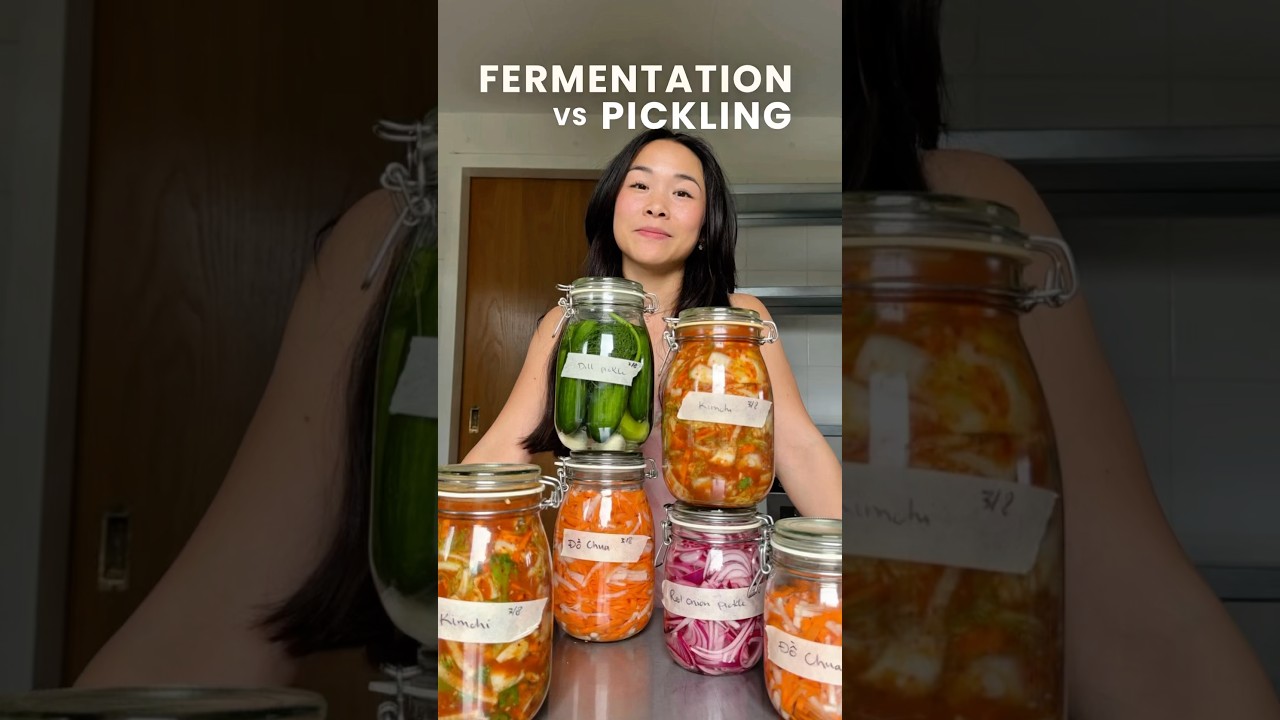
What’s the difference between fermentation and pickling?
By @wendythefoodscientist
As a food scientist, I get this question all the time:
Are all pickles fermented? What really makes a pickle a pickle?
Let’s dive into the food science:
🥬🥒 Fermentation
Uses beneficial bacteria (like Lactobacillus)
Converts natural sugars into lactic acid
Takes days to weeks depending on salt, temperature, and food type
Creates probiotics — great for gut health
Complex, tangy flavour develops naturally
👉 In this video: I make kimchi and fermented dill pickles
→ Kimchi recipe from @thekoreanvegan (I halve the gochugaru for less heat)
→ Pickles made with a simple 2% salt brine
🥕🧅 Pickling
Uses added acid (usually vinegar)
Instantly drops the pH — no microbes needed
Quick: ready in hours
Brighter, cleaner taste of the veg + your chosen aromatics
👉 In this video: I make Vietnamese Đồ Chua and pickled red onions
→ Basic acid pickling brine: 1:1 vinegar:water + 2 tbsp sugar + 1.5 tsp salt
For the Đồ Chua I use my family’s recipe, which is more sweet than the basic acid pickling brine.
🧪 Food safety tip:
Both methods aim for a pH below 4.6. This prevents harmful bacteria like Clostridium botulinum and makes both approaches safe for home preserving.
Whether you want the slow depth of fermentation or the quick tang of pickling, both are delicious, safe, and science-backed ways to preserve your summer harvest.
💬 Do you prefer fermented or pickled veggies? Let me know below!
👇 Save this post for harvest season & follow @wendythefoodscientist for more food science & from-scratch foods.
#foodpreservation #fermentation #pickling #foodscience #wendythefoodscientist #kimchi #pickledonions #pickles #harvestseason #guthealth #preservingfood #fromscratchcooking
Not all pickles are fermented and
not all fermented foods are pickles. Confused? Let’s dive into the food science.
Lacto-fermentation happens when naturally present bacteria convert food sugars
into lactic acid. This process takes days to weeks. It creates rich complex
flavors and introduces probiotics that may benefit your gut. Pickling is much
faster. No microbial fermentation, but just vinegar added to create an acidic
environment. In a few hours, the food develops a bright flavor. Both methods bring the pH below
4.6 to prevent harmful bacteria from growing.
9 Comments
Are pickles good for gut health too or? Is it just for the flavor and just a way of preserving? Thank you in advance
any kimchi recipe video? 🎉🎉
The smell of that fridge😢
Wow I'm planning of trying to make sauerkraut and kimchi and relish this season…I'll check if you got recipes
I've been bad at geting a balenced diet all my life but I've been diving into other cultures foods to see what would both taste good and be good for my personal body. I'm very happy I stumbled across this video, it's very interesting!
I fucking love learning about food preservation
"Not all fermented foods are pickles" this girl is dumb as rocks
can you explain how kimchi does nnot need to be weighed the vegetables and salt to get the 2%. i want yo make kimchi but i am so confused…
how can i make sure that i will be getting a good bacteria?
If I'm starting a new jar of vegetables to ferment, can I kickstart the process by adding some liquid from something that's already fermented? Has anyone had experience with this?