

On the surface, the US economy appears to be performing well, with GDP growing and the stock market booming. However, while the top-line is moving upward, the underperformance of some of the so-called ‘fast casual’ restaurant stocks points to the growing financial struggles of many US households.
Fast casual dining has surged in recent years. These restaurants are more expensive and healthier than traditional fast food, but more convenient than a sit-down restaurant. This group includes Chipotle Mexican Grill (US:CMG), Mediterranean restaurant Cava (US:CAVA) and salad chain Sweetgreen (US:SG).
Their shares surged between 2021 and 2024, but have been some of the worst performing US stocks this year. Chipotle is down 49 per cent year-to-date, while Cava and Sweetgreen have fallen 58 per cent and 83 per cent, respectively.
Read more from Investors’ Chronicle
All these businesses are dependent on US consumers and revenue growth has slowed to a halt. In the third quarter, Chipotle reported flat year-on-year same-store sales, which exclude the effect of new openings or closures.
Chief executive Scott Boatwright said “all income cohorts” were visiting its restaurants less. “Guests with household income below $100,000 represent about 40 per cent of our total sales and, based on our data, are dining out less often due to concerns about the economy and inflation,” he added.
Chipotle may have to start cutting prices as a result. This is the view of Jefferies analyst Andy Barish, who believes middle-income customers are increasingly going to start “favouring value”. This “uncertainty on pricing” has pushed him to lower his 2026 cash profit forecast for the stock.
It has been a similar story at Mediterranean chain Cava, which sells chicken shawarma and falafel salad bowls. In the same period, its same-store sales rose just 1.9 per cent, which was a sharp slowdown from the 18 per cent growth in the same quarter last year.
Group revenue grew 20 per cent to $290mn (£220mn) but this was almost entirely driven by new restaurant openings. When asked on the earnings call why comparative sales were slowing, chief financial officer Tricia Tolivar said it was the result of the “macro environment and the pressure on the consumer”.
Sweetgreen’s third-quarter results also disappointed. The company posted a 9.5 per cent drop in same-store sales, compared to a 5.6 per cent rise a year earlier. That reflected a 12 per cent drop in traffic and product mix – which the company said was a result of a “slowdown in consumer spending” – partially offset by a 2.2 per cent uplift from price hikes.
McDonald’s is loving it
The underperformance of fast-causal restaurants stands in contrast an improving performance from McDonald’s (US:MCD). The fast food franchise has been taking market share in middle-income consumers, which helped it increase US same-store sales by 2.4 per cent. This was ahead of the 2 per cent expected by analysts and an acceleration from the 0.3 per cent growth reported a year earlier.
McDonald’s has benefited from wealthier customers trading down to its cheaper menu options, with foot traffic from high-income consumers increasing “nearly double digits”. This more than offset the struggling lower-income customers, with chief executive Christopher Kempczinski saying he is seeing an increasingly “bifurcated consumer base” and believes this will continue “well into 2026”.
To keep attracting lower-income consumers who might be struggling, McDonald’s has been innovating with its menu. This summer it launched lower-cost items through its McValue platform, including the $2.99 Snack Wrap. The snack wrap has proven to be particularly popular, with nearly one in five US customers purchasing one during the third quarter.
This cheaper menu gives the company “defensive qualities” that will help it continue to take market share. This is the argument made by Goldman Sachs analyst Christine Cho. “McDonald’s has the scale, marketing, and digital presence to successfully navigate through an uncertain consumer environment,” she said.
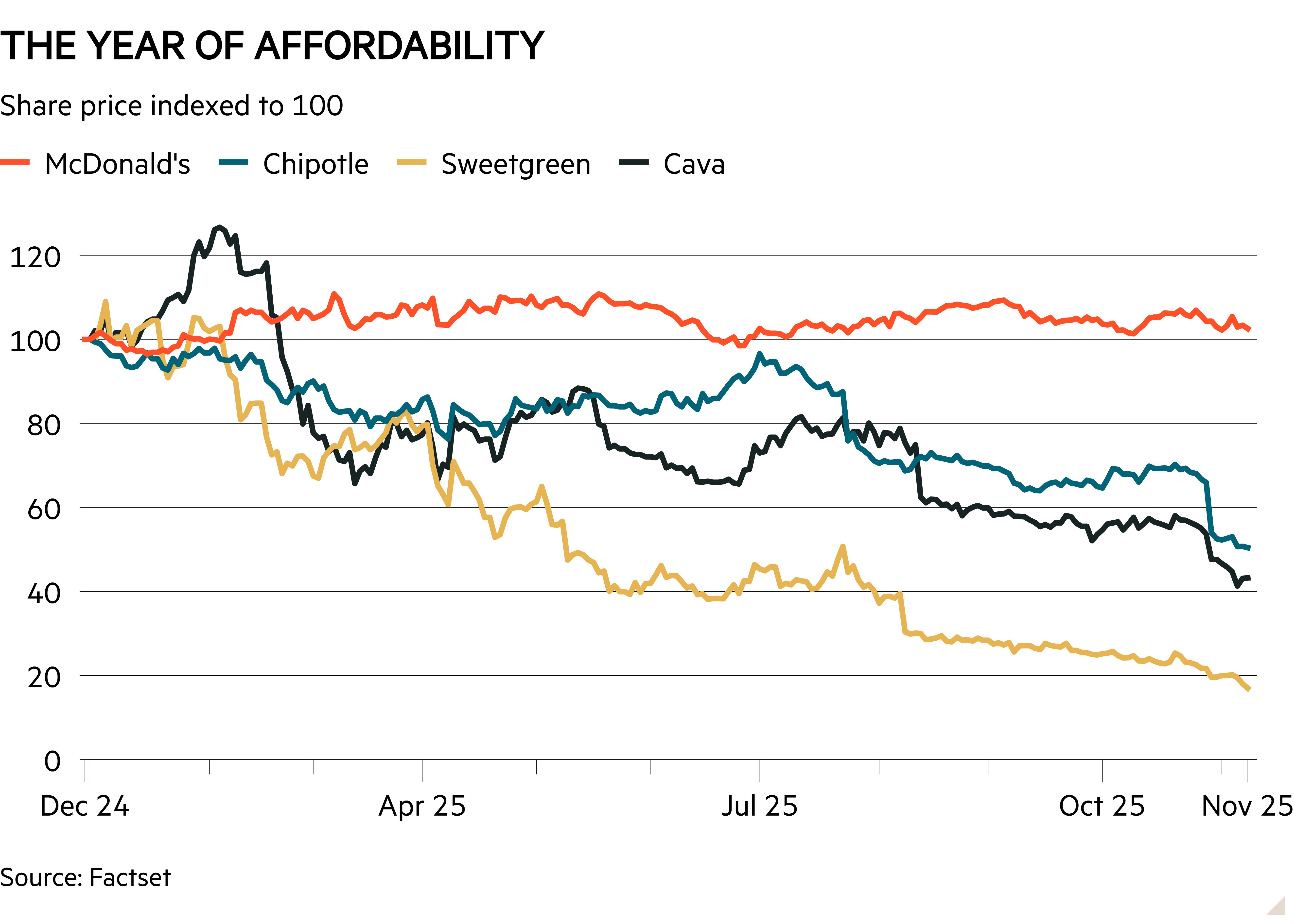
Investors agree that McDonald’s is best placed to take market share. While Chipotle and Cava have struggled this year, McDonald’s shares have risen 4 per cent.
The mixed performance among restaurant stocks mirrors the broader market, as the US economy continues to send conflicting messaging. The ‘Big Tech’ stocks beat analyst expectations across the board as companies increase investment in artificial intelligence.
But there are increasing signs that household budgets are getting stretched underneath. Import taxes impact lower-income households disproportionately, while the longest government shutdown in American history only increases the pressure on them.
The rise of fast casual dining was a reflection of the increasingly wealthy US consumer. With enough money, people no longer had to make a choice between fast and healthy. It was never essential spending, though, and now that households are being squeezed, it may be some of the first spending to be cut.
Dining and Cooking