

THEAsiago DOP It represents the essence of the dairy tradition of the Eastern Alps, a cheese capable of evolving over the centuries without ever betraying its ties to its territory of origin. FromPlateau of the Seven Municipalities to global markets, this excellent Protected Designation of Origin product stands out for its rigorous control system which protects both historical knowledge and pasture biodiversityIn this guide, GIFT explores the unique features of a cutting-edge specification, capable of responding to modern sustainability needs and firmly combating international counterfeiting.
Market dynamics and export prospects
In 2024 they were produced 1.505.500 shape of Asiago DOP, confirming a substantial production stability.Fresh Asiago recorded 1.286.000 forms (+0,03% compared to 2023), while theAged Asiago reached 219.500 wheels, following a significant increase in 2023 (+21,8%). Market demand remained higher than supply, with inventories on average lower than historical figures (Asiago Cheese Protection Consortium, 2026).
Sul Italian marketAsiago DOP confirms its position as the Protected Designation of Origin cheese with the highest growth in consumption: +8,9% in volume e +6,2% in value in 2024 (source: Circana). In the first three months of 2025, this cheese represents the only Italian PDO dairy product with double-digit growth in value (+ 11,4 %) and an increase in volume of + 4,5 %, with an increase in production of + 5,8 % compared to the same period in 2024 (Asiago Cheese Protection Consortium, 2026).
THE export – although representing a minority share of total production, due to widespread foreign counterfeiting – shows positive dynamics: in February 2025 it recorded a + 2,5 %The main destination markets are USA, Switzerland e Germany, while new commercial initiatives are being developed in South Korea, Vietnam e Taiwan, through a promotion project co-financed by the EU (Asiago Cheese Protection Consortium, 2026).
According to the ISMEA-Qualivita 2025 Report On the PDO Economy, the production of Asiago PDO reached 20.227 tons in 2024 (-1,0%) for a production value of 155 million euros (-2,8%), a consumer value of 233 million euros (+5,6%) and an export value of 13 million euros (-3%). Ranking sixth among Italian cheeses with Geographical Indication, after Grana Padano PDO, Parmigiano Reggiano PDO, Buffalo Mozzarella Campana PDO, Gorgonzola PDO e Pecorino Romano PDO (ISMEA, 2025).
Historical Roots: From the ancestor ‘Pegorin’ to modern success
The origins of Asiago date back to Middle Ages, when on the Sette Comuni plateau a dairy production developed which was initially linked to thesheep farmingHistorical evidence documents the existence of a cheese called ‘pegorin’ (from ‘pegora’, sheep in the Venetian dialect), considered the ancestor of today’s Asiago. The first document attesting to cheesemaking on the plateau dates back to 983 AD (Asiago Cheese Protection Consortium).
With the progressive affirmation of thecattle breeding between the 14th and 16th centuries, favored by the expansion of Alpine pastures and the growing demand from the markets of the Serenissima Republic of Venice, cheese evolved in its organoleptic characteristics. The transition from sheep’s milk to cow’s milk led to the transition towards sweeter, firmer, and more preservable types. In early seventeenth centuryAsiago was sold in the main Venetian markets, gaining fame as the ‘cheese of the Plateau’. Production gradually spread to the foothills, maintaining the name of its territory of origin.
Il Nine hundred marked a phase of profound transformation: the spread of modern cheese-making techniques, the introduction of refrigeration and the birth of the first cooperative social dairies (the first in 1872 in Vigardolo di Molvena) favored qualitative standardization. The events of the World War I they determined the extension of the production area from the mountainous areas devastated by the bombings towards the foothills and plains.
In 1979 was formed Asiago Cheese Protection Consortium, with the aim of protecting the authenticity of the product. The recognition of the PDO at European level, obtained in 1996, has transformed Asiago into a certified brand capable of competing on global markets.
The value of certification: DOP rules and guarantees
La Protected Designation of Origin, recognized in 1996 and governed by Regulation (EU) 2024/1143 – as well as recognized in some trade agreements between the European Union and partner countries (e.g. Japan, New Zealand, Mercosur) – protects not only the name but also a production system based on local milk, historical knowledge and rigorous quality standards, key elements in the premium positioning of Italian cheeses on international markets.
Il production specification Asiago DOP defines each stage of the supply chain in detail, guaranteeing its authenticity, traceability and quality (Asiago Cheese Protection Consortium, 2024). Verification of compliance with the specifications is carried out, before placing the products on the market, CSQA Certifications, Italian leader in agri-food certifications based in Thiene (Vicenza), in the heart of the Asiago DOP production area, which guarantees compliance with the specifications through systematic checks throughout the supply chain.
Since 2024, the Consortium has also implemented advanced systems traceability and got the certification Made Green in Italy, becoming the first PDO cheese to certify the entire supply chain ‘from grass to fork’ (Consorzio Tutela Formaggio Asiago, 2026).
Production area
Production is permitted exclusively in specific areas of the provinces of Vicenza, Trento, and in part of the provinces of Padova e Treviso, for a total of 130 municipalities. Thearea of historical origin It includes the Altopiano dei Sette Comuni and the surrounding mountainous areas, characterised by altitudes between 600 and 2.000 metres.
‘In the production area, the climatic and soil conditions They are homogeneous in terms of both rainfall and temperature. From a pedological point of view, the soil is essentially calcareous. In all altitude ranges of the area, calcareous soil is widespread. permanent forage crop, characterized by natural grasses and legumes and the cultivation of cereals (wheat, barley, corn). In the mountainous altitude zone all the non-forested agricultural area is used for pasture and meadow pasture’ (disciplinary code, article 6).
The designation ‘mountain product’ is reserved for Asiago obtained in production areas identified as mountainous territory as they are located at an altitude of no less than 600 metres above sea level (specifications, article 3).
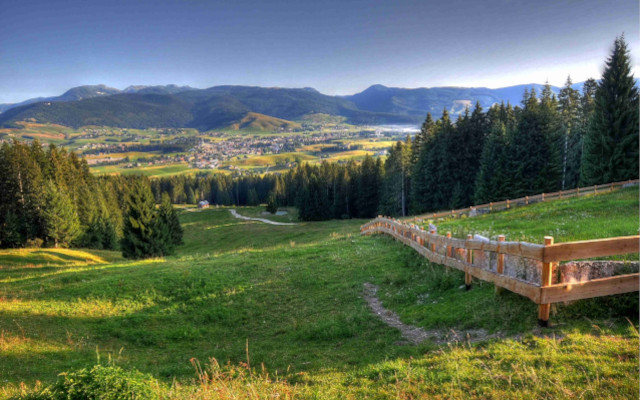
Territory and climate: the heart of Alpine production
Il cow milk must come exclusively from farms located in the PDO area.cow feeding It is strictly regulated by the specifications which define both the categories of permitted fodder and feed, as well as the conditions of use:
at least 50% of the dry matter feed ration must be produced locally;
at least 50% of the dry matter of the feed ration must be provided by fodder;
the use of is prohibited silage for feeding cows whose milk is intended for the Asiago mountain product.
Il milk must be collected within 36 hours from the first milking (48 hours for milk intended for fresh mountain cheese), and be sent for processing within 48 hours of entering the dairy.
The art of cheesemaking: quality standards and natural choices
The only ones permitted ingredients in the preparation of Asiago DOP there are milk, lactic ferments or milk starter, bovine rennet or vegetable coagulant (for versions compatible with a vegetarian diet) ‘and possibly modest quantities of sodium chloride’. With an express ban on the use of the additive lysozyme (E1105). The specification distinguishes between two main types of cheese:
1) Fresh Asiago (or pressed) PDO: obtained from whole milk Fresh, thermized, or pasteurized. The milk is coagulated at 35-40°C with bovine rennet or a vegetable coagulant. The curd is cut ’15/25 minutes after adding the rennet until the size of a walnut/hazelnut’, semi-cooked at 44°C +/- 2°C, placed in cylindrical molds and pressed for a maximum of 12 hours. The minimum maturation period is 20 days, 30 days for the mountain product, 40 for the Fresh Asiago. Reserve(category introduced in 2020). The cheese it has a white or slightly straw-coloured paste, marked and irregular eyes, and a delicate and pleasant flavour;
2) Aged Asiago (or d’Allevo) PDO: produced by semi-skimmed milk by natural surfacing, fresh or heated to 57/68°C. The semi-cooking temperature is 47°C +/- 2°C. Salting can be completed dry or in brine. minimum seasoning It is 90 days from the production date. It undergoes a prolonged maturation process. The specifications provide for four categories of matured cheese:
pimp (4-10 months);
Vecchio (10-15 months);
Stravecchio (over 15 months).
As the cheese ages, it becomes more compact and crumbly, with a deep straw-yellow color, small to medium-sized eyes, and a sweet, slightly savoury flavour; after 10 months, it becomes fragrant.
Branding and identification
‘All forms of ‘Asiago’ cheese are identified by means of numbered and branded casein plates with the appropriate logo. representing a cheese wheel cut and missing a segment; the missing segment, transformed into a ‘A’ stylized, it is partially inserted into the wheel. The overall height of the logo placed on the cheese wheels is 100 mm for Fresh Asiago and 80 mm for Aged Asiago.
The marking bands also include the alphanumeric code of the dairy producer and the name of the denomination, repeated several times and 25 mm high for theAsiago Fresco and 20 mm for theAsiago StagionatoAll the identifying marks of the ‘Asiago’ PDO (casein plate and origin marking) must always be visible on the whole wheel.
Non-cylindrical products must be provided with the following identifying marks: casein plate, alphanumeric code of the producing dairy, logo constituting the denomination, name of the denomination ‘ASIAGO’ repeated several times in sequence, on at least one side of the rind or plate of the form.
The ‘Asiago’ cheese forms that boast the additional mention ‘mountain product’They are distinguished by the inclusion, in the marking bands, of the words ‘mountain product’. Furthermore, at the end of the minimum maturation period, the aforementioned forms are further identified by a fire brand (…), placed on the edge’ (disciplinary code, article 8).
Purposes
THEFresh Asiago DOP It is appreciated as a table cheese and an ingredient in fresh dishes, salads, gourmet sandwiches, toast, and quick-cooked dishes. Its melting properties make it ideal for pizza, stuffed focaccia, and vegetable gratins.
THEAged Asiago DOP, especially in the Vecchio and Stravecchio versions, is suitable to be tasted on its own, in combination with Italian honey, mustards, jams or pears, even cooked. Grated, it enriches risottos, stuffed pastas, polenta, and soups.
The wine pairings favor evolved white wines (Soave Classico, Lugana Riserva) for the fresh types, and light or medium-bodied reds (Valpolicella Superiore, Bardolino Classico, Teroldego Rotaliano) for the aged Allevo.
The Consortium has also developed new formats to meet the needs of the circular economy as well as consumer trends: snacks, cubes, petals, slices, grated and julienned.
Brand Integrity: Authenticity vs. ‘Italian Sounding’
THEAsiago DOP is the subject of widespread imitations On international markets, especially in North America, some Central and South American countries, and Australia, cheeses are sold generically called ‘Asiago’, but have no connection to their territory of origin or European production regulations. These imitation products are made in production contexts that have no connection with theAlpine ecosystem of the Sette Comuni plateau, using milk from intensive lowland farms, industrial cheese-making technologies and, frequently, preservative additives, stabilizers and even cellulose as an anti-caking agent in grated products.
Such imitations not only differ radically from the organoleptic and nutritional characteristics of authentic Asiago DOP, but they erode the commercial value of the denomination and generate confusion among consumers. The phenomenon of the so-called ‘Italian sounding’ in the dairy sector it takes away an estimated value of billions of euros per year from the Italian PDO sector, damaging both certified producers and consumers who seek authenticity and quality (ISMEA, 2025).
For the ‘foodies’ he international buyers, the recommendation is categorical: always check for the presence of the DOP mark on the packaging and shape, of the logo of the European Union and tracking code Released by the Asiago Cheese Protection Consortium. Only these elements guarantee the product’s authenticity, compliance with production specifications, the absence of prohibited additives, and full compliance with European Union quality and food safety standards.
The team of GIFT (Great Italian Food Trade) offers consolidated expertise in supporting international buyers, facilitating meetings with certified and structured producers, capable of meeting the needs of premium and specialty markets.
Conclusions
THEAsiago DOP It confirms itself as a reference model for the entire European PDO economy. The ability to combine a thousand-year history with modern management of a supply chain whose protagonists are predominantly small and medium companies – which ranges from protecting Alpine production to opening up to new Asian markets – confirms its role as a key player in quality gastronomy. Protecting the authenticity of this cheese means preserving not only a nutritional, but also a social and environmental heritage, guaranteeing global consumers a wholesome, natural product of inimitable value.
Dario Dongo
References

Dario Dongo, lawyer and journalist, PhD in international food law, founder of WIISE (FARE – GIFT – Food Times) and Égalité.
Dining and Cooking