
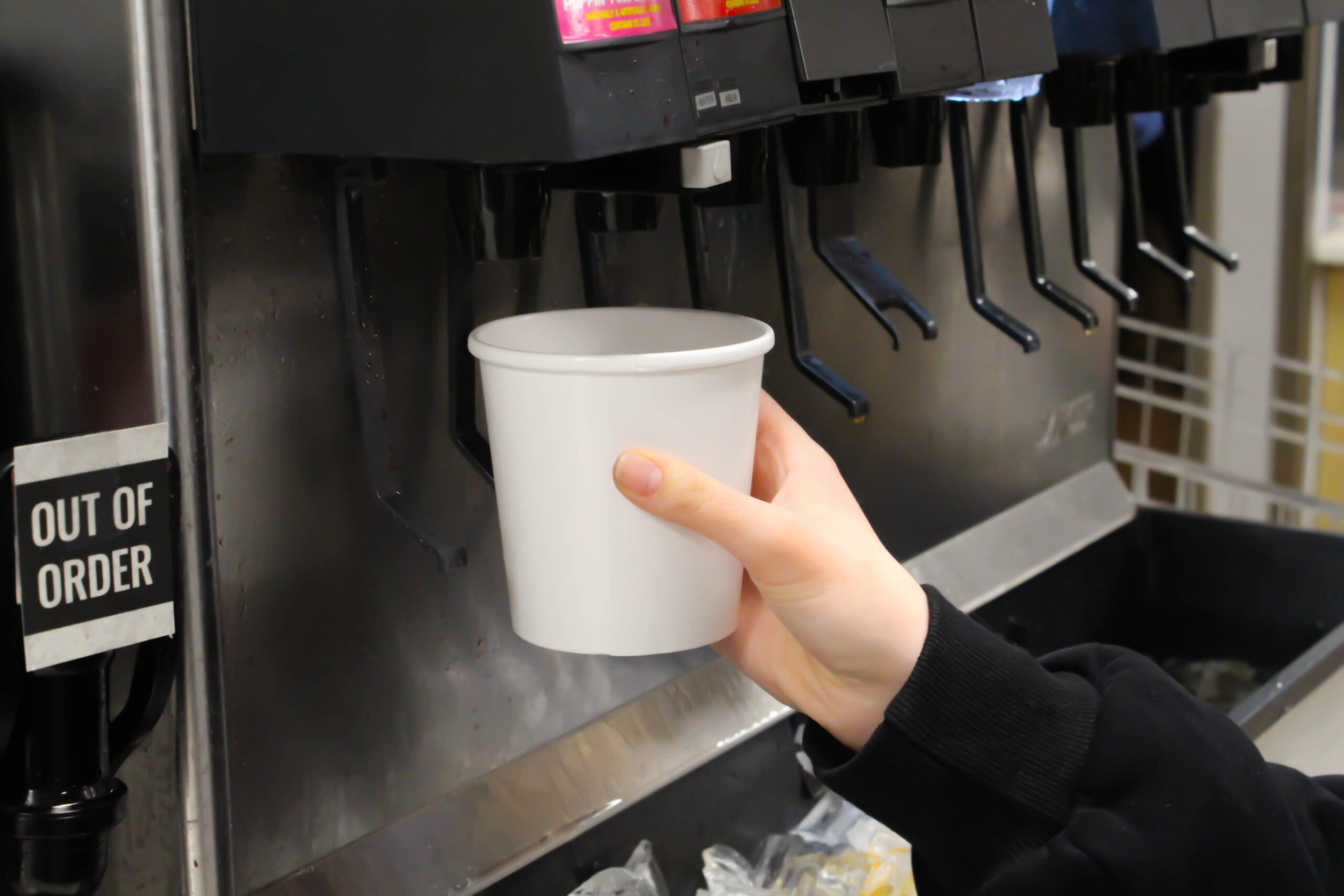
A student goes to fill up their cup at the Esposito Dining Hall. | LJ JOHNSON / THE TEMPLE NEWS

Johnson and Hardwick halls’ Esposito Dining Center, the university’s sole dining hall, is one of Temple’s primary focuses for sustainability initiatives. Despite the university’s concentration on the dining hall’s sustainability, it has encountered operational setbacks in maintaining initiatives in the past.
The dining hall typically provides reusable dishes and utensils. However, Temple switched to using plastic disposable dishware for dining in 2023 after the dishwasher at Esposito broke down, The Temple News reported.
The dishwasher remained out of order for more than a year, with Temple promising to return to reusable dishware in the Spring 2024 after facing complications finding a replacement.
Since then, Esposito has renovated its dining space and changed menus in efforts to improve sustainability at the dining hall.
Aramark Food Services, the vendor for dining services at Temple, collaborates with Temple’s Office of Sustainability to maximize efficiency and ensure dining halls are environmentally friendly, said Bryce Forys, the Office’s Sustainability Coordinator.
“In order to reach the goals and benchmarks we’ve set out for the university, we’ve had to work hand-in-hand with Aramark to develop goals that are achievable, but also meaningful in creating a sustainable campus as a whole,” Forys said.
The Office of Sustainability regularly releases action plans to set goals and track progress for improved sustainability at the university. The plan outlines goals for managing food waste and efficiency, including designs to divert 90% of food waste from Aramark food services from the landfill and reduce the annual pounds of waste per student by 55% by 2030.
Temple has multiple key initiatives with its dining services to help improve sustainability, Forys said. These include Temple’s Weigh the Waste program, where volunteers help sort food waste from disposable materials at the dining hall by weighing and directly disposing of food waste.
In the most recent Weigh the Waste campaign in October, 687 pounds of food waste was diverted from landfill, according to Forys.
Dining locations, including at Esposito and the Morgan and Student Center food courts, also have anaerobic biodigesters for breaking down food waste from the cooking process, Forys said.
Anaerobic biodigesters, a kind of composter, are sealed vats with microorganisms that digest disposed food waste without directing it to landfills and instead outputted as wastewater.
The dishwasher at the Esposito Dining Hall has been repaired, Director of Sustainability Rebecca Collins wrote in an email to The Temple News. However, Aramark may have to switch to providing disposable dishware for dining services when there are not enough dishes in circulation to operate effectively.
“There has been an uptick in students leaving the dining hall with reusable dishware,” Collins wrote. “When this happens, Aramark is forced to provide single use items. If students have taken items from the dining hall they should be returned to Esposito Dining Hall dish return.”
Food waste from the dining hall is disposed of in the anaerobic biodigester, Collins wrote. Other dining hall waste is combined with waste from the residence halls.
Despite temporary changes, Alex Farb said he generally estimates seeing reusable dishware in the dining hall on an average of six out of seven days a week.
“I think usually I see reusable plates fairly often,” said Farb, a junior musical theater major. “I think recently there was a period where there was a long stretch where they were using only disposable plates and silverware.”
Temple also hopes to ensure and report that a certain percentage of food at dining services is locally sourced and low carbon, Forys said.
Beyond dining hall initiatives for sustainability, Forys wants students to actively get involved in researching and participating in programs for sustainability at Temple. These include the Give and Go Green program, where students can donate food, clothing and other important materials when they move out.
Forys encourages students to use the Give and Go Green program to donate any reusable dishware that may have been taken from the dining hall.
“Another thing that we’re targeting in collection is any dishware and tableware that students have taken from the dining halls,” Forys said. “That is one thing we’ve noticed that students take a lot of, so I’d encourage them to, if you have forks and knives and plates, return it to those bins.”
Dining and Cooking