
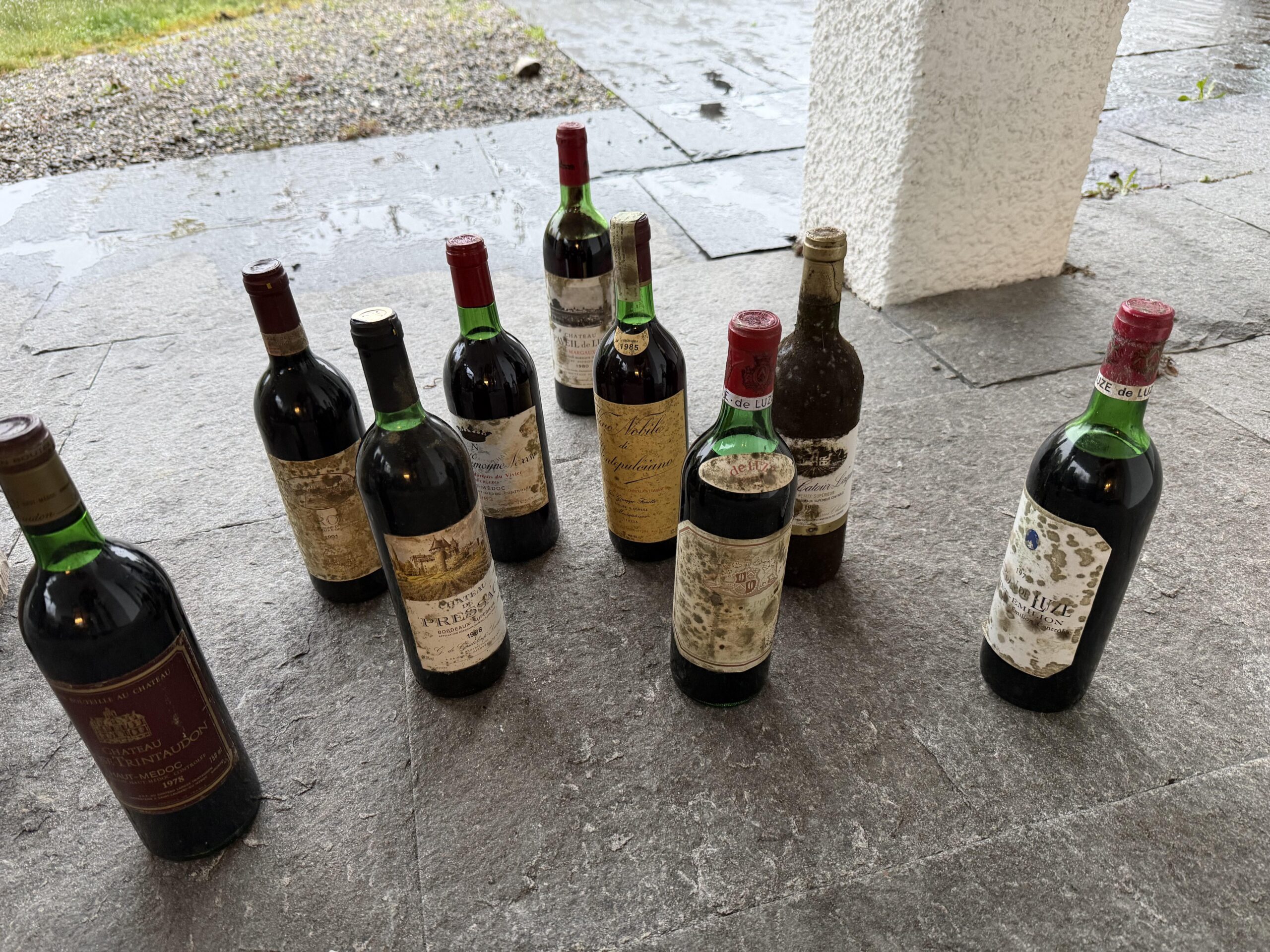

Hi fellow wine lovers
We bought a house couple of weeks ago and the previous owner left some wine in the wine fridge in the kitchen. Now some of the bottles are in pristine condition and I was able to identify them with no problem. Best one I believe is a Penfolds Grange 1998.
Quite a few bottles however have really bad mold on them. I know that mold per se is not bad as long as the cork is intact. I would try to clean the bottles and labels and store them for (soon) drinking.
However I was wondering if these bottles on the picture are actually worth going though that hassle? Can you recognize them? Vintage I guess are all around 1980 – 2005.
On another note, the wine fridge also has some mold spots. Any experience with that? I wiped it clean with 80% alcohol. I am a bit worried about hidden mold though, e.g. in the fan and in the air ventilation behind the back wall. Can I use it again and maybe just pay attention if mold shows up again? Unfortunately forgot to snap a picture before cleaning.
Thank you so much!
by blueskych
11 Comments
As they say the proof of the pudding is in the eating. It will be impossible to know until the cork is pulled but it will be a fascinating journey
Fills look low. Some of those will be vinegar just by looking at it. This is a pop and pour to find out situation. Wouldn’t bet on anything being good based on your notes.
>Best one I believe is a Penfolds Grange 1998.
Tremendous wine!
>I know that mold per se is not bad as long as the cork is intact.
That’s correct. This is why it’s good to visit grand old cellars – you quickly learn a bit of mould isn’t necessarily a bad thing at all, else great wines wouldn’t come from outright fluffy cellars.
I wouldn’t bother with cleaning things too well, but it’s a good use of a carafe. You don’t have to clean the bottle too well, because you can’t ever get it actually clean. If you’re iffy about mould, get the cork out, wipe the mouth of the bottle and use a mylar pourer to pour into a carafe so there’s no dribble from the outside of the bottle.
>However I was wondering if these bottles on the picture are actually worth going though that hassle? Can you recognize them? Vintage I guess are all around 1980 – 2005.
I can’t tell what the Barolo(?), second from left, is. The rest are pretty solid wines, or were back in the day, but not meant to be kept this long – though fill levels on several of these are surprisingly good and you might well be in luck. Nothing remotely in the same stratosphere as Grange.
I see you have a 1978 Larose-Trintaudon there (far left). I tasted a 2000 vintage last month. I rather enjoyed it, and while it was still more primary than tertiary, it was clearly losing power, the tannins were unbearably soft already etc. Pinned it as a 2006 Haut-Médoc, so pretty happy with that, but I certainly wouldn’t advise anyone to keep it for another 22 years. However, it might actually show very well.
I’d open them all in fairly short order, best with other people curious about wines that are likely past it. Keep an open mind, take notes, try to find interesting things in each glass. Worst case it’s a lesson of what really really tertiary wines taste/smell like. Best case a couple of these really shine and it’s a great experience. One thing we can all be certain about is that none of these are getting any better if you wait longer.
>I am a bit worried about hidden mold though, e.g. in the fan and in the air ventilation behind the back wall.
You’re concerns are well-placed. Cleaning the filter for example is a must. If you’re somewhere that’s about to have a warm, dry spring/summer, placing the fridge (open, tilted towards the sun) outside for a few days in a row might also help dry things out – but not if it’s too hot as you might harm the electronics. Silica gel and similar desiccants are another option.
I’m sure someone with specific experience will pop up with advice as well.
Let’s focus on the hassle part. It’s a sunk cost and doesn’t owe you anything. What are they worth? Well you know where they were stored when you found them. But not before that. So no you don’t have provenance. So whatever price you see online. Half it. Now let’s say you have now decided to drink them. You could research the wines, look at vintage charts, choose a special occasion, cook a dish, etc…. Open the wine and it’s no good. Now what? So what I recommend is have them all ready to go. Get some friends around and open a bottle. No good? Move onto the next one…. Hopefully you find something you enjoy! Then come back and share it here. The only thing I enjoy more about finding that amazing bottle of wine that sings. Is hearing that someone else has done the same!
I see a lot of very fancy vinegar.
Sadly, sometimes we run out of time and don’t get to finish our collections. I’m guessing that’s what happened here.
I don’t know if you have experience with older wines, but if they are not obviously spoiled (offensively sour or musty basement smell), you might still not find them to your liking, especially if you’re used to fresh young vintages. But there might be people in your local community who would really enjoy them. I have rescued some decades old bottles that should be gone and still found considerable enjoyment, just in a different way.
Enjoy!
The ‘78 could be good.
‘80 was a weak vintage for Bordeaux.
Generally, I have been pleasantly surprised when drinking Bordeaux wines (even modest ones) which are beyond their supposed ’drinking window’.
oh man what a find. the penfolds grange alone makes this whole thing worth it, those go for serious money even in less than perfect condition. if the cork is intact and the fill level looks decent you’re sitting on something really nice there.
for the mold on the bottles honestly dont stress too much about it. mold on the outside is super common with older wines stored in humid conditions, it doesnt affect whats inside at all. just wipe them down with a damp cloth before opening. the wine fridge mold is a different story tho, id give that a really thorough clean with a diluted vinegar solution and let it air dry completely before putting anything back in there. the fan and vents especially, mold loves those spots.
for the other bottles id try to get clearer pics of the labels when you can. some of those look like they could be burgundy or bordeaux based on the bottle shapes which would be pretty exciting for that era. even if a few turn out to be past their prime its always worth opening them, worst case you have an interesting evening learning what aged wine tastes like when its gone a bit too far lol
If stored well, that ‘85 Fanetti Vino Nobile could be really nice. I had one a couple of years ago that was fantastic.
Wipe the fridge down with strong vinegar, leave it turned off and open for a while so it can dry out.
You can use the fridge again. Getting it dry is key to keeping the mold out. If there’s continued issues you could also try hydrogen peroxide. Don’t mix hydrogen peroxide with vinegar though.
Wipe off all the bottles, you can use cleaning wipes (in the US we have disposable cleaning wipes for kitchen surfaces that are more gentle chemicals than bleach). Let the bottles dry out as well. Keep them on their sides, but don’t put them back in the fridge if the bottles still have mold on them.
I would just open, decant and drink. As you don’t know the cellaring conditions… you can’t in good faith sell them. The mold won’t hurt them in any way, shape or form. Provided the cork is intact. 98 grange is a great year. My favourite short of 96 and 90 in that decade. You have some incredible memories to make OP. Get opening! Some will be gone but others won’t and you are playing with house money.