
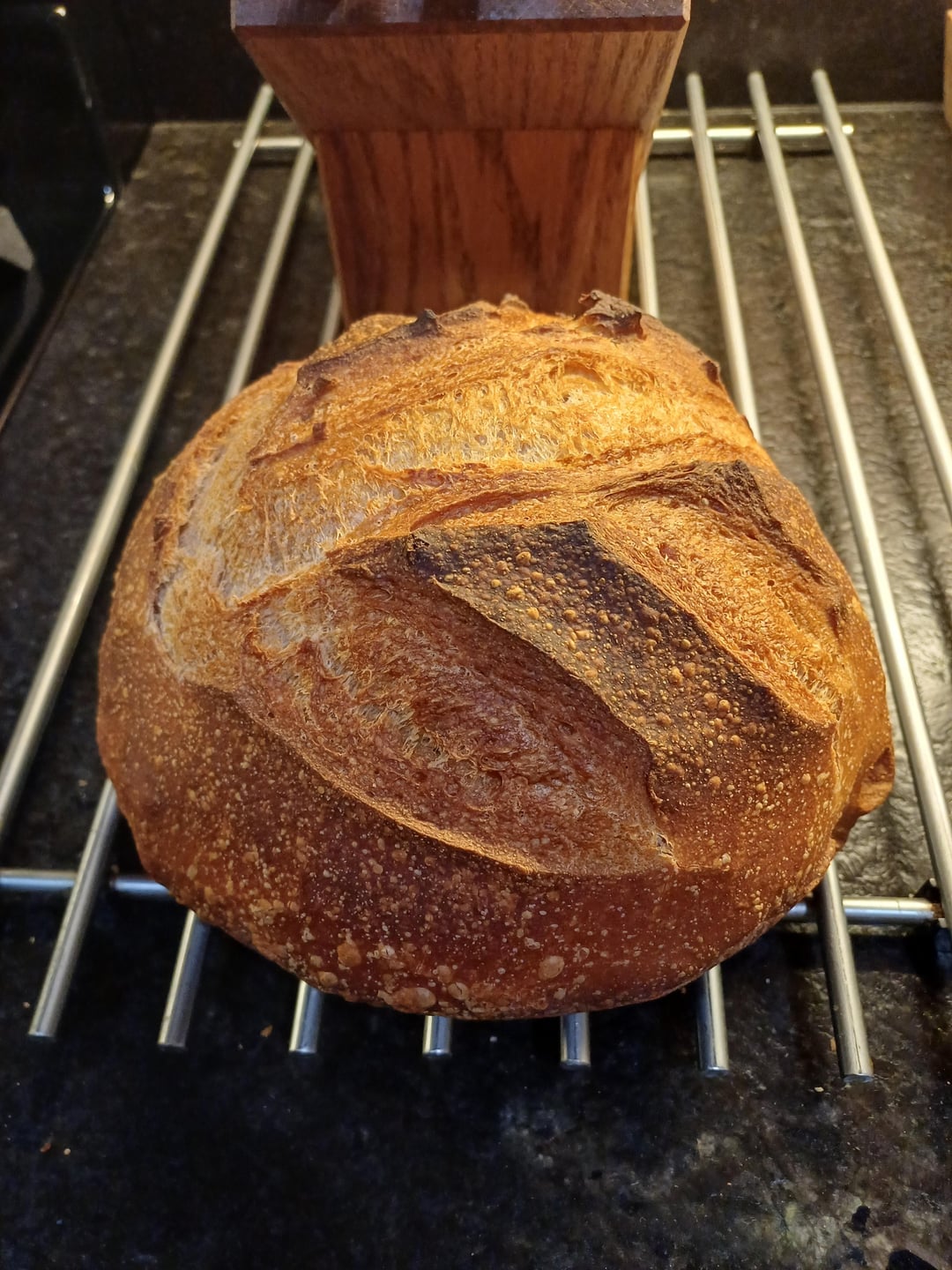
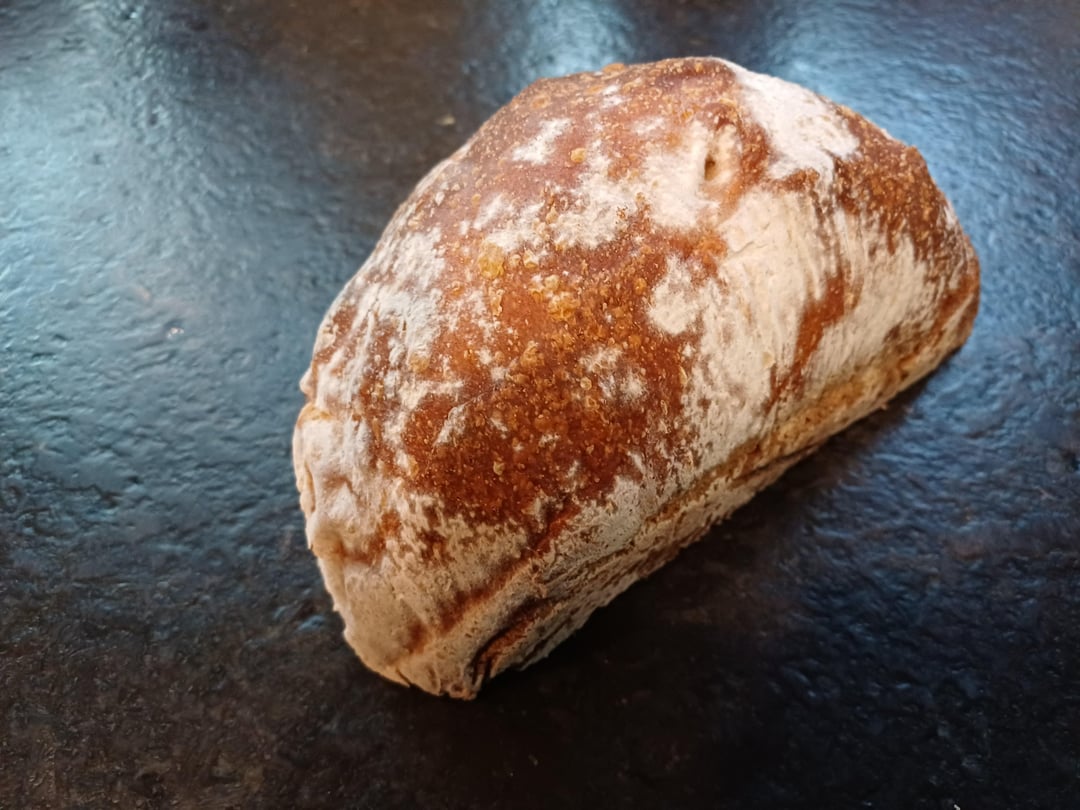
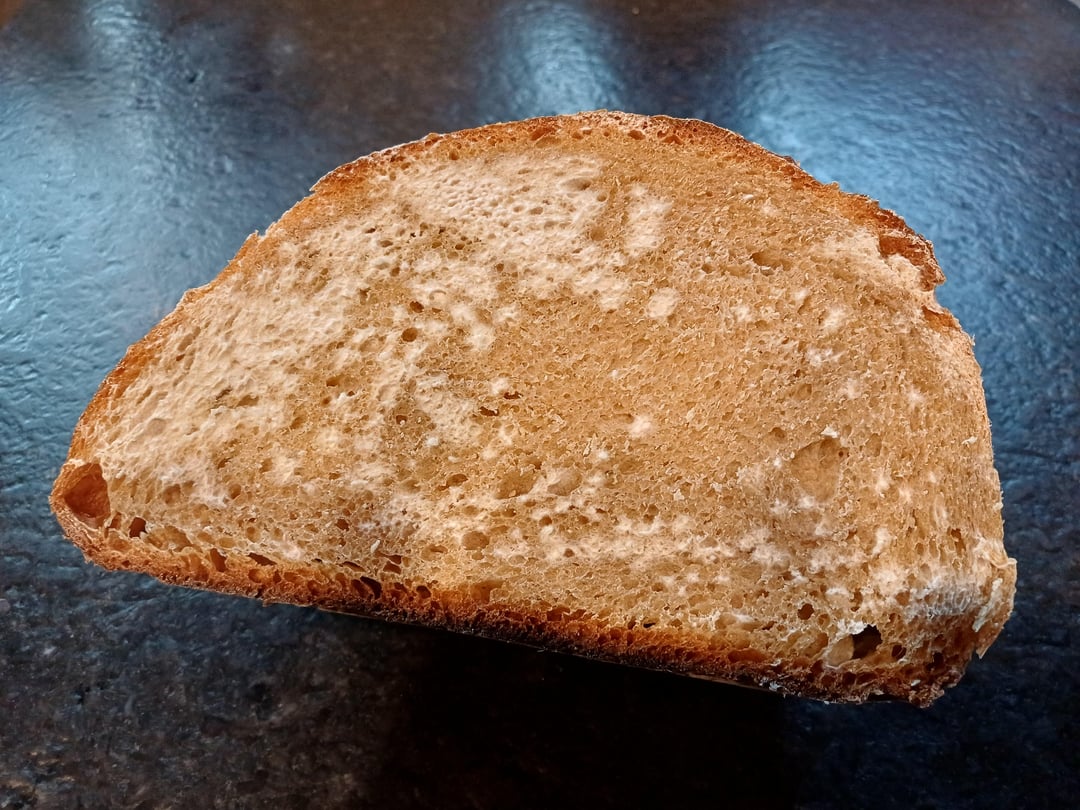
I've been baking sourdough bread since 2013 and I'm usually happy with the results. I like the crumb with small bubbles, the German style. The big holes irritate me when I shmear my butter. I made my own starter and it's now about 8 years old. I keep it in the fridge and feed it once a week.
Nevertheless, my question is about how long my loafs last in the bread box. In the pictures you can see the loaf after 4 – 5 days. It develops this white mold. I've had sourdough bread I bought at the farmers market for longer than that and it did not get mold. The baker assured me that there are no preservatives in the dough.
Any advice why my bread is getting mold so quickly?
Ingredients:
225g Bread Flour
200g Whole Wheat
250g Sourdough Starter
270g Water
8g Salt
Process:
Feed the starter in the morning and wait till it's fully active. 3 to 6 hours depending on room temp.
Mix the dry ingredients
Add the starter and water
Mix until all is incorporated
Let it rest for 30 min
Stretch and fold
Let it rest for 30 min
Stretch and fold
Let it rest for 30 min
Stretch and fold
Cover and put it in the refrigerator over night
Next day take it out and form a loaf
Let it sit for about 2 hours, depending on room temp
Put it in a dutch oven and cover with lid
Bake at 450F for 30 min
Bake for another 15min with lid off
Let it rest and cool before slicing it
by phaidron51
32 Comments
It certainly looks like a lot more than I’m used to seeing, but that’s about the countertop lifespan of my home baked loaves 🤷🏻♀️ I started keeping my bread in the fridge to have it last longer, it really helps. Also, how are you covering the bread? If you’re not covering it at all you may need to clean out your bread box.
Make sure to check your bread box for mold that may be infecting your loaves.
Are you storing it any differently than you stored farmer’s market bread?
Personally I slice and freeze all my bread the day after baking (I store in the Dutch oven overnight once cooled). If toasted very lightly from frozen, it’s like fresh bread.
Mold comes from external, of course. A fresh batch of bread won’t have mold spores on it that survived the oven. There’s a few things about a recipe and ingredients that can make it more challenging to grow mold, but ultimately what mold needs to grow is:
* Moisture (a lower moisture bread will mold less quickly)
* Spores from the air, your hands, surfaces, anywhere
* warmth
* Nutrients – sugards & starches
* Lack of preservatives
What can you do?
* Let your bread cool completely before storing it. Trapped steam makes faster mold. Don’t seal warm bread in plastic.
* Days 1-3, store your bread in a paper bag or bread box that allows airflow, and reduces moisture build up.
* Medium term – plastic bag
* long term – freezer
* Fridge can slow mold, but it won’t prevent it, and will cause your bread to get stale faster. Although I will typically toss my bread in the fridge after 3 or 4 days myself as it’ll be gone by day 5 or 6 usually.
* Use a clean bread box.
* Slice as needed
* Sourdough has more acids which slow mold growth
If you’ve got a lot of mold spores in your kitchen, that may be another problem to look into. Might be time to check your air filters.
Great looking loaf, sorry about mold issues. There are just 2 of us, this is what I do. Once bread is cooled, I cut it in half, cut one half into slices and freeze it. The other half lasts 2-3 days, no problem. Then I take out slices as needed. Good luck.
I mean, 4-5 days isn’t ABNORMAL. It’s not your process or your starter. It could just be time of year, or storage with some retained moisture. As long as your starter is doubling like clockwork and making bread and doesn’t smell obviously bad then you’re money. Try storing what you aren’t using right away in the freezer, I usually bake two loaves on the weekend, cool em and slice em and forget em, you know the drill.
I know people say it’s the devil, but I keep my loaves in a big ziplock bag in the fridge. I do t find that it affects the taste or quality of the bread, and I never get mold. Just make sure it’s completely cooled before you bag it. If you want to get away from plastic, a breadbox will also work.
If you’re worried about maximum freshness, cool your loaf, slide it, and freeze the slices. Most people use plastic bags for this too, but I’ve heard some folk like foil or wax paper. Slices defrost quickly and still taste great.
Slice and freeze it. This is what we have to do once it warms up. Toasting just long enough to thaw it, it’s like just baked.
I use a bread conditioner for my whole wheat sandwich bread. It makes my bread last an extra 3-4 days and stay soft.
Homemade Dough Conditioner
• ½ cup vital wheat gluten – boosts gluten strength • ¼ cup instant potato flakes ground fine – retains moisture and softens crumb • 2 tbsp sunflower lecithin granules – natural emulsifier for softness and shelf life • 1 tbsp ascorbic acid powder – strengthens gluten, improves oven spring • 2 tbsp diastatic malt powder – enhances yeast activity and crust color) • 1 tbsp powdered milk – adds tenderness and improves browning
I don’t know if it is right or wrong, but I store my bread in the Dutch oven. That way it is always going into a sterile “bread box”.
Sanitize your bread box. Any spores in there will infect the next loaf and so on. Once you get mold you sanitize to get rid of it.
Make sure your bread is fully down to room temperature before storing in the box. Put your bread in a paper bag i side the bread box.
If your room is kept at warmer temperature the bread will mold faster. Maybe your bread needs to go into the fridge at day 4. Or you need to cut the loaf in half and freeze half while you keep the other half in the box.
Single living– this is why I started freezing half my loaf after baking and why I only bake one loaf at a time. It’s organic and lacks preservatives.
A decade ago when I started organic gardening I was shocked by how quickly things go bad, even in the fridge–but then I realized we have no idea how many chemicals are put into everything we buy in the stores.
Real question. How are you not eating it within 24 hrs or do I have a bread problem?
Never seen it this fast. Are you in a really humid environment? FWIW, I “store” my loaves so that the cut side is face down on the cutting board and the rest is uncovered. If the cut side isn’t flat enough for that I’ll wrap only the exposed crumb in plastic and leave the rest uncovered or put in a linen bag. This seems to stop the inside from becoming dry for at least a week. The crust eventually gets soft and chewy, but we almost always finish it well before then. House is typically 30-50% humidity. For long term storage, definitely slice and freeze as soon as the bread is cool, as folks have recommended.
I’m amazed that your bread is still around after 4-5 days. In my house, 4-5 hours is a miracle.
Each time someone walks by another slice mysteriously disappears…
Good suggestions abound in this discussion.
Bread boxes are ironically bad to keep bread in. They are really good places for mold to grow on things. Just use the bread for a few days and then slice it up and freeze it.
Soak a paper towel or cotton pad in hard alcohol and put it in with your bread in an airtight container. the alcohol will evaporate and slow mold growth. you do need to refresh it when you open the bag though.
source: i work in a lab that does lots of food and food storage testing. we’ve got some baked goods that have been sitting around for literal years like this. doesn’t help with going stale though.
You may have microscopic mold spores in your bread box. I’d wipe it down with a bleach solution and let it air dry, then wipe it again with water to remove any lingering bleach smell to see if that helps.
My sourdough easily lasts a week with no mold, are you keeping it in a airtight bag or something? It needs to be allowed to dry so it becomes stale rather than moldy over time
side note: i have never seen a recipe with that much starter. my jaw actually dropped!
Day 1 keep your loaf cut side down on cutting board
Evening of Day 1 put loaf in paper bag cut side down. Mine lasts a week no mold ever (SoCal)
Next loaf, use new paper bag
I slice mine, and freeze it. Take it out directly into the toaster.
Honey, olive oil, vitamin C powder, or a tiny bit of vinegar can all inhibit mold growth if you add it to your dough. Be careful with the vitamin C powder or vinegar. Only used in small amounts or they may affect the taste. I use olive oil and honey in mine, about 10 to 15 g per loaf.
Your breadbox is infected with mold spores. In addition, it’s probably creating a perfect breeding ground with respect to moisture and what-have-you to go along with the spores.
I store my bread in large 2-gallon zip top bags from WallyWorld with a couple desiccant packs which I change weekly tossed in with it. I live in Georgia where it’s almost always humid. After it cools, I store my loaves in the fridge, and just barely toast slices before eating them. I reuse the bags and desiccant packs as many times as I can.
If, somehow, my bread lasts long enough to mold in the fridge, I toss the whole bag, loaf, and desiccant pack and start over with all of that.
You’re not eating it fast enough.
Isn’t the shelf life of homemade sourdough like 3-5 days
Put vinegar in it. That’s what all the breads I used to buy at hippie health food stores back in the day would do with their breads and savory pastries. Google AI says between .5-2% of the total flour weight, or a half to full teaspoon of vinegar per 500g flour. Supposedly there are other benefits, but I’ve never tried it myself.
get a wax bag set inside of a cloth bag! King Arthur has a great option or you can make it with wax beads and cotton/muslin and an iron 🙂
What climate do you live in?
I live in a dry climate and I think would take ages to happen here. But I agree with the folks saying to sanitize your bread box, because even in a humid climate that sounds fast for mold to develop
I feel like bread is best within 2-3 days. I slice it after it cools, then freeze the slices. It’s the best way to do it IMO!
I always cool it, slice, and store in gallon zip bags in the fridge. Lasts for over a month.
Bread without preservatives goes bad pretty quickly at room temp.
Bake the bread, let it cool, slice it, freeze it. Toast it straight from the freezer when you want some it will taste like it was baked that day.