
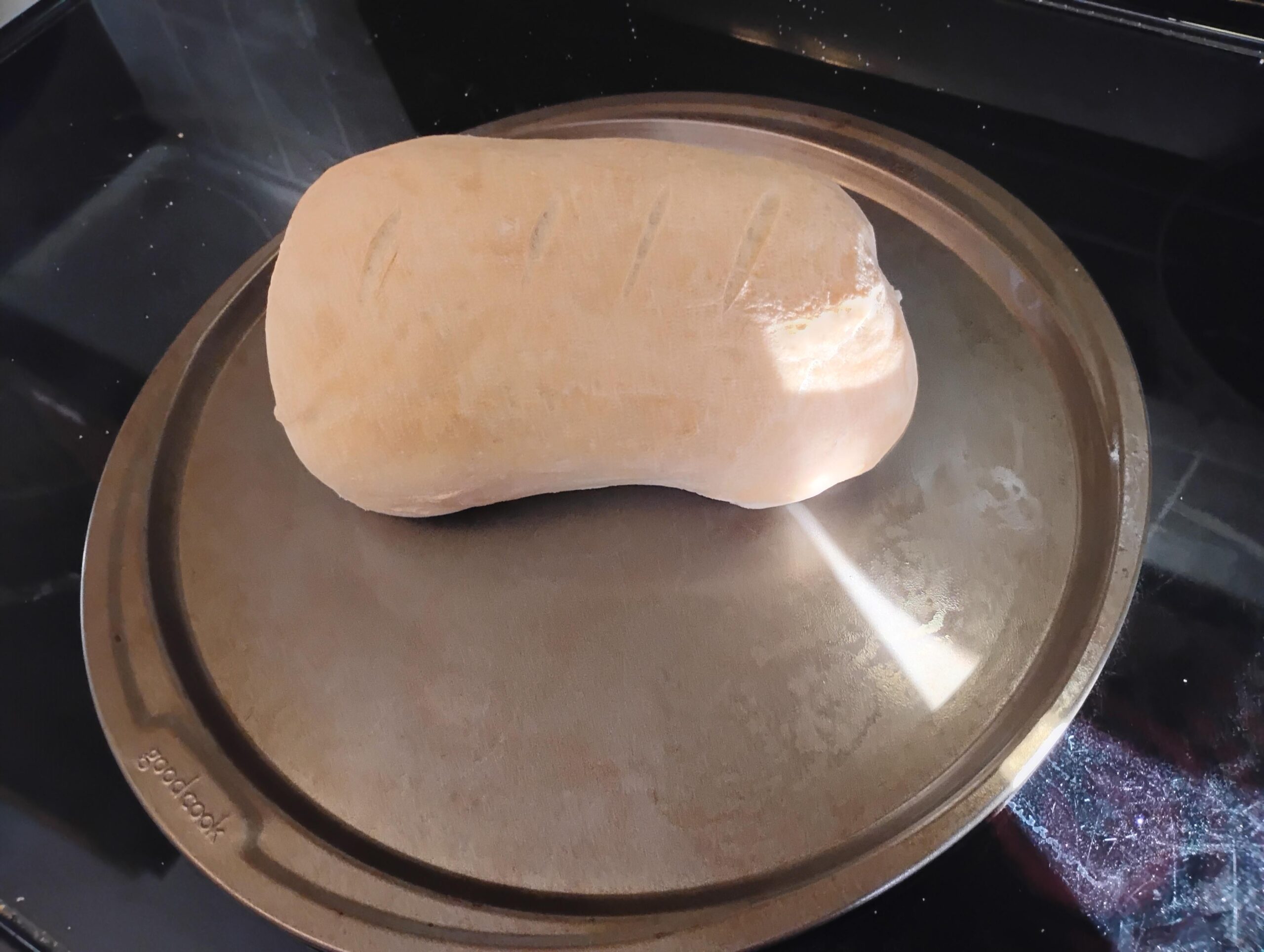
I've gotten into bread making, and I'm wanting to keep things simple but good, and while this bread is absolutely good, it just doesn't come close to what the bakery has to offer and is basically just white homestyle in a different shape.
I'm at a loss, do I really need to get a sour dough starter just to make good bread?
by Reasonable_Depth_354
20 Comments
What are you wanting it to be like? What type of recipe did you follow for this?
Turn the oven on!
All jokes aside, what are you aiming for and what’s your recipe?
Nope, you can get tons of different flavor profiles without moving to sourdough—also making your own starter is dead simple. Are you using a particular bread book, just finding recipes online, or what is your process?
Add some Honey in there. It helps with browning
My first successful baguette: https://tasteofartisan.com/french-baguette-recipe/
Maybe you need a little more salt for your tastes.
Also, I could never really nail sourdough bread, but I kept up the starter. I add the starter to a basic yeasted bread recipe (maybe 2T per 2-3C flour? I don’t measure) and it really elevates the flavor, without interfering with the yeast’s dynamics.
I suggest finding a recipe for the particular style of bread you are looking for that has a video so you can watch the process and get an idea what each step should look like.
You did a number of modifications to the recipe you used and until you have a better base familiarity with bread baking I would follow your recipe exactly. Cooking temp and shaping are pretty important components that will affect your overall outcome. King Arthur Flour has a lot of recipes with videos you can use.
Maybe you’d enjoy working with some other flours. Half whole wheat adds flavor and fiber but keeps a lot of the tender texture of white flour. Rye, spelt, kamut, oat, potato… then there are add ins like seeds, bran, porridges, cheese, herbs….
I like a whole grain seed and nut bread for toasting. My husband loves something with a little fruit in it like dried apricots or raisins.
The King Arthur site has a wide variety of free recipes to get started and they’re pretty reliable in my experience.
White bread is delicious, but you don’t have to stick with it.
I swear by King Arthur recipes. Especially for newer bakers. Even the very simple ones are or can be varied and flavorful. Easy to follow and well written. Just one man’s opinion.
Turn up the oven and cook it for longer. If you don’t have a Dutch oven, get one and use it to get a crusty loaf – it needs a certain amount of humidity in the first part of the cooking for it to develop a nice crust, which is achievable by closing the lid of the Dutch oven for the first part of cooking and then taking off the lid.
As far as the doughy part is concerned, if you absolutely refuse to do sourdough, doing a poolish or biga can add flavour. However, i find non-sourdough bread to just generally lack a depth of flavour that I crave. Also, make sure you salt it adequately, and you can also play around with adding oil/other fats to it to enrich and get a softer loaf, just for variety’s sake, or different types of flour (rye, whole wheat, kamut, spelt, etc). Usually I do a ratio of 1/5-1/4 rye, 2/5-1/4 whole wheat, the rest unbleached white flour, though sometimes I up the ratios if that is what I’m feeling. You can also mess around with the hydration of the dough – I tend to stick around 70%, but going lower or higher can create different effects.
You can stick to instant yeast and get different flavors. One idea is a poolish, which is a pre-ferment. Another is changing or adding enrichments (butter, milk). Also different flours can affect taste too.
Lendo suas mensagens abaixo, eu começaria com um pão básico.
Ingredientes:
500g de trigo
65% de água fria, de preferência da geladeira
2,5% de sal
0,2% de fermento seco, ou 3 vezes isso de fermento fresco
Preparo:
Mistura tudo
Aí você pode fazer a sova, até desenvolver uma estrutura de glúten, nada de ponto de vel, só estrutura inicial já dá certo.
Segunda opção seria dobras, a cada 30 minutos faz 4 dobras na massa esticando bem. (Método dobras é só bater no Google pra ver imagens é bem simples nada complexo), faz 4 sessões de dobras.
Após fazer um dos dois métodos acima, espera a massa dobrar de tamanho.
Aperta ela pra tirar um pouco do ar e modela do formato que você quiser e coloca na forma.
Espera dobrar de tamanho.
Coloca pra assar até ficar dourado.
Quando você dominar essa receita base, aí você começa a incrementar, pode fazer polish, fermentação a frio, e várias outras coisas.
Com essa base dominada você experimenta mais coisas aí você vai ter uma base e noção do que fez de diferente e oque pode ter dado errado ou certo.
Eu chamo isso de pão de treino, eu fiz isso todos os dias por várias semanas no meu inicio, e na verdade eu fazia 2, um de fermento biológico e um de fermento natural.
Isso me deu uma base excelente de oque fazer ou oque não fazer para ter determinado resultado.
Hoje eu faço pães com dobras que é mais tranquilo pois tenho pouco tempo, e cansa menos rsrs
*Na panificação tudo é medido em percentual tomando como base o peso total da farinha de trigo
i think you might need a dutch oven
Look into biga. It’s sourdough *lite*
This looks underbaked, and underproofed, but the recipe is definitely workable!
So, first thing you should get to know as a new baker. Lets start with flour. White flour is basically just pure ground starch. Bread flour should be higher protein compared to other “white” flour (more gluten because gluten is a protein.) You can look on your bag for the amount of protein.
Bread flour will inevitably vary depending on the wheat that was the source and how it was also processed. Realistically, the more processing and refining, the less taste there is when you start, because all the stuff to make it super fine, super white, and shelf stable for a long time inevitably remove most of the actual properties that had flavour! Absolutely not all wheats are the same, and there will be taste differences noticeable to someone based on if your flour came from Canada, or the USA, or Italy, etc..
That being said, this is arguably not enough time at all in this recipe. 🙂
You are describing – to ME, at least – that you would like a more flavourable non-sourdough started loaf. To me this sounds like maybe you want more a pain l’ancienne type of loaf.
Alternatively maybe you want to change your flour to a whole wheat, or mix in even rye, spelt, or other grain flour to add taste and different texture. But that is not keeping with your general recipe so that is for another time.
Mostly you can get a different result in your taste of your recipe using the same ingredients, BUT with all the difference in technique.
Rule number 1. And yes it IS a rule. And yes I will die on this hill, and not just because I live on a hill. Time is an irreplaceable ingredient in bread.
You CAN replace time – in the technical sense – with a bigger proportion of yeast to flour, with sugar, with more chemical additives and refinements to the flour (amylase and other enzymes lab-produced and added to the bread as dough relaxers, lab produced powder acidifiers to act as strengtheners. Theres retardants, emulsifiers and foaming agents, preservatives, etc. The use of all these things is how cheap factory sponge bread is produced. )All these additives help reduce time, but the trade off is always in taste and texture. Always. Not sometimes. Not if or or. Always. Time , as an ingredient, is a very important flavouring!
A basic pain l’acienne recette would be about 500 gr of flour to 375ml of water, you can keep the 12g of salt or maybe increase it a bit to 15g if youre quite salt tolerant like I am, and the 5 gr of yeast. (Ideally, your flour should be unbleached, and if you are in the USA, also without bromine treatment, which was actually banned many places a long time ago but still used in many refined flour in the USA to be cheapest way to make it shelf-stable.) Salt, btw, is a retardant. It slows the yeast as much as it adds its own flavour. Salt is also essential- if you ever accidently left out the salt, you WILL know in every way. lol.
Aim for at least 18 hours of proofing time in the fridge, for a slow rise to develop taste and texture. You can start at 12, but since you said already you tried an overnight in the fridge, I am assuming you were at 12 – more or less- and still you are looking for more. No harm there, you’re on the right track already! You can do a bit more once you are more comfortable with the techniques and when you really start to understand your dough, and understand your bread.
Then you would also bake it at a very hot temperature, at least 250C is recommended. (One of my ovens is formulated to go to 300C so works very nice for bread, but not everyone has the benefit of a really hot oven.) If you do not have a thermometre to place to the oven, I would actually really recommend one. My old home had a cheap electric oven that might have said it was on the maximum, but never ACTUALLY got up to that temperature. My sister inlaw has an expensive electric oven thats even more garbage. lol. Takes it like 45 minutes to preheat just to get to a basic cooking temperature, I dont know why she puts up with it (well she doesnt cook much, so I guess its fine for her… even though she complains about it.)
The idea is not to add too much flour, so the dough is dense and hard to rise. Keep it loose and easy. A long and slow cold rise allows the yeast to do its work slowly, which digests the grain better, and increases the flavour. Relaxed dough goes and springs better in the oven.
Also, this is where shape becomes important. In your own recipe it is to make baguette styles. The general style of loaf in your recipe requires they be thin so they bake quickly in a hot oven. The heat forces the spring reaction and water to make the maillard reaction to the crust and colour it. It is hard to bake a single fat sized loaf in such a hot oven, You will end up with too much crust to the centre ratio – the outside will burn and the inside still dough, and it creates cracking and density as the bread fights itself from outside and in. So of course the oven must be a lower temperature so it can bake all the way through, but this makes differences. If you notice in your photo, you slashed your bread but there was almost no expansion. So this signals to me it was not quite ready to be baked, or the oven wasnt the right temperature, or he was too dense. Hard to tell what, exactly, but it is a signal.
You CAN bake a single loaf, in a lower oven, and still have good and tasty results. For your results, the bread in the photo above is as anaemic as I am. haha. Vampiric loaves will have the most minimums of taste because there is an important taste quality to developing the crust. With no colour is no taste.
If you are to bake one fat loaf instead of cutting and shaping it smaller to baguettes, the better results might be had by a longer oven cooking time, at least 45 minutes. Do not be eager to remove him when he is barely coloured. Let him roast a little more. You can also try baking in the dutch or clay ovens, use a good sprinkle of flour as the base to keep him from sticking, especially if it is the enamel. People also use the parchment papers instead, if you like. I would recommend a digital display thermometre until you get the experience. You are looking for 95C+ for bread (apologies, I do not care to know fahrenheit besides it is something 212 decrees for 100, so whatever in the nuances besides that. ) You want the colours to really develop in the crust to add the flavour.
Good luck on your baking, and please dont be discouraged. Your beginning loaf isnt bad. He just needs refinement in techniques. Understanding BREAD, like this simple sustenence of life that is the backbone of human civilisation, is such a reward. If you keep at your experiments, I am sure you will be able to develop a loaf you find really enjoyable and tasty to eat.
Make Anadama
Why didn’t you make it as a baguette? I’m sure that would change a lot the final flavour.
Let it cold-proof in the fridge for 48 hours.
Experiment with seasoning the dough with herbs, fermentation, adding dairy or yolks, adding extracts, spices, or ingredients, sweetening methods, even natural food colourings (to trick the brain).
Also, baking methods make a huge difference. Try dutch ovens, steaming, loaf pans, etc,.
I jumped to sourdough about 5 years ago and zero regrets. I make lots of things with the starter – multi grain, pizza crust, cinnamon rolls, babka, sandwich bread, various inclusions, etc etc etc. I just bought my starter, I do fridge starter storage, I probably bake once or twice a week. I actually shy away from regular bread now because sourdough is so much more flexible with timing and I can walk away from it for long periods.
I just like to throw that out there, it might click for you. I was baking right out of the gate with a purchased starter.
I have a pizza dough recipe I got from Martha Stewart and it is simple as hell. I now make a double batch and adjust as I want. First adjustment was just garlic and butter brush before baking. Now, I dust with almond flower for texture and grit, some olive oil and garlic. Mix in more basic seasonings to the brush mix. I know it’s unhealthy but damn does it taste good when I want little ceasars garlic bread but I don’t want to go out or spend more money.