
PDO/PGI-Linked Mediterranean Ingredient Collections Market Size, Market Forecast and Outlook By FMI
The PDO/PGI-linked Mediterranean ingredient collections market reached USD 820.0 million in 2025. It is expected to be valued at USD 890.0 million in 2026 and rise to USD 2,340.0 million by 2036, reflecting a CAGR of 10.1% over the forecast period. Ongoing commercial investment and tighter sourcing controls among import distributors are supporting this growth, especially as concerns around counterfeit liability continue to rise.
High-end grocers are facing more pressure to confirm origin claims across multiple Mediterranean suppliers at once. When retailers build shelf sets from loosely sourced individual SKUs, supply chain checks become more expensive and harder to manage. In response, many buying teams are turning to pre-verified Mediterranean PDO collections that reduce administrative effort and place more traceability responsibility on packagers. These certified specialty food ingredients help preserve shelf trust and improve margin potential. FMI observes that retailers continuing with uncertified item-by-item sourcing may run into growing compliance friction. Delayed adoption of certified bundled formats could increase exposure as regulation becomes stricter.
Summary of PDO/PGI-Linked Mediterranean Ingredient Collections Market
PDO/PGI-Linked Mediterranean Ingredient Collections Market Definition
The market covers authenticated Mediterranean food assortments that combine several GI-protected items into one packaged offering for organized commercial distribution. These collections rely on strict EU geographical indication rules that protect origin, production method, and regional distinctiveness. They are sold across retail, wholesale, gourmet, and gifting channels where provenance-led value is important. The category excludes loose product groupings without certification, one-off regional food packs lacking GI recognition, and individual food products marketed without being part of a multi-item assortment.
Demand Drivers in the Market
Counterfeit liability fears compel grocery category managers to demand pre-verified consortium-backed bundles.
Supply chain auditing costs force import directors to consolidate fragmented regional sourcing into unified packaging operations.
High-margin gifting strategies push specialty retailers to stock integrated regional narratives rather than loose items.
Key Segments Analyzed in the FMI Report
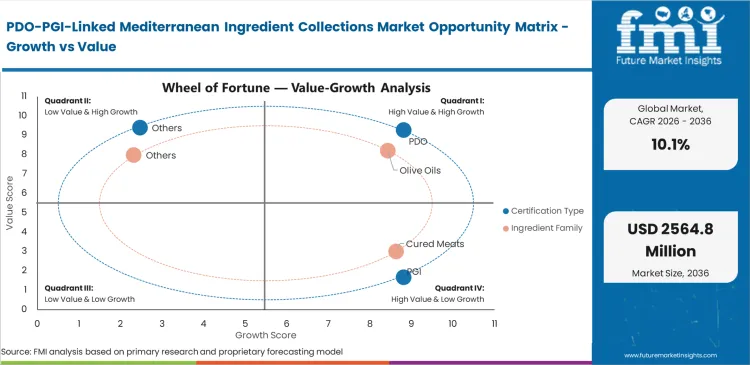
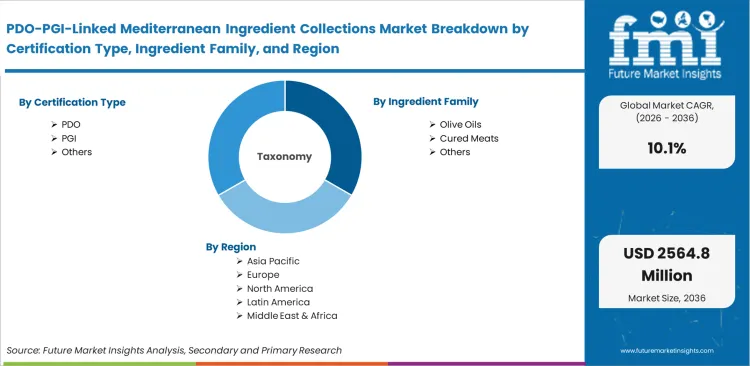
Certification Type: PDO is expected to hold 58.0% share in 2026, driven by absolute retailer demand for strict provenance legalities.
Ingredient Family: Olive oils are projected to lead ingredient families, serving as an essential anchor item securing buyer confidence.
Collection Format: Retail gift boxes are set to capture 33.0% share, reflecting massive baseline demand during holiday merchandising windows.
End Use: Gourmet retail is anticipated to account for 35.0% share, representing primary distribution nodes for premium regional narratives.
Italy-led collections: 10.9% compound growth, supported by highly organized export consortium infrastructure.
Analyst Opinion at FMI
, Principal Analyst, Food and Beverage, at FMI, states, ” In our updated PDO/PGI-Linked Mediterranean Ingredient Collections Market analysis, my team and I have identified origin authentication as the primary value driver. Protected designation frameworks such as PDO and PGI elevate ingredients beyond commodity status by linking them to geography, tradition, and quality benchmarks. Brands that leverage certified Mediterranean ingredients can command premium positioning, provided traceability and labeling integrity remain uncompromised.”
Strategic Implications / Executive Takeaways
Import directors must prioritize aggregators capable of managing divergent expiration dates across mixed pallets.
Co-packing facility managers face critical investments in modified atmosphere packaging to protect fragile PDO seals during transit.
Gourmet retail buyers gain significant leverage by negotiating exclusive seasonal assortments directly with regional consortiums to justify the premium pricing of GI ingredients.
Methodology
Primary Research: Procurement directors and specialty import buyers navigating complex European consortium regulations.
Desk Research: EU PDO/PGI registry databases, export consortium shipping manifests, and customs declaration archives.
Market-Sizing and Forecasting: Aggregated export container volumes cross-referenced with premium retail SKU velocity metrics.
Data Validation and Update Cycle: Independent cooperative sales reports cross-validate baseline assumptions annually.
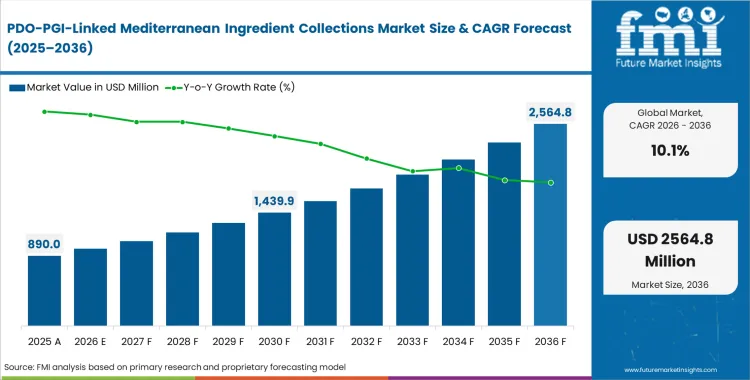
Once national customs authorities implement standardized digital tracking for mixed-origin pallets, container clearing times plummet. Logistics directors trigger this accelerated volume scaling by integrating regional consortium data directly into import manifests. Crossing this digital verification threshold transforms low-volume artisanal imports into a highly scalable geographical indication Mediterranean ingredient market. Distributors signal this logistical shift by abandoning loose container loads in favor of palletized assortments closely tied to emerging food tourism narratives, capitalizing directly on rising export demand for origin-certified Mediterranean foods.
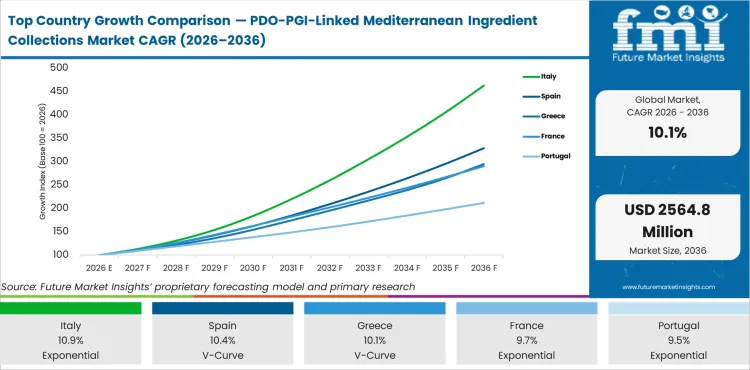
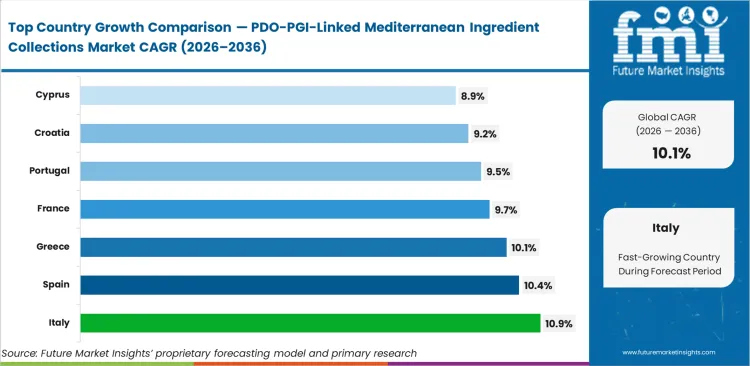
Italy remains the fastest-growing market at 10.9%, driven by localized consortiums that have improved co-packing for export channels. Spain records 10.4%, with growth supported by stronger aggregation among large farm cooperatives. Greece reaches 10.1% as consolidation efforts across island supply bases continue to strengthen. France grows at 9.7%, and Portugal posts 9.5%, helped by established dairy export specialization. Croatia is set at 9.2%, while Cyprus records 8.9% through niche product development. Much of this variation comes down to structure, with centralized export networks performing better than highly fragmented producer systems.
PDO/PGI-Linked Mediterranean Ingredient Collections Market Definition
PDO/PGI-linked Mediterranean ingredient collections refer to selected multi-item packs of regional food products protected by strict European Union geographical indication standards. Each primary component in the collection must hold valid legal certification. These products are packaged for unified retail or distribution use rather than sold as bulk standalone commodities. As a result, they are classified specifically as Mediterranean GI ingredient assortments.
PDO/PGI-Linked Mediterranean Ingredient Collections Market Inclusions
This category includes mixed retail boxes, gifting assortments for corporate buyers, and foodservice packs built around certified regional specialties. Covered components include bottled extra virgin olive oil, cured meat servings, and artisanal cheese wedges grouped in a single commercial package. FMI assesses these bundles when they are promoted as PDO and PGI Mediterranean collections and when the packaging reflects a clear regional connection.
PDO/PGI-Linked Mediterranean Ingredient Collections Market Exclusions
This market excludes collections built around Mediterranean-style branding when official EU certification is missing. Bulk shipments of single PDO products meant for downstream repackaging are not counted within the scope. Assortments that combine GI-certified European products with non-Mediterranean items are also left out because they weaken the regional focus of the offering.
PDO/PGI-Linked Mediterranean Ingredient Collections Market Research Methodology
Primary Research: Procurement directors and specialty import buyers navigating complex European consortium regulations.
Desk Research: EU PDO/PGI registry databases, export consortium shipping manifests, and customs declaration archives.
Market-Sizing and Forecasting: Aggregated export container volumes cross-referenced with premium retail SKU velocity metrics to accurately model the PGI Mediterranean ingredient collections market size.
Data Validation and Update Cycle: Independent cooperative sales reports cross-validate baseline assumptions annually.
Segmental Analysis
PDO/PGI-Linked Mediterranean Ingredient Collections Market Analysis by Certification Type
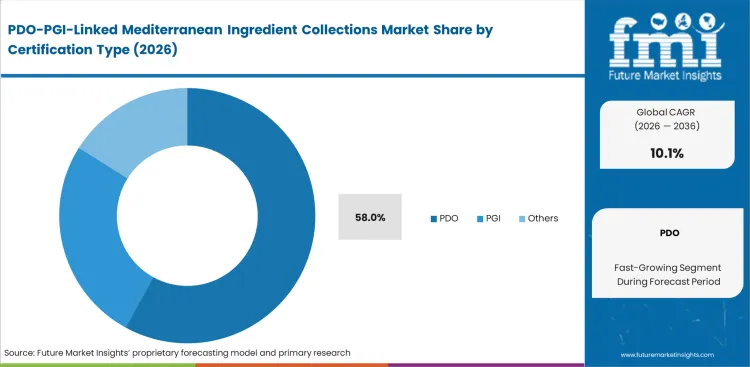
PDO accounts for 58.0% of the market share, largely because major grocery chains prefer products with the strongest geographic certification. For retailers selling premium packaged foods, PDO status offers clearer proof of origin and reduces the risk tied to misleading sourcing claims. Import managers often favor these ingredient bundles because they help protect product authenticity across premium retail shelves. At the same time, demand does not always translate into easy volume growth. Compared with PGI-based sourcing, PDO-only supply is more tightly tied to the agricultural output of specific protected regions, which limits how far sourcing can scale.
Initial listing requirements: Compliance officers demand exhaustive audit trails before approving new SKU introductions. Import directors secure rapid approvals effortlessly using recognized PDO consortium documentation.
Ongoing spot validations: Customs inspectors target mixed Mediterranean pallets for rigorous origin verification checks. Logistics managers avoid costly port delays when every item carries unassailable legal seals.
Renewal expansion dynamics: Category managers expand successful regional programs only when supply chains remain unbroken. Sourcing executives fail to secure program renewals if initial test shipments reveal inconsistent provenance.
PDO/PGI-Linked Mediterranean Ingredient Collections Market Analysis by Ingredient Family
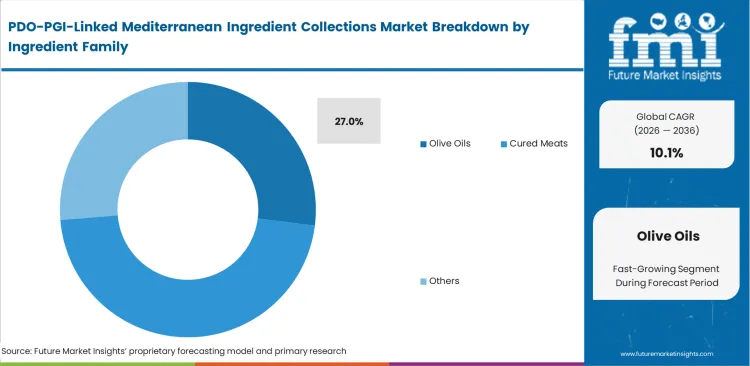
Olive oils account for 26.0% of the market share, as buyers tend to treat well-known estate-labelled bottles as a clear marker of authenticity and quality. They also work well as the foundation of a broader assortment, making it easier to add products like vinegar and pasta that fit the same culinary positioning. Retail buyers are usually more hesitant when a box lacks that kind of clear centerpiece, because it becomes harder to defend a premium price. FMI notes that the overall value perception weakens when premium cheese is paired with uncertified oils, or when authentic balsamic vinegar is placed alongside standard condiments. Once the quality mix starts to feel uneven, retailers often have to rely on deeper markdowns to move the assortment.
Seal integrity compromises: Flimsy glass bottles shatter during aggressive trans-Atlantic pallet movement. Supply chain directors face total inventory loss when leaked oil destroys surrounding cardboard structures.
Temperature excursion risks: Extreme container heat degrades delicate phenolic compounds during summer transit routes. Quality assurance managers reject entire shipments if dataloggers reveal sustained temperature spikes.
Corrective transit protocols: Specialized thermal liners mitigate heat transfer across complex mixed containers. Logistics planners implement costly safeguards to capture full retail margins upon successful arrival.
PDO/PGI-Linked Mediterranean Ingredient Collections Market Analysis by Collection Format
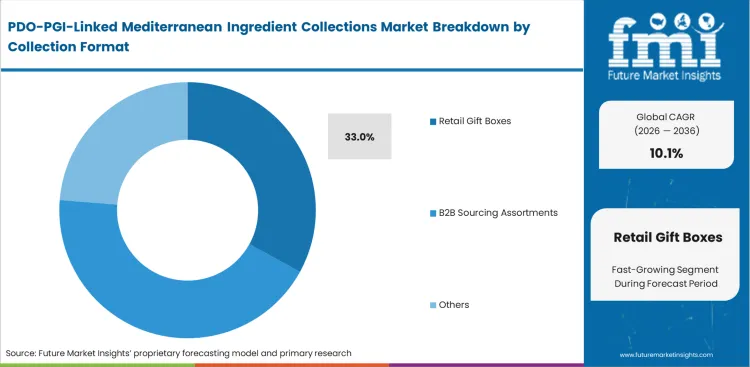
Retail gift boxes hold 33.0% of market share because presentation plays a major role in holiday purchasing. In this format, packaging does more than protect the product. It also helps drive shelf appeal and makes premium assortments easier to sell as ready-to-gift purchases. Packaging teams usually develop rigid box structures that can handle long-distance shipping while still keeping delicate items presentable at retail. For category managers, these pre-arranged assortments are also easier to place in seasonal displays because they reduce the need for extra in-store assembly or handling. Much of the pricing power in this segment comes from the packaging format itself, not just from the food items inside. In many cases, suppliers are able to earn higher wholesale value by using standard PDO products in better-designed, more durable gift presentations. Poorly structured boxes, by contrast, often create losses at retail when heavier jars damage more fragile items packed alongside them.
Procurement savings logic: Unified cardboard structures replace dozens of individual protective inventory sleeves. Packaging procurement managers capture immediate margin improvements through smart structural consolidation.
Hidden transit penalties: Oversized presentation boxes ship mostly empty air across expensive ocean freight routes. Logistics directors discover terrible volumetric efficiency metrics when auditing volumetric pricing.
Lifecycle waste profiles: Elaborate holiday packaging requires massive municipal recycling capabilities post-consumption. Sustainability officers force packaging redesigns to eliminate non-recyclable plastic viewing windows entirely.
PDO/PGI-Linked Mediterranean Ingredient Collections Market Drivers, Restraints, and Opportunities
Grocery buyers are facing greater pressure to reduce counterfeit exposure, and that is increasing demand for pre-verified consortium-backed bundles. As enforcement around Mediterranean GI foods becomes stricter, major retailers are finding it harder to rely on fragmented sourcing models that carry added compliance risk. Buying authenticated multi-item collections allows retailers to place more of the origin-checking responsibility on European packagers. Many sourcing executives are now working to secure trusted regional consortiums ahead of broader digital customs tracking requirements. Without that shift, import teams may face longer border delays and weaker seasonal shelf readiness.
Synchronized shelf-life management creates immense operational friction slowing rapid assortment building across diverse categories. Sourcing aged hard cheese alongside fresh harvest olive oil establishes highly volatile expiration windows for entire packages. Packagers must deliberately downgrade fresh components or face massive shrink rates when category managers mandate unified twelve-month retail shelf lives. Emerging modified atmosphere packaging offers partial relief but struggles accommodating highly divergent organic degradation rates simultaneously within rigid formats.
Opportunities in the PDO/PGI-Linked Mediterranean Ingredient Collections Market
Tourism-driven demand for Mediterranean GI products: Returning travelers seek authentic flavors experienced abroad. Retailers capture immense revenue by positioning curated regional boxes as direct extensions of affluent European vacations.
Blockchain provenance tracking: Integrating QR-coded digital ledgers connects consumers directly to specific agricultural estates seamlessly. Brand managers command massive retail premiums by offering unassailable digital transparency.
Cross-appellation collaborations: Merging distinct regional items like authentic balsamic vinegar with specialized coastal sea salts creates novel pairings. Product development managers bypass crowded traditional categories entirely.
Regional Analysis
Based on regional analysis, PDO/PGI-Linked Mediterranean Ingredient Collections is segmented into Western Mediterranean, Eastern Mediterranean, and Central Mediterranean across 40 plus countries.
Country
CAGR (2026 to 2036)
Italy
10.9%
Spain
10.4%
Greece
10.1%
France
9.7%
Portugal
9.5%
Croatia
9.2%
Cyprus
8.9%
Source: Future Market Insights (FMI) analysis, based on proprietary forecasting model and primary research
Western Mediterranean PDO/PGI-Linked Mediterranean Ingredient Collections Market Analysis
The efficiency of exports across Iberian agricultural zones increasingly depends on how well cooperative networks are organized. Large cooperatives are taking advantage of bulk consolidation hubs to move into higher-margin retail assortments with greater speed. This enables buyers to secure volume directly from centralized export points instead of navigating fragmented broker channels. FMI analysis suggests that the direct-to-cooperative model lowers sourcing costs for large international customers. Operations that pair strong olive oil supply with advanced dry-goods packaging are building a notable logistics advantage.
• Spain: In Spain, long-established agricultural cooperatives are moving beyond bulk delicatessen supply and putting more emphasis on curated assortment packaging. Rather than relying only on traditional sales channels, they are repackaging familiar food lines into retail-ready premium assortments that can earn better pricing. This gives producers a way to lift value from their existing supply base without making major changes to sourcing or production. The Spain market for premium Mediterranean food assortments is projected to grow at a 10.4% CAGR through 2036, as packaging-led value addition helps established suppliers improve margins and expand their reach in specialty retail.
• France: France benefits from a strong quality reputation that fits well with the expectations of premium gifting channels, especially in department stores and upscale seasonal retail. Domestic quality standards and consortium-led control systems make it easier for buyers to trust the consistency and origin of curated food assortments positioned at the higher end of the market. That credibility matters in gifting formats, where presentation alone is not enough and the product mix also has to feel unquestionably premium. Against this backdrop, the France segment is expected to register a 9.7% CAGR over the forecast period, supported by steady demand for authenticated assortments suited to luxury gifting and prestige retail placement.
• Portugal: Portugal’s growth is being shaped by the strength of its regional food combinations rather than by scale alone. Coastal canning specialists and inland dairy producers give assortment builders a broader set of locally rooted products to combine into bundles with a more distinct national identity. That makes Portuguese assortments stand out in premium channels, where buyers are often looking for offerings that feel specific and authentic rather than broadly Mediterranean. This is expected to support a 9.5% CAGR for Portugal during the assessment period, as retailers continue to favor assortments built around recognizable regional pairings and stronger origin-led differentiation.
Central Mediterranean PDO/PGI-Linked Mediterranean Ingredient Collections Market Analysis
The strength of centralized export hubs comes in large part from geographical indication systems that have been in place for years. Italian consortiums developed export protocols early and built consolidation centers that can handle a broad range of PDO products together. These established pathways help supply chain managers maintain dependable holiday shipping schedules. FMI estimates suggest that many facilities once used mainly for single-item export are now being reworked for multi-item co-packing. That move is increasing pressure on local producers to match the specifications required by major packagers.
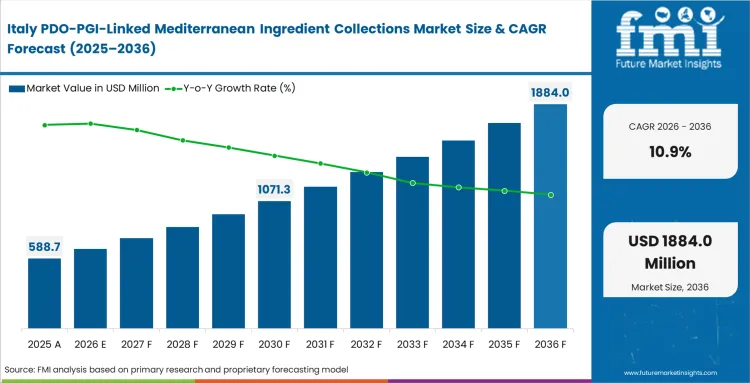
• Italy: Italy is projected to grow at a 10.9% CAGR, helped by export co-packers that combine products from multiple regional appellations into a single commercial shipment. That coordination matters for sourcing teams looking for better scale, more consistent supply, and fewer fulfillment issues across export programs. It also makes Italian assortments easier to place in premium international retail channels, where buyers value reliability as much as product quality. This added operational efficiency is strengthening Italy’s position in high-value overseas assortment sales.
Eastern Mediterranean PDO/PGI-Linked Mediterranean Ingredient Collections Market Analysis
Infrastructure modernization is reshaping the way fragmented cooperatives connect with demanding overseas markets. Many producers are coming together through joint export platforms to build the scale required by large retail buyers. Procurement managers are using these newer aggregation models to access regional narratives that were previously harder to source in a coordinated way. FMI notes that bypassing traditional European distributors is giving Eastern consortiums greater pricing flexibility. Operations that pair upgraded packaging systems with strong agricultural supply are capturing new market opportunities more quickly.
• Greece: Greece is expected to post 10.1% CAGR, supported by island cooperatives that are joining forces to use shared export facilities on the mainland. That setup makes it easier to move beyond small local markets and supply specialty retail channels more consistently. For buyers building premium assortments, the appeal lies in processed meat and dairy products with a more distinct regional identity. Those differences help Greek offerings stand out in niche premium food assortments, where origin and character often carry as much weight as the product itself.
• Croatia: In Croatia, producers along the coast are moving into EU-certified supply programs faster than many importers had anticipated. That is improving access to products with clearer documentation, stronger compliance backing, and more credible origin positioning. For brands trying to bring something less familiar into premium assortment lines, Croatia offers a newer regional story without losing quality assurance confidence. The Croatia segment is forecast to grow at 9.2%, with demand supported by buyers looking for authenticated inputs that feel both compliant and commercially fresh.
• Cyprus: Cyprus is projected to expand at an 8.9% CAGR, with growth centered on tightly curated premium assortments rather than broad-scale volume supply. Land constraints continue to limit agricultural output, but they also add to the scarcity and distinctiveness of local product combinations. That makes Cyprus especially relevant in holiday and gifting channels, where retailers often prefer compact assortments with a strong regional identity. Producers are using selective aggregation, small-batch coordination, and premium export packaging to improve shelf appeal, turning the market’s physical limits into a source of exclusivity and pricing strength.
FMI’s report includes adjacent North African coastal territories developing emerging agricultural certification frameworks. Facility investments across emerging zones slowly disrupt established Southern European consolidation models.
Competitive Aligners for Market Players
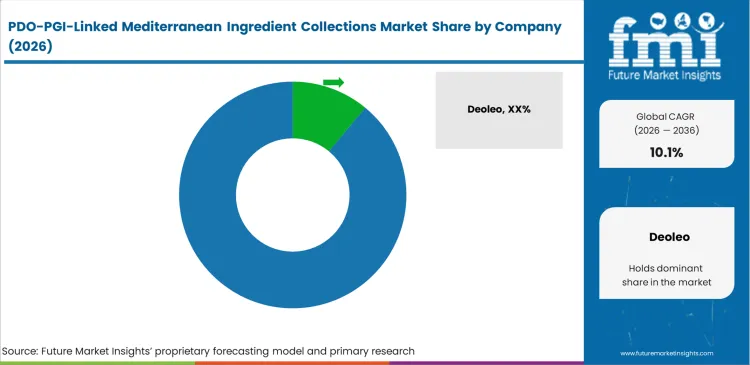
In this market, competitive strength depends less on raw agricultural access and more on the ability to manage certification requirements across multiple regions. Suppliers with strong compliance and documentation capabilities are in a much better position than smaller players trying to assemble mixed assortments on their own. Buyers looking for Mediterranean PDO and PGI ingredients usually prefer partners that can verify several regional certifications at once, rather than dealing with fragmented local suppliers one by one. That has widened the gap between large aggregators, which are better equipped to serve international trade, and smaller packagers, which often remain focused on narrow local niches. As certification rules become more demanding across export markets, finding dependable distribution partners is getting harder.
Access to supply is also shaped by long-standing relationships, not just logistics. Large aggregators have spent years building trust with local producers, while newer entrants often struggle to gain the same acceptance. Even when they invest in similar packaging or handling capabilities, many still face hesitation from rural cooperatives that prefer buyers with a proven record of payments and stable commercial terms. This gives established suppliers an advantage that is difficult to replicate quickly. In practice, those long-built networks help protect leading aggregation hubs from direct price-based competition.
At the same time, large retailers are starting to rely less on traditional intermediaries. As aggregation becomes more concentrated, some are building in-house private-label certification capabilities and working more directly with smaller cooperatives where that model is practical. This is especially visible in condiment lines and selected assortment programs that do not always require a large packaging middle layer. The shift is gradually changing how margin is distributed across the supply chain. Aggregators that offer only basic coordination and shipping support may find it harder to protect profitability as buyers look for more direct sourcing options.
Key Players in PDO/PGI-Linked Mediterranean Ingredient Collections Market
Deoleo
Monini
Acetum
Granarolo
Borges International Group
Savencia Fromage & Dairy
Scope of the Report
Metric
Value
Quantitative Units
USD 890.0 million to USD 2,340.0 million, at a CAGR of 10.1%
Market Definition
Curated multi-item assortments of authenticated Mediterranean foods bound by strict EU geographical indication protocols, packaged for cohesive retail or wholesale distribution.
Segmentation
Certification Type, Ingredient Family, Collection Format, End Use, Geography Focus, Region
Regions Covered
North America, Latin America, Western Europe, Eastern Europe, Asia Pacific
Countries Covered
Italy, Spain, Greece, France, Portugal, Croatia, Cyprus
Key Companies Profiled
Deoleo, Monini, Acetum, Granarolo, Borges International Group, Savencia Fromage & Dairy
Forecast Period
2026 to 2036
Approach
Aggregated export container volumes cross-referenced with premium retail SKU velocity metrics.
Source: Future Market Insights (FMI) analysis, based on proprietary forecasting model and primary research
PDO/PGI-Linked Mediterranean Ingredient Collections Market Analysis by Segments
Certification Type:
PDO
PGI
Mixed PDO/PGI collections
Regional quality extensions
Limited seasonal editions
Ingredient Family:
Olive oils
Cheese and dairy
Vinegars and condiments
Cured meats
Herbs, olives, and preserves
Collection Format:
Retail gift boxes
B2B sourcing assortments
Foodservice curation packs
Travel retail assortments
E-commerce discovery bundles
End Use:
Gourmet retail
Hospitality and restaurants
Corporate gifting
Specialty import distribution
Direct-to-consumer online
Geography Focus:
Italy-led collections
Spain-led collections
Greece-led collections
France-led collections
Cross-Mediterranean assortments
Region:
North America
Latin America
Western Europe
Eastern Europe
Asia Pacific
Bibliography
European Union Intellectual Property Office. (2025). “What’s on your table?” EUIPO calls out counterfeit food and beverages in the EU.
Deoleo. (2026). Deoleo increases EBITDA by 50% to €50M and achieves a net profit of €20M.
Monini. (2025). Monini official website.
Savencia Fromage & Dairy. (2025). Activity of the 1st quarter 2025.
This bibliography is provided for reader reference. The full FMI report contains the complete reference list with primary source documentation.
This Report Addresses
Specific infrastructure investments required to consolidate highly fragmented Mediterranean agricultural cooperatives for export.
Synchronized shelf-life degradation challenges impacting mixed organic matter inside rigid retail packaging.
Regulatory food fraud crackdowns forcing category managers to mandate unified consortium-backed assortments.
Trans-Atlantic logistics vulnerabilities exposing fragile glass and PDO seals to severe transit damage.
Centralized Italian export moats heavily outmaneuvering decentralized Greek and Spanish aggregator networks.
Cardboard structural engineering strategies securing massive wholesale margin improvements over loose agricultural items.
Exclusive channel distribution friction between independent specialty grocers and national supermarket chains.
Blockchain provenance technologies enabling direct farm-to-consumer verification across mixed retail pallets.
Frequently Asked Questions
What is the forecast for Mediterranean GI ingredient collections?
Escalating food fraud crackdowns force major retail chains to abandon fragmented sourcing strategies. Sourcing executives scramble to lock in recognized regional consortiums, triggering massive volume consolidation and pushing revenues to USD 2,340.0 million by 2036.
What is the difference between PDO and PGI collections?
PDO mandates that every step of production, processing, and preparation occurs within a specific region. PGI requires only one of those stages to happen locally. Compliance officers treat PDO assortments as the absolute highest tier of legal provenance protection.
Why Mediterranean GI ingredients cost more?
Authentic certification requires exhaustive compliance auditing and rigid volume limitations tied to specific agricultural yields. Retailers accept these high premiums to secure unassailable shelf integrity and shield themselves entirely from devastating counterfeit liabilities.
Why does PDO hold 58.0% share?
Compliance officers at major grocery chains categorically reject loose geographic claims on premium items. Import directors rely on strict legal frameworks to shield retailers from devastating food fraud penalties and negative consumer exposure.
How do olive oils lead ingredient families?
Verified estate bottles serve as visual centerpieces securing immediate buyer trust. Procurement directors refuse assortments lacking this critical liquid anchor, knowing consumer willingness to pay collapses entirely without high-quality oil components.
What secures retail gift boxes 33.0% share?
Visual presentation directly drives impulse purchasing during critical holiday merchandising windows. Category managers depend entirely on pre-merchandised rigid structures to build massive end-cap displays without requiring specialized labor.
Why do gourmet retailers account for 35.0% volume?
Store owners continuously hunt for unique regional stories unavailable in mainstream supermarkets. Independent grocers accept higher unit costs to secure exclusive appellations completely absent from national grocery chains.
What accelerates expansion in Italy at 10.9%?
Highly organized consortiums established export-ready consolidation hubs decades ago. Import directors effortlessly build comprehensive pallets featuring dozens of distinct appellations through single regional aggregators, bypassing fragmented supply chains completely.
How does Spain achieve 10.4% compound growth?
Massive legacy agricultural cooperatives install advanced assortment packaging lines aggressively. Operations directors monetize existing bulk production streams, capturing higher retail margins by transforming raw materials into shelf-ready bundles.
What creates operational friction during assortment building?
Sourcing aged hard cheese alongside fresh harvest olive oil establishes highly volatile expiration windows. Packagers must deliberately downgrade fresh components or face massive shrink rates when category managers mandate unified twelve-month retail shelf lives.
How do massive retailers resist aggregator consolidation?
Sourcing executives intentionally cultivate direct relationships with smaller regional cooperatives. Funding proprietary private-label certification teams decouples retailer reliance from dominant intermediary packagers, maintaining vital pricing leverage during negotiations.
Why do uncertified assortments face structural decline?
Retail buyers face immense supply chain auditing costs verifying independent suppliers. Assembling loose SKUs into cohesive shelf displays exposes retailers to severe liability, shifting purchasing entirely toward pre-verified, consortium-backed assortments.
What role does cardboard engineering play in margins?
Unified structures replace dozens of individual protective inventory sleeves. Packaging procurement managers capture immediate margin improvements through smart structural consolidation, realizing profits on presentation rather than purely agricultural inputs.
How do Italian export networks outmaneuver rivals?
Centralized consolidation points drastically reduce customs friction for massive international buyers. Rival nations lacking unified logistics infrastructure cause constant shipment delays awaiting missing certificates from isolated rural cooperatives.
What threatens mixed pallet shipments during summer transit?
Extreme container heat degrades delicate phenolic compounds inside olive oils. Quality assurance managers reject entire shipments if dataloggers reveal sustained temperature spikes, forcing costly thermal liner integrations.
How does Greece leverage island-based processing?
Specialized island cooperatives pool resources building unified mainland export facilities. Formulation officers demand distinct geographic profiles, driving specialized premium brand integrations independent of dominant Italian networks.
Why do regional chain followers demand packaging modifications?
Mid-size luxury supermarkets adopt successful formats once independent stores validate consumer interest. Category directors alter structural presentations deliberately to obscure direct price comparisons against pioneering independent grocers.
What dictates equipment choice during co-packing?
Protecting fragile PDO seals requires highly precise handling. Co-packing facility managers face critical investments in modified atmosphere packaging to prevent transit damage without compromising visual merchandising aesthetics.
How do blockchain applications alter category positioning?
Integrating QR-coded digital ledgers connects consumers directly to specific agricultural estates. Brand managers command massive retail premiums by offering unassailable digital transparency bridging regional farms directly to international consumers.
What limits rapid expansion across Eastern Mediterranean zones?
Decentralized producer networks struggle to synchronize export documentation simultaneously. Logistics planners face massive port delays attempting to aggregate specialized items without established centralized consolidation hubs.
Why do premium brands abandon single-item shipments?
Distributors signal logistical shifts by abandoning loose container loads in favor of palletized assortments. Pre-cleared collections closely tied to emerging culinary narratives generate higher wholesale margins with significantly lower customs friction.
How do travel retail formats unlock new revenue?
Re-engineering rigid boxes into compact, flight-approved configurations captures affluent returning tourists. Packaging directors unlock lucrative airport channels by condensing complex regional narratives into highly portable impulse purchases.
What role do compliance teams play in vendor selection?
Masterful regulatory compliance forces smaller packagers into highly specialized niches. Procurement directors bypass independent brokers entirely, demanding suppliers who can verify multiple different regional certifications simultaneously across mixed pallets.
Why do fresh ingredients compromise multi-item bundles?
Dynamic organic degradation impacts items differently over time. Retail buyers treating these collections as static shelf items fundamentally misunderstand decay profiles, forcing aggregators to exclude highly perishable artisanal items completely.
Dining and Cooking