
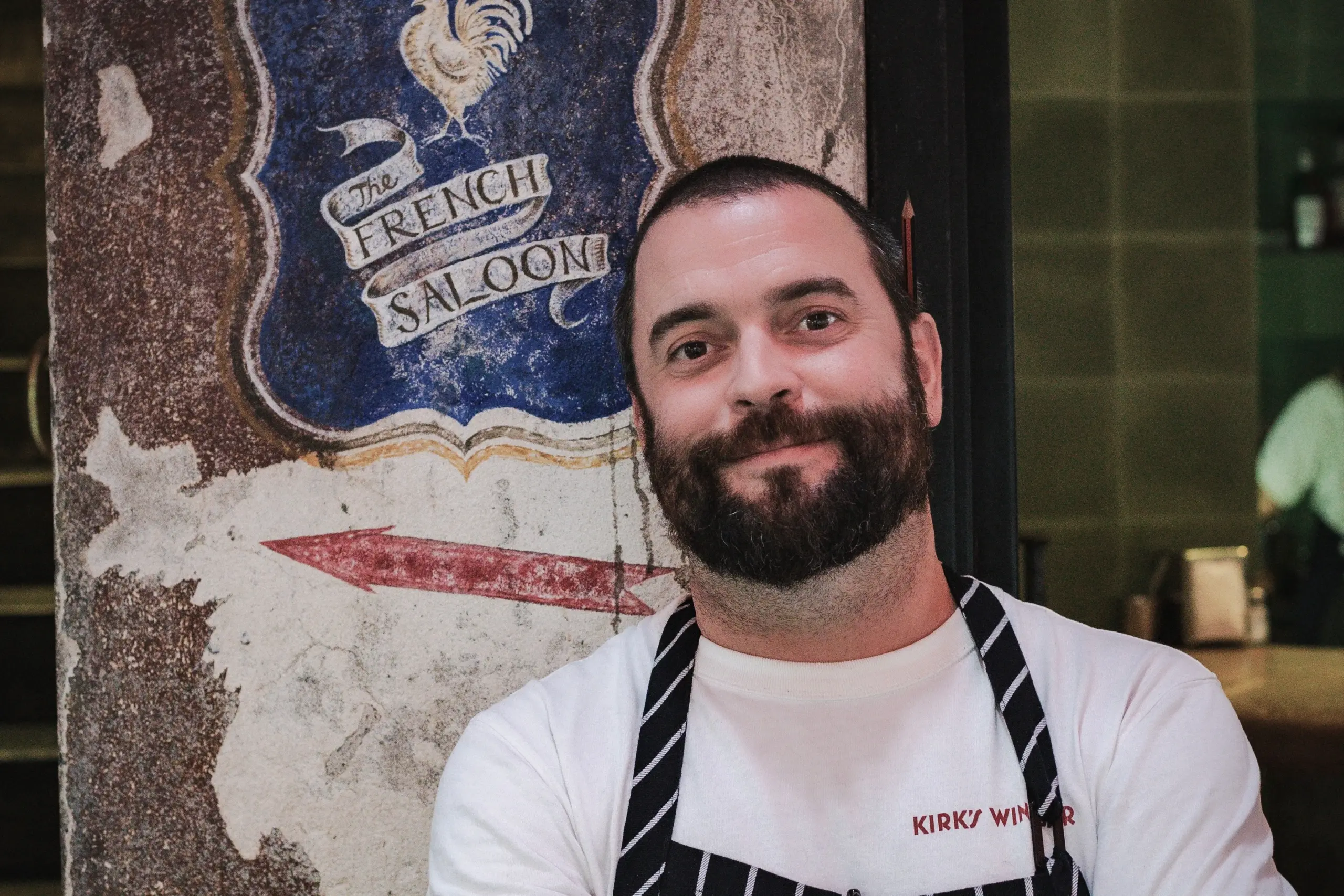
If you’ve been to European Group’s Hardware Lane venues Kirk’s Wine Bar, French Saloon or Le Pub, you’re likely familiar with Luke Fraser’s food. Fraser is the executive chef across the three interconnected spots.
He started at Kirk’s as head chef in 2011, opened French Saloon in 2016, and helped open Le Pub in winter 2025. While his executive chef job is multifaceted, Fraser still feels most at home in the kitchen. “I try to be 90 per cent in the kitchen with everyone. I hate admin, I hate paperwork. I always prefer to be wearing an apron with a knife in my hand.” We took five minute to get to know Fraser.
How did you get into the industry?
I’ve been in professional kitchens since I was 14, so that’s 27 years now. I started off as a kitchenhand – like most of us – at a cafe in Geelong, where I’m originally from, and then I begged the sous-chef to give me an apprenticeship when I turned 16. He said [he’d do it] only if I passed year 10 with all As. I’m not sure if I got all As or not, but he gave me a job anyway.
I moved to Melbourne in 2014 and started working at Cecconi’s when it was at Crown, working with Harry Lilai. That was an eye-opener. Everything I learnt in Geelong I had to learn again.
How would describe your style of cooking?
I’d cooked Italian for so long [in Melbourne]. I wanted to cook French, and I wanted to do it at a high level. I went overseas to London to train in French, and I worked for Philip Howard at the two-Michelin-starred restaurant The Square and also at his one-Michelin-starred restaurant called Kitchen W8 in Kensington. Both were very heavily influenced by old-school British French technique, and that’s what I took away from that experience, and I’ve applied that across all three venues here.
How do you think of the three European Group venues individually?
Kirk’s first and foremost is a wine bar. You don’t have to commit to a meal. You can pop in and can just have a couple of snacks like a charcuterie plate or a beef tartare. Whereas at French Saloon, you can do the exact same thing, but you can come up and commit to more of a long lunch or a long night indulging, but at the same time, it’s still a casual, non-committal approach. It’s more of a Parisian bistro sort of vibe. Then Le Pub is more affordable. It’ll be quite nourishing and comforting food, but obviously a lot cheaper for the cost-of-living crisis. We use a lot of tertiary cuts in Le Pub, a little bit of offal – not too much, so it’s still approachable.
Where does your inspiration in the kitchen come from?
I don’t think I could put my finger on any particular thing. I go to the market at least twice a week and talk to a lot of people there about what’s in season and what’s coming up in season. Just walking through and having that visual stimulation really helps.
When you’re thinking up new dishes, is it obvious which venue they belong in?
Sometimes with the creative process, you have an idea for one venue, and it ends up working better in another. When I first started before French Saloon opened, we did a snapper tartare downstairs [at Kirk’s] that I wanted to do at French Saloon. I put it on downstairs before [French Saloon] was open as a litmus test, and it became so popular at Kirk’s that I couldn’t really take it off for a couple of years, because people would have hung me out to dry.
The presentation of the roast rock flathead at French Saloon is so striking. Where did that idea come from?
In London, they’ve got monkfish and it’s amazing – it’s like cooking chicken. Nine times out of 10, it’s cooked on the bone, rested and served on the bone. Rock flathead is probably the most similar fish that I’ve found to purvey those sorts of qualities where it’s quite a meaty texture and it gets quite gelatinous from cooking it on the bone. We get in a whole flathead and take out all the ribs, but we keep it attached to the spine. We’ll truss it back onto the spinal cord, so then you still get that gelatinous texture from the bones. It’s a lot of work. But I think with the greatest work comes the greatest reward.
Of the three venues, is there a kitchen that you feel most at home in?
I always feel comfortable in each kitchen – each kitchen has a different crew and a different sort of vibe about it, and I really enjoy getting amongst that. But if I had to get changed and walk into a kitchen not knowing what the day was going to bring, I’d walk into French Saloon. For the first half of the journey, that’s what I worked so hard to get open. It’s the mothership of the building.
Dining and Cooking