
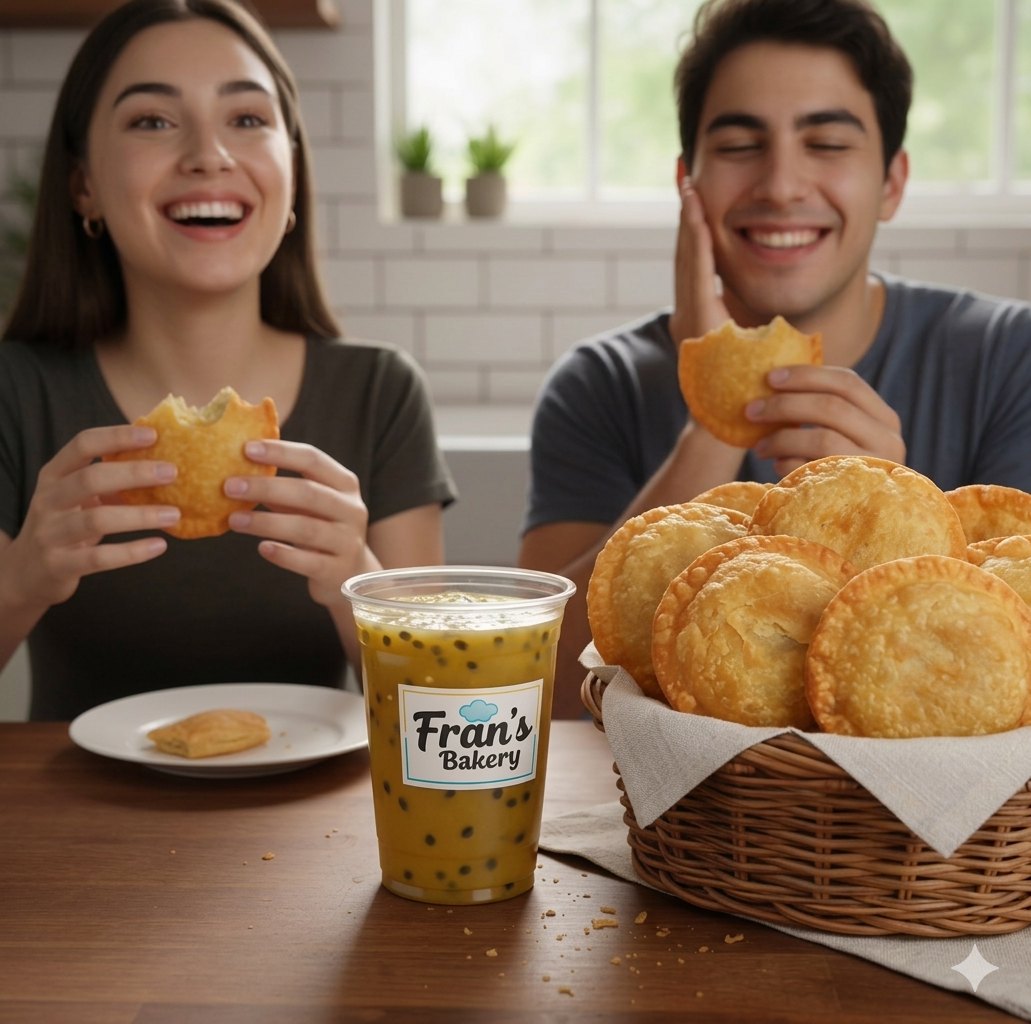
This photo illustration generated with AI was used to advertise for Fran’s Bakery, a Venezuelan restaurant in Spring.
Susana De Carlo
A photo illustration generated with AI to advertise for Cavatore Italian Restaurant.
Cavatore Italian Restaurant
The pastelitos nestle in a wicker basket, golden and precisely crimped. Behind them two young, smiling people bite in. Their skin is smooth. Their nails are round.
Posted to the Facebook account of a Venezuelan restaurant in Spring called Fran’s Bakery, the photo looks perfect. A little too perfect.
It is, of course, AI. And it’s far from the only AI-generated image used to promote a local restaurant.
Article continues below this ad
MORE FOOD NEWS: Black Restaurant Week showcases 60+ Black-owned Houston eateries
In the past several months, videos of talking boba and pictures of too-glossy food have saturated Instagram and local Facebook foodie groups. Some images are obviously fanciful: Penguins did not stop at an Indian restaurant in the Heights. Some look like caricatures or artsy posters. Others look much closer to reality.
For restaurant owners, the technology can save time and money. For diners, it can make it harder to tell what’s real. If they visit, will the restaurant’s interior look like that? Will the food be plated the same way?
Photo illustrations generated with AI, based on real photos of food from Fran’s Bakery.
Photo illustrations generated with AI, based on real photos of food from Fran’s Bakery.
“You have to be very careful, in all the food and other services,” said Susana De Carlo, the marketing specialist who generated that image for Fran’s Bakery.
Article continues below this ad
De Carlo prefers to use real photos. But when the Fran’s Bakery team is too busy for a photo shoot, she sometimes generates a picture or video that looks as close to the real deal as she can get it. When images of food are involved, she makes them as accurate as possible, De Carlo said.
Francis Uzcategui, the co-owner of the restaurant, said AI has been “very helpful” in alleviating her work load.
But some consumers say they feel turned off by food photos that appear fake. Ryan Kasey Baker, a freelancer for Houston Food Finder who’s often on local Facebook groups, said he sees them everywhere.
“If (restaurants) don’t trust their food enough to sell it,” he asked, “why would I want to spend my own money?”
Article continues below this ad
The business case
When Federico Cavatore’s sister retired in December, she left him to manage the family-run Cavatore Italian Restaurant on his own. Suddenly, he had to handle accounting and HR, on top of day-to-day tasks and marketing.
Cavatore came to dread the tedium of setting up social media posts every day. So he turned to ChatGPT.
Two photo illustrations generated with AI, used to advertise for Cavatore Italian Restaurant.
Two photo illustrations generated with AI, used to advertise for Cavatore Italian Restaurant.
He asked it to create imagery in wide-ranging styles, most of them plainly not real. One post shows a caricature of his employees washing dishes. Another features the pope inviting guests to Cavatore for Lenten specials. A third shows an actual image of his salmon dijon penne, edited by AI so that it hovers in front of a blurred, warmly colored restaurant interior.
Article continues below this ad
Longtime customers complimented Cavatore on the playful approach of his Facebook page. Plus, he got to exercise his creative side.
“It’s been amazing. It really has helped quite a bit,” Cavatore said. “I love it, and it’s a lot of fun.”
Left: A photo of salmon dijon penne at Cavatore Italian Restaurant. Right: A photo illustration of the penne, generated with AI.
Top: A photo of salmon dijon penne at Cavatore Italian Restaurant. Bottom: A photo illustration of the penne, generated with AI.
Large restaurants with investors, expensive build-outs and celebrity chefs can afford professional photographers and a marketing team. A lot of family-owned restaurants cannot. AI offers a faster, cheaper alternative — not to mention a chance to experiment with their image in new ways.
When Inna Klebanskaya opened Slice of Venice in Spring last year, she hired a marketing team. She paid them about $1,000 a month and wasn’t happy with the results.
Article continues below this ad
So she took over, posting on at least four platforms regularly while running the restaurant. It took too much of her time; AI helped simplify the work. Klebanskaya generated images of a frowning pizza when the restaurant was struggling, and a pizza with a clock on it to indicate a change in hours.
Then negative feedback rolled in. Customers and online commenters told her they’d rather see real food. “People thought it was enhanced too much,” she said.
Now her Facebook feed is full of real photos of pepper-topped pizzas and crispy mozzarella sticks. Klebanskaya wishes she could rely more on AI. But she doesn’t want to drive people away.
That’s one reason why Nick Barnes, creative director at Austin-based photo and video firm 51st & Eighth, mostly uses AI pictures internally in his work. For Houston’s Zanti Cucina Italiana, for instance, he asked AI to mock up a chocolate soccer ball dessert. He showed it to the chefs and restaurant owner as an example of a World Cup special they could run.
Left: A photo of Zanti Cucina Italiana. Right: A photo illustration generated with AI, used to advertise a New Year’s Eve party.
Top: A photo of Zanti Cucina Italiana. Bottom: A photo illustration generated with AI, used to advertise a New Year’s Eve party.
He’s also made a few external images: For a New Year’s Eve party, for instance, Barnes made a rendering of Zanti filled with balloons to post online.
And for another client, who he declined to name, he’s begun looking into a fully AI advertising campaign. It speeds up the time it takes to do promotion and lets the food and drink look as perfect as possible.
Barnes knows this is a tricky balance, though, especially as consumers get “tired” of AI.
“Food is a craft, and it’s an art, so that’s something where we don’t necessarily want to take away from the experience or what is true to the restaurant,” he said.
Confusion around AI
Food photos have been polished for years, long before AI. Styling, editing and filters can all change how a dish appears.
“I don’t really see AI as any different than somebody that’s spray painting a turkey on TV to make it look juicy,” said John Frels, who sees plenty of AI posts on the Houston Heights Foodies Facebook group he runs.
But in some instances, AI imagery has created confusion all its own.
When a new dual-concept restaurant combining Crawfish Cafe and Pho Prime opened this spring, it splashed photos of its mural all over social media. A crawfish grinned; a woman looked out from red sunglasses.
Commenters promptly popped up to criticize: “AI slop walls is a WILD choice.” The restaurant should have used real artists, they said.
It did. Mamba Hospitality Group founder and CEO Kiet Duong said the company used AI to generate mock-ups for the wall but hired two local artists, Jesse de Leon and Alex “Donkeeboy” Roman Jr., to flesh it out and turn it large-scale.
Online, Duong said, people were “just commenting on stuff that they don’t know anything about.”
On the flip side, there are also AI images that fly under the radar. At Fran’s Bakery, Uzcategui said some of her customers have told her they think AI-generated content is real.
What’s known as “hallucination,” when AI generates incorrect information, can also create problems. In March, as Paul Miller scrolled on Instagram, he came across a video from real estate agency Houston Properties Team. In it, an AI avatar of company founder Paige Martin described a new steakhouse in Garden Oaks called Jax on the Tracks.
READ MORE: From crawfish to a Mexican cafe, Houston saw these 12 bars and restaurants open in February
Miller was curious about the restaurant — and shocked when he heard its name. Miller owns Jax on the Tracks. And he can say with confidence that it’s a family-friendly bar and grill, not a steakhouse. He commented on the post, and the agency took it down.
“I think AI is fantastic,” Miller said, “but I also think it takes a human touch to make sure that you know that all the information is correct.” (He’s also not too annoyed about the mishap; promotion is promotion, after all.)
The real Paige Martin, who runs the account with Bob Martin, posts AI-generated videos about restaurants both because she enjoys eating out and because they draw traffic to her page. They typically feature her AI avatar, “pAIge,” plus AI-generated B-roll. AI-created crawfish might spill out of a bowl to illustrate a video on a crawfish spot, for instance.
After the error about Jax on the Tracks, the Martins added a redundancy to try and prevent it from happening again. Another AI system would fact-check new videos.
“Our goal is to give an essence of what the experience is,” Paige Martin said, not to share an exact recreation of it. And she has heard from friends excited to learn about new restaurants from “pAIge.”
Nevertheless, many marketing professionals are warning clients to steer clear. Marie Elgamal, publicist and owner of Pop Studios PR in Houston, said she takes a “hard no” on using AI-generated photos and videos to promote her clients.
“The audience, the viewers, the potential consumers and customers, they want to know what they can expect from a restaurant,” Elgamal said. “People want to see the actual food, the actual drink, the space, the vibe.”
She prefers phone photos, even imperfect ones, to AI.
But plenty of others don’t. So for now, as AI becomes more accessible, restaurants and diners alike are still figuring out where to draw the line.
Dining and Cooking