
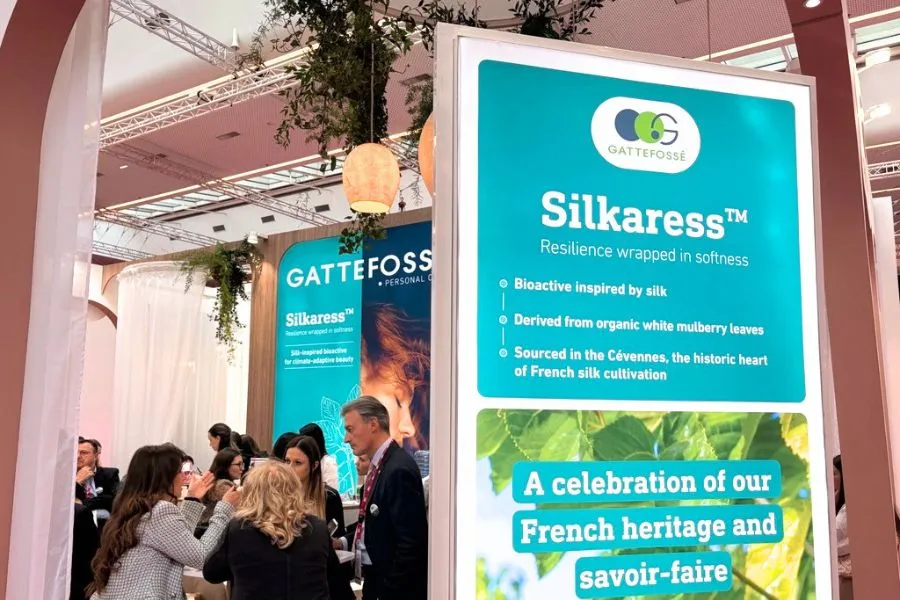
French ingredient supplier Gattefossé has unveiled Silkaress, a silk-inspired active designed to help skin adapt to increasingly changing environmental conditions, at the ongoing In-cosmetics Global 2026 tradeshow this week (April 14–16).
The ingredient is positioned as a “climate-adaptive” solution and aims to actively support skin resilience amid fluctuating temperatures, humidity shifts, pollution, and indoor climate transitions.
Personal Care Insights speaks with Laurie Canel, product marketing leader of Active Ingredients at Gattefossé, about the inspiration behind the ingredient. She tells us live from the show floor in Paris, France, that Silkaress is based on the idea of mimicking the softness and protective properties of the silk cocoon.
“The silk cocoon is produced by the silkworm, which has a unique food supply through a plant called white mulberry. This insect eats the leaves of the white mulberry for approximately one month, and then it will start producing silk and wrap itself into a cocoon, which will protect it during its most vulnerable stage — the metamorphosis into a butterfly,” Canel explains.
“Our R&D scientists were intrigued by this alchemy between the insect and the plant, wondering ‘What if we could take benefits from the white mulberry leaves, from the principle of producing a cocoon of silk for protection?’ We wanted to create an active solution that helps protect the skin against unpredictable changes in our climatic environment.”
Climate adaptive cosmetics
According to Gattefossé, there is a growing consumer demand for adaptive skin care solutions, and brands are urged to formulate products for the visible impact of climate change on skin health.
Innova Market Insights data further indicates that there has been a 4% CAGR in personal care launches with anti-pollution claims from 2020 to 2024, with Europe accounting for half of these launches.
“In the summer, we have heat waves, and the climate outside is either very humid and hot, and then you go inside where there is air conditioning, and the climate suddenly becomes dry and cold. So what happens to the skin in that type of condition?” asks Canel.
.webp) Industry professionals explore new climate-adaptive skin care solutions on the show floor.To answer the question, Gattefossé studied different skin cell adaptation systems. At a mechanistic level, Silkaress works by modulating protein phosphorylation in keratinocytes — a key process involved in cellular adaptation.
Industry professionals explore new climate-adaptive skin care solutions on the show floor.To answer the question, Gattefossé studied different skin cell adaptation systems. At a mechanistic level, Silkaress works by modulating protein phosphorylation in keratinocytes — a key process involved in cellular adaptation.
By activating the signaling pathways that link epidermal cohesion and vitality, the ingredient aims to reinforce the skin barrier and improve its ability to respond to environmental stressors.
The ingredient was then further optimized using AI to map its activity in skin cells.
“Going deeper into AI analysis, we could identify that the ingredient was able to modulate phosphorylation events through signaling pathways that are essential for the epidermis’ adjustment to external conditions,” Canel explains.
Three-fold efficacy
The company assessed Silkaress’ ability to modulate phosphorylation through multiple rounds of testing. The first examined barrier function at the level of epidermal differentiation, by looking at cell junctions, cell growth, and global skin viability. Based on this data, the company was able to study how the ingredient helps cells adapt to climatic conditions.
“We used a 3D skin model that has been exposed voluntarily to climate stress, alternating between hot and cold conditions. We looked at different things based on this model: first, the production of filaggrin, which is a protein involved in the barrier function. We found that this filaggrin expression has been boosted with the use of Silkaress by 160%,” Canel says.
The company also measured Silkaress’ permeability of the barrier function. According to Canel, the ingredient helped reinforce the skin barrier by 109%.
.webp) Gattefossé presents its latest ingredient innovation at In-cosmetics Global 2026 in Paris.After these tests, Gattefossé proceeded to a two-part clinical trial to measure the ingredient’s effect on “real people” rather than isolated skin cells. The first part was a clinical study, where women were asked to use a cream containing 2% Silkaress for one month, in comparison to a placebo.
Gattefossé presents its latest ingredient innovation at In-cosmetics Global 2026 in Paris.After these tests, Gattefossé proceeded to a two-part clinical trial to measure the ingredient’s effect on “real people” rather than isolated skin cells. The first part was a clinical study, where women were asked to use a cream containing 2% Silkaress for one month, in comparison to a placebo.
“Three types of efficacies came from this study. The first one was an improvement in hydration, including more intense hydration, but also more homogeneous hydration. We also observed an improvement in terms of micro-relief for the skin with smoothing properties, which in turn translated into a silk-like touch effect. This was measured through an innovative device named the Touchy Finger.”
The Touchy Finger, Canel explains, is a connected object that attaches to the top of your finger to assess the softness of skin. “It records the different vibrations and frictions emitted by the skin, and if the skin has been smooth enough through the ingredient, then the softness parameter increases,” she says.
The second part of the clinical trial was a well-being evaluation study. Using a Neuron test, women were asked to look at themselves in the mirror and answer different questions regarding their physical appearance.
“The goal was to characterize the emotional responses of using Silkaress, regarding [the women’s] perception of their skin’s comfort and its physical appearance,” says Canel.
“At the beginning of the study, they described their skin as uncomfortable, dry, or tight. At the end of the study, it is more positive, like ‘my skin is less tight, I like my skin, it’s more comfortable,’” she concludes.
With live reporting by Sabine Waldeck at In-cosmetics Global 2026 in Paris, France.
Dining and Cooking