
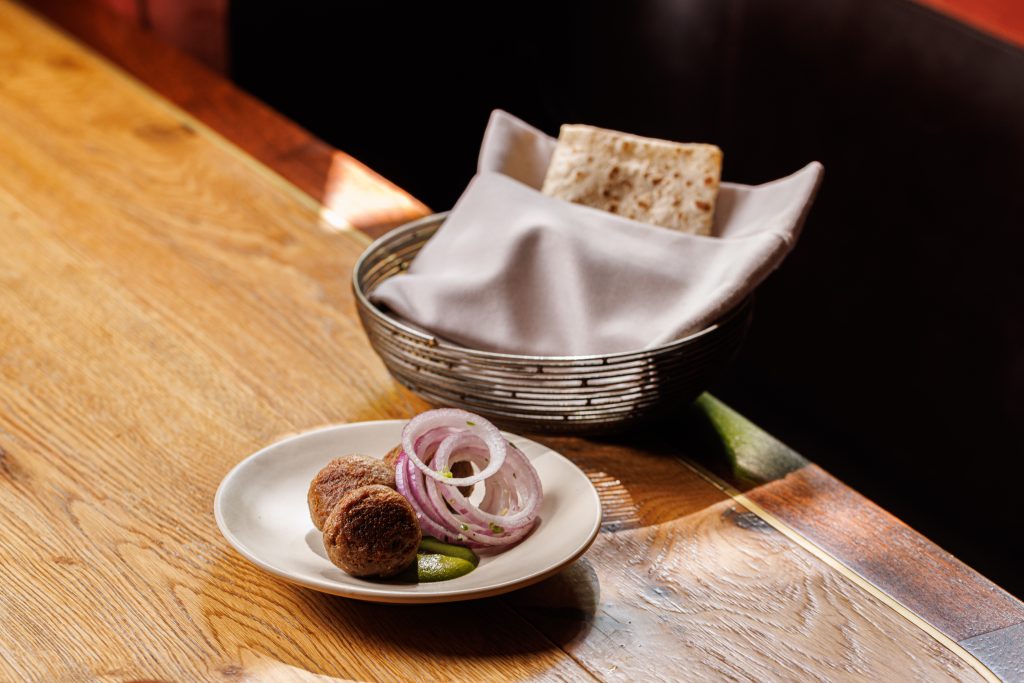

From Oxford physicist to award-winning chef, Chet Sharma blends memory, science and storytelling to create a deeply personal take on modern South Asian cuisine.
Chet Sharma has always lived in two worlds. Growing up in Berkshire and visiting family in India exposed him to cultural and culinary diversity. Studying chemistry at University College London, he DJed at the Ministry of Sound to fund his education. This taught him grit and allowed for self-expression. Earning a DPhil in Condensed Matter Physics from Oxford while pursuing his love for cooking showed him that remarkable achievements exist in both academia and creativity.
Today, Chef Sharma channels his talents into BiBi, his award-winning South Asian restaurant in London. He named the restaurant after the extraordinary cooks who influenced him—his two grandmothers. Naming BiBi was core to its creation, as he aims not to recreate his favorite childhood dishes, but to honor them.

“Nostalgia plays a central role, but I’m careful with it,” he explains. “I’m not trying to recreate dishes exactly as I remember them—that wouldn’t be honest, because memory itself isn’t exact. What I’m trying to do is capture the emotional essence of those experiences. When someone eats a dish at BiBi, they might not recognize it visually, but there should be something deeply familiar in the flavor. That’s the goal—that moment where something feels instinctively ‘right,’ even if you can’t immediately explain why.”
His academic background is important to his culinary processes. Although his recipes are not science experiments, each one requires intentionality, refinement, and precision to reach the right texture and flavor.
YOU MAY ALSO LIKE: THIS RESTAURANT SURVIVED COVID—AND CAME OUT WITH A MICHELIN STAR
“Having a background in academia trained me to think in systems—to test, refine and repeat. In a restaurant environment, that becomes incredibly valuable because there are so many moving parts. From sourcing to service, everything benefits from structure and precision.
On the food side, it allows us to be very deliberate. When we’re trying to recreate a memory, say, something as simple as nimbu pani, we’re breaking it down into acidity, sweetness, aroma, texture,” he notes.


Storytelling recurs in Sharma’s cooking. It not only reflects his upbringing but also sparks familiarity for those dining at BiBi. To achieve this, he never scrimps on ingredients, as each plays an important role in his recipes.
“It’s difficult to isolate one ingredient because BiBi is really about the relationship between ingredients, but if I had to choose, I’d say spices, specifically the way we source them,” he remarks. “We work with single-origin, pesticide-free spices from India, often from heritage varietals. For me, they’re not just flavoring agents—they’re carriers of geography, history and culture. What’s important is how those spices interact with British produce. That’s where BiBi really exists—in that intersection.”
YOU MAY ALSO LIKE: ELEVATED WORLD-CLASS DINING EXPERIENCES WORTH THE JOURNEY
With each dish he creates, Sharma seeks to change how Indian food is perceived. He aims not just to honor South Asian cuisine, but to bridge cultures and create something uniquely personal.
“What I hope guests take away is a shift in perspective. Indian food is often misunderstood—it’s seen as either traditional or modern, heavy or refined, but rarely both. What we’re trying to show at BiBi is that it can exist in a much more fluid space,” he explains. “I want people to feel that they’ve experienced something personal. Not just a meal, but a story—of migration, of memory, of translation between cultures. And ultimately, I hope they leave with a sense of curiosity. That they realise Indian cuisine isn’t one thing, it’s a vast, evolving landscape. And what we’re doing at BiBi is just one very personal expression of that.”
Dining and Cooking