
 Escape to ancient times at San Antonio Museum of Art
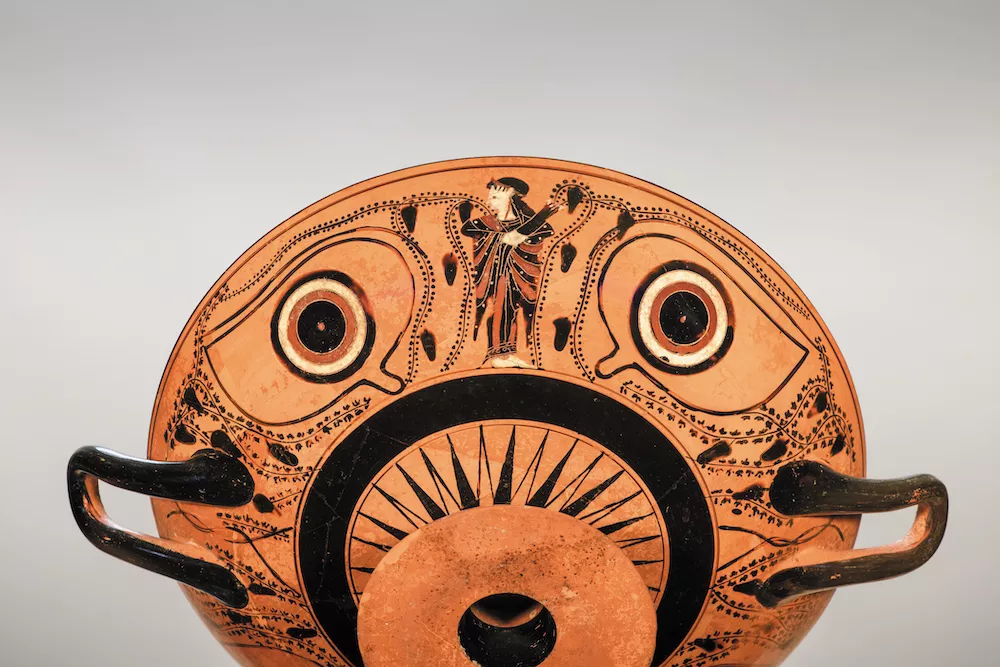
200 W Jones Ave, (210) 978-8100, samuseum.org Sure, air conditioning wasn’t invented yet but ancient times had some other stuff that was pretty cool. The cup pictured here dates from around 520 B.C. Credit: Courtesy Photo / San Antonio Museum of Art
Here’s a phrase to test your Latin prowess: In vino veritas.
If you guessed “in wine there is truth,” you’d be halfway there. The original, Roman meaning is said to be more like “after a few glasses of wine, the truth will out.” But the saying has held sway since the days of the ancient Greeks.
A look back might be in order in an era when wine — future tariffs notwithstanding — is presently in good supply, but truth might be harder to come by.
Vino has been produced and consumed since at least 6000 B.C. That’s quite a track record. It might have taken a few thousand years, but by the first millennium B.C., in Greece and its surrounding islands, wine had evolved into an important part of cultural identity.
But you don’t have to read Homer to put early Greek wine culture in context. A quick trip to the San Antonio Museum of Art should suffice. Here, I recently viewed the permanent collection of Ancient Greek pottery through a new, wine-focused lens. Turn left at the main lobby.
Much of the collection is the result of a bequest from the late Gilbert Denman, who clearly had an eye for its graceful forms, dramatic colors, and stylized decorations.
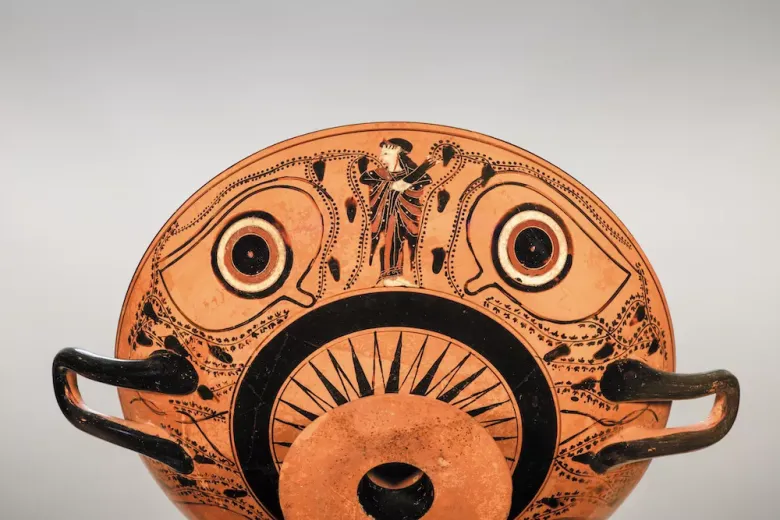
And speaking of eyes, why not start with a particular piece. Eyes are a prominent feature on the underside of a black-figure eye-cup dating from around 520 B.C.
But let’s back up just a bit to acknowledge the importance of the Greek god Dionysus. This mercurial figure held dominion over multiple realms — not just wine but also grape cultivation, harvest, festivity, pleasure, fertility and even theater. Google the painting by Caravaggio for an especially decadent interpretation that acknowledges the god’s androgynous attributes and reinforces his ultimate role as a symbol of transformation of all kinds. With so much to worship, many cults arose.
One aspect of those cults was surely the symposium, the cultivated gathering, primarily of men, that often followed a banquet and centered on such activities as consumption of wine, civilized discourse, and recitation of poetry — all appreciated while reclining on low couches or platforms. Seems inordinately uncomfortable, but perhaps the discomfort kept the mind alert — until the very end, at which time a ritual slinging of the dregs might occur. Decorum is often the first mask to be shed.
Which brings us back to SAMA’s eyed cup, which is a kylix, or drinking vessel. With its wide, shallow form, it too, seems somewhat awkward from a purely functional point of view. Think martini glass but bigger and heavier. But moderation in drinking was expected — at least at the outset of an evening — so this two-handled, footed bowl was meant to be passed around from one recumbent partaker to the next.
With its lustrous, red and black embellishments, it was also meant to remind the drinker of cultural context. Decorations might depict charioteers, lissome youths in conversation or Dionysus himself. Adorning this kylix, he’s flanked by grape vines, possibly paired with his consort, Ariadne, and bracketed by those eyes. In the bottom of the bowl, a fearsome face may also remind one not to overdo it.
Before wine hit cup, it was stored in tall, clay amphorae, often lined with pitch or resin as a barrier to porosity. Though they tend to be less decorative than the drinking cups, SAMA has several versions of these in varying sizes, some meant for shipping wine, since the Greeks traded widely.
Between amphora and kylix, though, was yet another container, the krater. On these, the ancient Greeks spared no decoration.
The krater was meant for mixing wine with water prior to serving and, often with the inclusion of snow, for cooling it. For good example, seek out SAMA’s Red Column Krater. Both sides depict “the drunken procession, or komos, that followed the symposium,” according to the museum’s label. Unencumbered by bothersome tunics, the men hold a kylix, a wineskin and another, deeper drinking cup called a skyphos.
But what of the wine that led to such an apparently unfettered aftermath? Historians tell us the Greeks added water to promote sobriety. Indeed, those who drank their wine uncut were considered uncouth. However, that was only part of the equation. Wine was also consumed for reasons of nutrition and because it was frequently safer than straight water.
Taste may have had something to do with dilution as well. Knowing nothing else, the ancient Greeks likely thought highly of many of their wines, especially those coming from the Aegean islands. Some were even considered suitable for a modest period of aging in amphorae capped with clay stoppers sealed with more resin. A taste for resin, which survived until recently, may well have been cultivated out of necessity.
Imagine the reds, then, dauntingly dark and rife with sediment — they were often passed through a strainer prior to serving — and the whites likely amber, often sticky-sweet or scented with herbs, and occasionally even adulterated with seawater. Few of the indigenous grapes that produced them are cultivated today, at least in commercial quantities.
Free (members, children under 12 and Bexar County residents who visit 4-7 p.m. Tuesday or 10 a.m.-noon Sunday), $12 (students) or $22 (general admission), 10 a.m-7 p.m. Tuesday and Friday, 10 a.m.-5 p.m. Wednesday, Thursday, Saturday and Sunday, San Antonio Museum of Art, 200 W. Jones St., (210) 978-8100, samuseum.org.
Subscribe to SA Current newsletters.
Follow us: Apple News | Google News | NewsBreak | Reddit | Instagram | Facebook | Twitter | Or sign up for our RSS Feed
Related Stories

The San Antonio Museum of Art’s spring exhibition blends new photography and historical works depicting Hindu deities.

San Antonio artist Phil Ross has been building his tower of junk for decades. Now he’s fighting the city to keep it.
The annual festival will return Thursday, May 15, bringing 30-plus food and drink vendors plus a cooking competition.
This article appears in Apr 30 – May 13, 2025.
Dining and Cooking