
Goskova Tatiana/Shutterstock
Whether olive oil is the star of your kitchen or just another ingredient stuffed away in the pantry, it actually matters what kind of bottle it comes in. After all, olive oil will eventually go rancid, and the way it’s stored will affect how long it stays fresh. To find out more about the best kind of bottle for olive oil, we reached out to Patrick Martin, the owner and miller at Frantoio Grove.
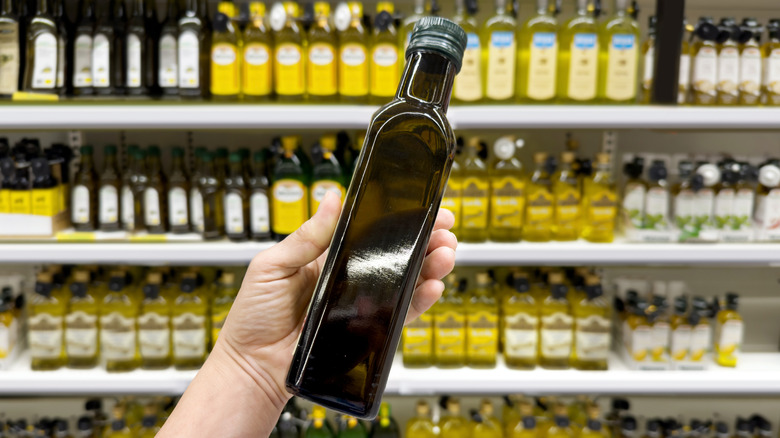
“Olive oil storage and quality are complex problems that manufacturers need to consider when addressing packaging,” Martin told The Takeout. “Most olive oil manufacturers that do care about quality are packaging in dark glass or metal containers.” Light — both UV and artificial — can hasten olive oil deterioration, but darker and opaque packaging shields olive oil from breaking down due to the light.
However, Martin said, “Plastic, whether clear or dark, is more permeable to oxygen and is never ideal, although dark or opaque plastic is certainly better than clear plastic.” Then, there’s also the problem of plastic polluting food. “Additionally, BPA is known to leach into olive oil, and it can sometimes be difficult to verify that the manufacturer is using a BPA-free plastic,” Martin said. Olive oil packaged in glass bottles or food-safe lacquer-coated metal containers doesn’t have these same issues, since they protect against oxidation better and don’t contain BPA.
All that being said, Martin did note that a plastic bottle isn’t an immediate write-off for him. ” … I wouldn’t necessarily write off an olive oil for the sole fact that it’s packaged in a plastic container, [but] it would indicate the priorities of the manufacturer, and I generally recommend steering away from those olive oils when possible.”
Is there any way around the plastic olive oil bottle dilemma?
LADO/Shutterstock
Given just how many olives it takes to make a bottle of olive oil, it makes sense you’d want to preserve it. And although cooking oil is a kitchen essential used in nearly every dish under the sun, it still takes a while to work your way through a bottle. With that in mind, we asked Patrick Martin if transferring olive oil from a plastic bottle to a better container would help. “You could probably find some minor benefits from doing this,” he said, “but the majority of the time the olive oil is going to spend in that container has likely already elapsed by the time the consumer gets the olive oil home to their kitchen.”
That isn’t to say it doesn’t matter how you store olive oil once you get home, but if it takes a few months to empty out a bottle of olive oil and that same bottle sat in a warehouse somewhere for a year already before you purchased it, then yeah, quite a lot of damage has already been done. There isn’t usually a date given on the label that tells you when the olive oil was bottled, but on higher-quality oils, you can usually find a harvest date of the olives. Because olive oil tastes better fresh, this is a good thing to look out for regardless of packaging, but it can be extra helpful when determining whether to purchase an oil packaged in plastic.
Dining and Cooking