
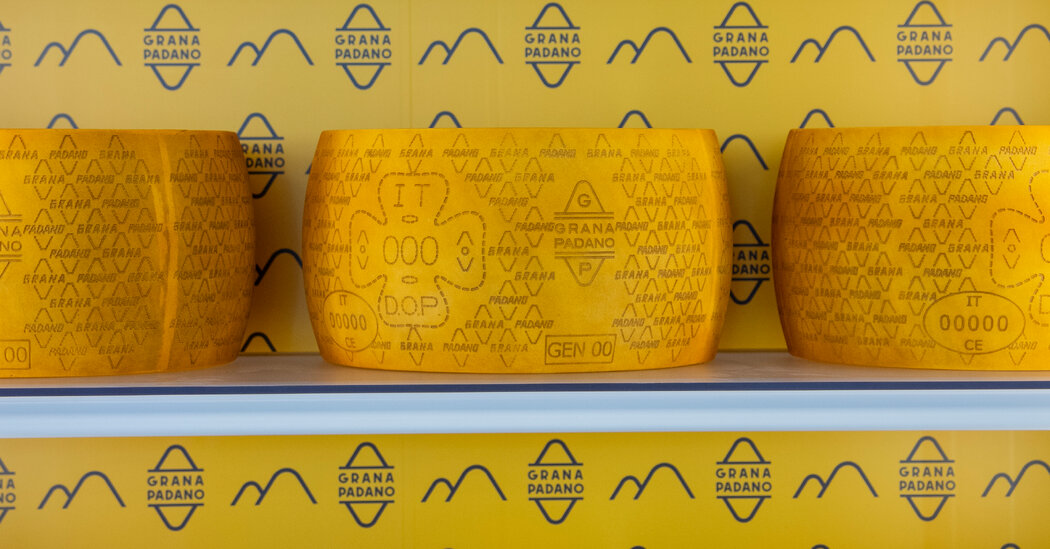
If Italian food had an athlete at this year’s Olympic Games, it would be Grana Padano. The crumbly, less expensive big brother to Parmigiano-Reggiano seems to be everywhere.
A wedge floats next to an Alpine skier on billboards in Milan. Facebook ads show the Italian skiing star Sofia Goggia taking a little jog followed by a big bite of Grana. In the athletes’ villages, flurries of grated Grana crown bowls of pasta and risotto, little bars wrapped in Olympic logos are handed out as energy hits and afternoon snack hour features cheese baked into high-protein muffins.
The idea, said Mirella Parmeggiani, the marketing and communications manager in Italy for the consortium that controls the cheese’s production, is to make it “an ally in the healthy diet of sports enthusiasts.”
The consortium is spending about $6.5 million at the Games, which includes giving away a lot of free cheese at Olympic venues. The effort builds on years of investment by Grana Padano’s producers in scientific research to play up attributes, such as a high protein content, that they say make the cheese a healthy snack.
The return of the Olympics to Italy after 20 years has offered a golden opportunity to promote Italian food and wine on the global stage. Italy reached a record $70 billion in food exports in 2025, in large part by highlighting the quality and reputation of exports like Gorgonzola and Prosecco (also a big Olympic sponsor).
“The state is savvy about leveraging international attention, and Italy uses food as soft power,” said Katie Parla, an author and scholar of Italian food.
Many of Italy’s premier foods are produced under the European Union’s “protected designation of origin” system, which sets strict standards for how and where regional specialties can be made. To sell Prosciutto di Parma, for example, the ham must come from pigs that were raised in one of 11 regions and fed a special diet. The meat must be aged for at least 14 months in the city of Parma.
More than 850 of Italy’s most notable food and wine products are part of the system. Producers pay for the designation. Various branches of government regulate it, lend money to farmers and kick in for marketing. The government also fights against fraud and impostors. That’s why Kraft can’t sell its shelf-stable green containers of “100 percent grated Parmesan cheese” in Italy.
Grana Padano, which monks began making in the 12th century, is a predominant cheese in Italian households, and accounts for more than 40 percent of all hard cheese sold by retailers. The cheese must be aged at least nine months, and the milk must come from one of five regions in Northern Italy, including the ones hosting the Games.
The Milan-Cortina Games would not be the first time Italian food has reaped economic benefits from an association with the Olympics. After the 2006 Winter Games in Turin, Italy, the surrounding Piedmont region enjoyed a bump in global recognition for its Barolo wine and gianduja, the hazelnut chocolate that inspired Nutella.
Parmigiano-Reggiano — which can be made only in parts of two regions and must be aged for at least 12 months — was the first in Italy to position itself as the cheese of Olympic champions, when its consortium sponsored the Italian gymnast Giorgia Villa in 2021. A photo shoot featured her interacting with several large wheels of cheese, performing splits atop four of them.
Ms. Villa injured her ankle and missed that year’s Summer Olympics in Tokyo, and Parmigiano-Reggiano didn’t renew the sponsorship. But in 2024, at the Paris Games, she earned a silver medal, and images of her cheese-wheel gymnastics went viral.
Big Parma has moved on to other sports. In 2025, it became a partner with the New York Jets, which means that fans can enjoy a “cheese cam” at home games and stadium food made with Parmigiano-Reggiano. Its consortium is sponsoring professional tennis tournaments, and in November hired United Talent Agency to be its Hollywood agent.
Grana, meanwhile, has leaned into the Games — not that it’s a competition. But some Italians worry that the size of the big cheeses and the emphasis on them are sidelining regional diversity.
Cheese makers in the Valtellina valley, where the towns of Bormio and Livigno are hosting Alpine skiing and snowboarding at the Games, had worried that they would be prohibited from marketing their Bitto and Valtellina Casera cheeses to spectators in any official capacity.
To their great relief, Grana Padano didn’t get in their way. Visitors in Bormio can wander through a sponsored food festival and sample both Grana Padano, which produces nearly six million wheels a year, and the rare Storico Ribelle, whose 12 cheesemakers in the Bitto Valley sometimes turn out less than 3,000 wheels a year.
“Grana Padano and Parmigiano-Reggiano are national treasures in terms of cheeses, but these big companies can put a little bit of shade on the large variety of beautiful local cheese we have in Italy,” said Eugenio Signoroni, an Italian food journalist.
Still, what’s good for the big guys can also be good for the little ones, he said.
“The fact that they have become players at the level where they can compete with Coca-Cola and those kinds of brands at an international event like the Olympics,” he said, “is great for all of Italy.”
Follow New York Times Cooking on Instagram, Facebook, YouTube, TikTok and Pinterest. Get regular updates from New York Times Cooking, with recipe suggestions, cooking tips and shopping advice.
Dining and Cooking