
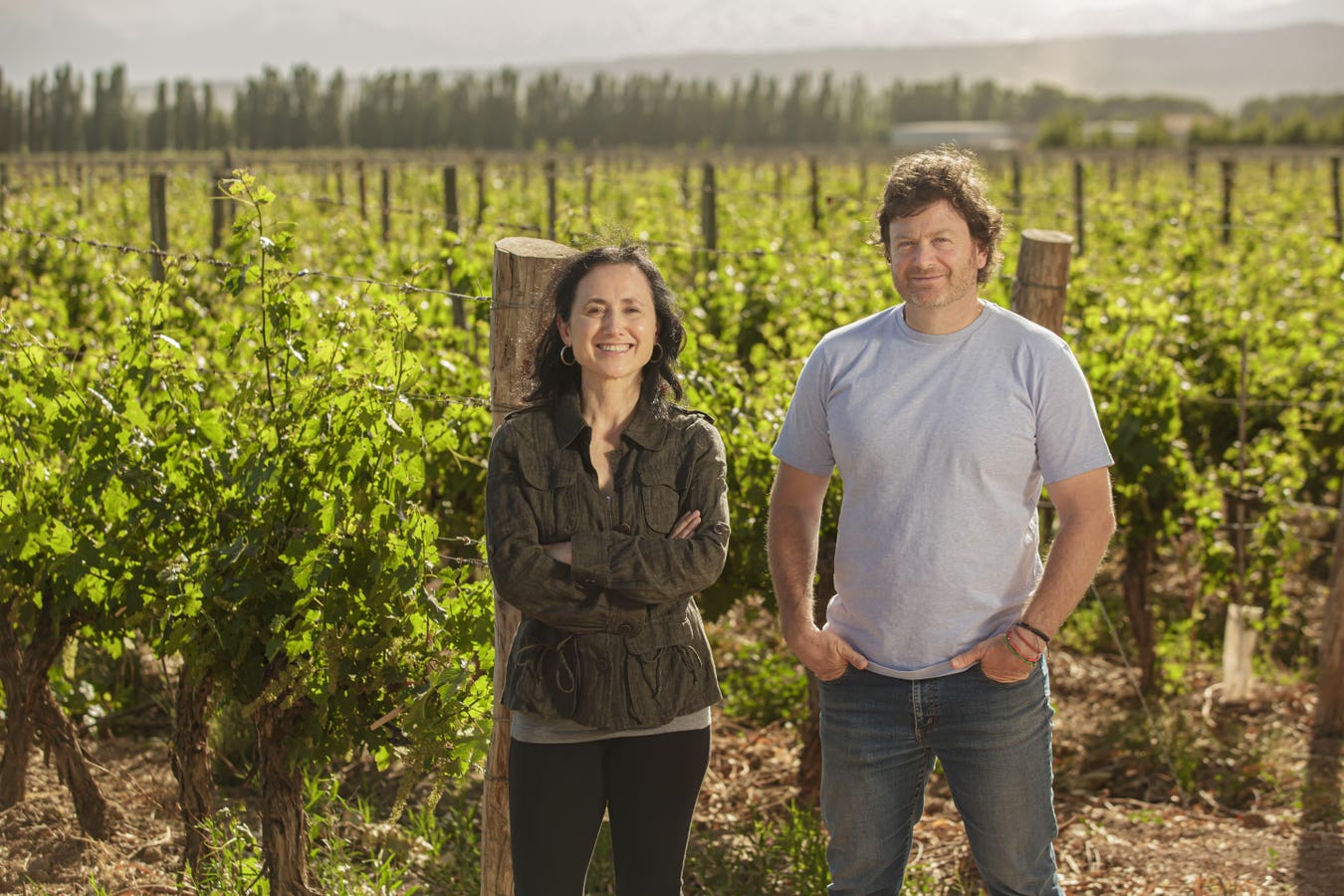
Dr. Laura Catena and Luca Winery winemaker Luis Reginato
Luca Winery
In the late 1990s, Dr. Laura Catena drove the dusty back roads of Mendoza on a mission that had nothing to do with medicine. The physician and daughter of legendary Argentine winemaker Nicolás Catena was tasting grapes and what she found convinced her that Argentina was sitting on a treasure it was about to throw away.
Old vines were being ripped out across the region and plantings of Malbec had collapsed from 50,000 hectares in the mid-20th century to just 15,000 by the 1980s. The logic, as local viticulturists told it, was that old vines yield less, growers make less, so old vines are the problem.
But Catena had recently visited France, where the grands crus of Bordeaux reserved their finest wines exclusively for fruit from vines 25 to 35 years and older. The contradiction was hard to ignore.
“I had an affinity towards the old vines,” she says. “To me, pulling out a vineyard at 25 years rather than letting it live to at least 75 was akin to murder.”
In 1999 she founded Luca Winery to pay growers enough for old-vine fruit to make it worth their while to keep those vines in the ground. The result, more than two decades later, is Luca Old Vine Malbec, a $35 bottle that makes a case that some of Argentina’s most historic vineyards are also producing some of its most compelling wine.
Why Are Old Vines Special
Catena’s team launched a formal experiment in 2003 at the family’s Angélica Vineyard (planted in 1922 to 1924) where original old vines and younger vines propagated from them grow side by side in identical soil. The results showed that old vines produced fruit with higher levels of anthocyanins and catechins.
While not everyday wine tasting terms, these are the compounds responsible for color, structure and aging potential. Blind tastings suggested that old vines make better wine. The reason, Catena explains, goes deeper than chemistry.
“Old vines express terroir more consistently than young ones, thanks to deep and ancient root systems and microbial civilizations living within the soil and mycelia.” Those roots can reach three to six meters below the surface, drawing on water and nutrients that younger vines can’t access. In drought years, that depth is the difference between a vine that struggles and one that barely notices.
Climate resilience, Catena argues, is where the old-vine story merges into the future of viticulture. Argentina’s old vineyards were planted using massal selections, cuttings from individual vines rather than uniform clones, which means each block expresses genetic diversity. That diversity produces natural variation in ripening times of up to two to three weeks within a single vineyard.
As temperatures rise and growing seasons compress, those later-ripening genetic variants become increasingly valuable. “Finding clones that ripen later is adaptive,” Catena says, “because these vines will ripen more slowly and are more likely to reach sugar and tannin maturity at the same time.”
Argentina, cut off from international markets during decades of economic and political isolation, preserved something some spots in the wine world have lost. Some 89% of the country’s vines are massal-planted and ungrafted, living links to pre-phylloxera viticulture.
Luca Old Vine Malbec ($35) makes a straightforward argument: Argentina’s oldest vineyards are also its best.
Luca WineryA Model Built On Trust
Luca doesn’t own the vineyards it sources from. It partners with small family growers through long-term stewardship agreements. Luca helps manage vineyard upkeep at a low cost in exchange for purchase agreements. When hail or frost wipes out a crop, Luca has stepped in with loans.
“In Argentina we mostly have handshake deals,” Catena says, “but a handshake deal in Argentina is just as good as or better than a legal contract.”
The model has not been without losses. One prized source, the Rosas Vineyard, was eventually sold to a housing developer. This is a fate that Catena says has claimed many of Mendoza’s most historic blocks in Chacras de Coria, Vistalba, Maipu and La Consulta.
Luca managed to rescue the Rosas vines by relocating them to the family’s Adri y Lauri Vineyard in Gualtallary Alto, where they now contribute to Nico, Luca’s top cuvée at over $100 retail. The $35 Old Vine Malbec, by contrast, is deliberately priced for accessibility.
“We realize that in order for people to hear the Luca Old Vine message, the wines need to be priced accessibly,” Catena says. She suggests that a comparable heritage-vineyard wine from California, France or Italy would likely carry a price tag two to three times higher.
The gap, Catena argues, is a dual opportunity for the consumer and for the growers who depend on demand staying strong enough to keep old vines economically viable. “The consumer cares the most about quality, about how delicious the wine is,” she says. “And through relationships with old vine family growers we have been able to make wines of extraordinary concentration and personality at fairly affordable prices.”
That equation remains fragile. Global wine consumption is down, and growers across Mendoza are weighing whether crops like pistachios might be a smarter bet than Malbec. The Luca model depends on convincing them otherwise, one vintage at a time. “I can honestly say today that through the Luca Old Vine Project we have saved thousands of vines from being pulled,” says Catena.
“Not only because of our wines, but because other producers in Argentina began to understand the quality levels possible from sourcing grapes from old vine vineyards.”
More From FOForbesChoose Organic Wine: A Winemaker’s PerspectiveBy Jill BarthForbesWorld’s 50 Best Crowns 2025 Vineyards—Chile Takes TopBy Jill BarthForbesThe Humboldt Current: A Hidden Force Behind Exceptional Chilean WineBy Jill BarthForbesLabels, Logistics And Legacy. The New Business Of Old French Wine FamiliesBy Jill Barth
Dining and Cooking