
Hi everyone – before I get into today’s post, I hope you’ll join me Thursday, April 23, at 8 p.m. Eastern US time for my third WineLine Live! here on Substack. My guest will be Jessica Dupuy, co-author of the new book “Italianity: The Culture of Italian Wine,” as well as an excellent Substack, Direct to Press.
Last month, I had the pleasure of attending an intimate tasting at the Chilean ambassador’s residence in Washington, D.C. The guest of honor was Felipe Müller, CEO and chief winemaker at Viña Tabalí, a pioneering winery in the Limarí Valley in northern Chile. I had over the years tasted and enjoyed Tabalí’s lower tier of wines, and this would be an opportunity to sample some of Müller’s premium efforts.
Limarí is a young wine region, with the first vineyards planted only in the early 1990s. Chile’s wine history dates to 1551, when Spanish explorers planted Mission vines (typically called País in Chile) in the south. Wine migrated northwards, through the Maule, Central, Colchagua and Maipo valleys, and by the mid-1800s was well established around Santiago and the Aconcagua Valley to the capital’s north. Bordeaux varieties, especially Cabernet Sauvignon, Merlot and Carmenère, became Chile’s signature wines.
More recently, wine has moved to the north and toward the coast, or higher into the Andes foothills, looking for cooler climates. The Casablanca and Leyda valleys have become known for crisp, tasty Chardonnay, Sauvignon Blanc and Pinot Noir.
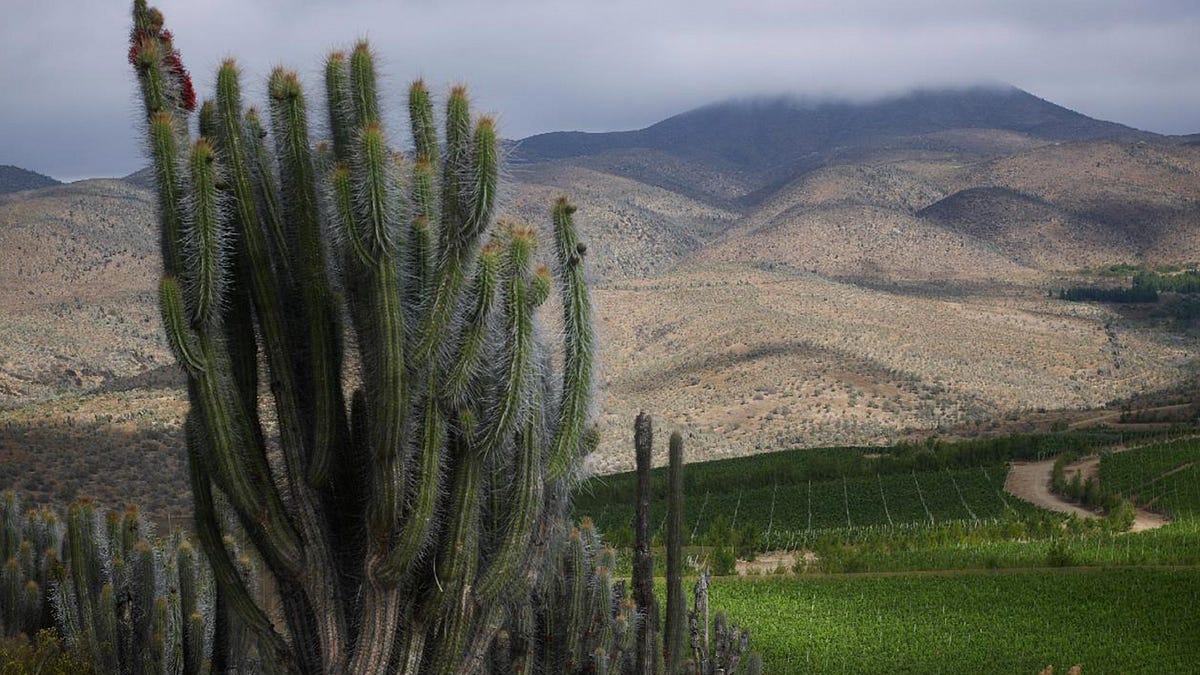
The Limarí Valley is further north, about a four-hour drive north of Santiago, and the river valley extends from the coast to the Andes, given it a variety of terroirs. The dry, cool climate reduces disease pressure and helps keep the wines fresh. Syrah, Cabernet Franc and Malbec can grow in Limarí, but the stars are Pinot Noir and Chardonnay, so naturally winemakers and publicists like to call the valley “the Burgundy of Chile,” Müller said.
At Viña Tabalí, “We are not about big volumes, and not about average wines,” Müller said. “We decided to show something different from Chile.”
Tabalí has three vineyards in the Limarí Valley. Talinay vineyard, about 12 kilometers from the Pacific Ocean, features chalky, limestone soils, a rarity in Chile, where granitic soils are much more common. The vineyard’s rolling slopes are covered daily in spring and summer by fog from the Humboldt Current. Talinay is planted to Chardonnay, Pinot Noir, Sauvignon Blanc, Malbec, Cabernet Franc and Syrah.
 Talinay vineyard. Photo: tabali.com
A bit further inland, Espinal vineyard still benefits from the ocean winds, perched on an alluvial terrace surrounded by deep ravines. The soil is clay over volcanic rock, with veins of calcareous soil in various parts of the vineyard. Grapes here are Chardonnay, Viognier, Pinot Noir, Cabernet Franc, Merlot, Malbec and Syrah.
The Rio Hurtado vineyard lies to the north and east, near where the Limarí river descends from the Andes. At about 1,600 meters, it’s the second-highest elevation vineyard in Chile, Müller said. Here, Malbec and Viognier are planted in basaltic fractured soils over volcanic rock.
The first wine Müller poured was a sparkler called Tatié, a joint venture between Tabalí and Champagne Thiénot. A 60-40 blend of Chardonnay and Pinot Noir, aged 30 months on the lees, the wine featured crisp, mineral and yeasty aromas, promising complexity. The acidity on the attack was quite firm, but after the wine and I became acclimated to each other, I enjoyed the expressive stone fruit flavors. Priced in the U.S. at $35-40, it’s a steal.
Next was the Talinay Caliza Chardonnay 2023, Tabalí’s top Chardonnay, named for the vineyard’s limestone soils. Barrel fermented and aged for 12 months with no secondary malolactic fermentation, the wine was citrusy, mineral and intense. As he savored his own creation, Müller sighed and said, “I love wines with tension.” U.S. retail price is $60-$70.

Talinay PAI Pinot Noir 2020 was smoky and flinty from the limestone, with rosehips and berries emerging with a little coaxing. The palate was bright and lively with tension and medium weight and a long finish. Müller said the original vine material came from Geverey-Chambertin and Vosne Romanée, but this wine seemed unmistakably Limarí. U.S. retail $70-$80.
Roca Madre Malbec 2018 came from the Rio Hurtado vineyard. It featured dark vibrant color and a lithe structure on the palate. It definitely tasted “warmer” than the two Talinay wines (as in, from a warmer climate, though not strictly speaking a “warm” climate). It’s quite floral, with aromas of lavender and violets, and features the smooth disappearing tannins Argentina is famous for in Malbec. U.S. retail $60-$70.
Finally, the DOM Cabernet Sauvignon 2018 came from the Dom vineyard in Maipo Valley, south of Santiago. This was classic Chilean cabernet, deep in color, with aromas of blackcurrant, sage and mint. I felt as though I had stuck my nose into a fresh-picked bouquet of herbs. Outstanding, elegant, lithe and long. I didn’t note a price but it should be in the $60-$70 range.
These premier wines from Viña Tabalí are not cheap, but given their quality they are fairly priced. My only complaint is that they may have ruined me for Tabalí’s more affordable wines. At the very least, when I try those, I’ll be reminded of the wines from Talinay, Roca Madre and Dom.
Dining and Cooking