
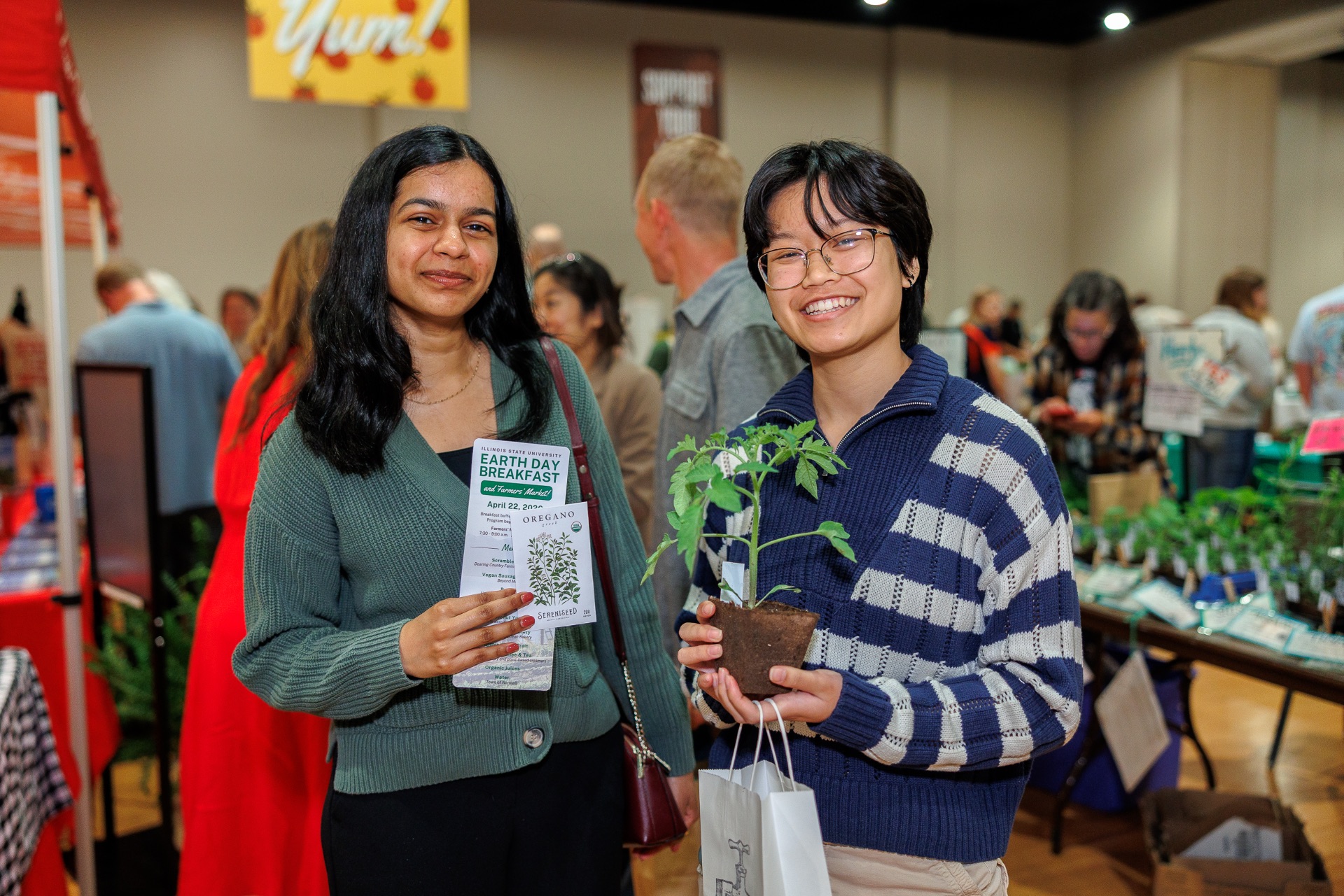
A farmers market added fresh flavor to Illinois State University’s 2026 Earth Day Breakfast featuring best-selling author Kelsey Timmerman on Wednesday, April 22, in the Bone Student Center’s Brown Ballroom.
Nearly 400 guests browsed the market before and after Timmerman’s talk. It featured locally grown vegetables, sustainable soaps, organic jams and herbs, homemade baked goods, essential oils, and a wide variety of plants.
The farmers market addition was inspired by Timmerman’s latest book, Regenerating Earth: Farmers Working with Nature to Feed Our Future. In his keynote address, Timmerman highlighted how farmers and activists around the world are using regenerative agriculture, showing how personal choices link to sustainability and social justice.
An environmental storyteller, Timmerman’s work connects audiences to the people and places behind the products they consume while exploring social and sustainable challenges. He used humor and personal stories from his family’s Midwestern farming roots to illustrate how society has become disconnected from the land despite relying on its resources every day.
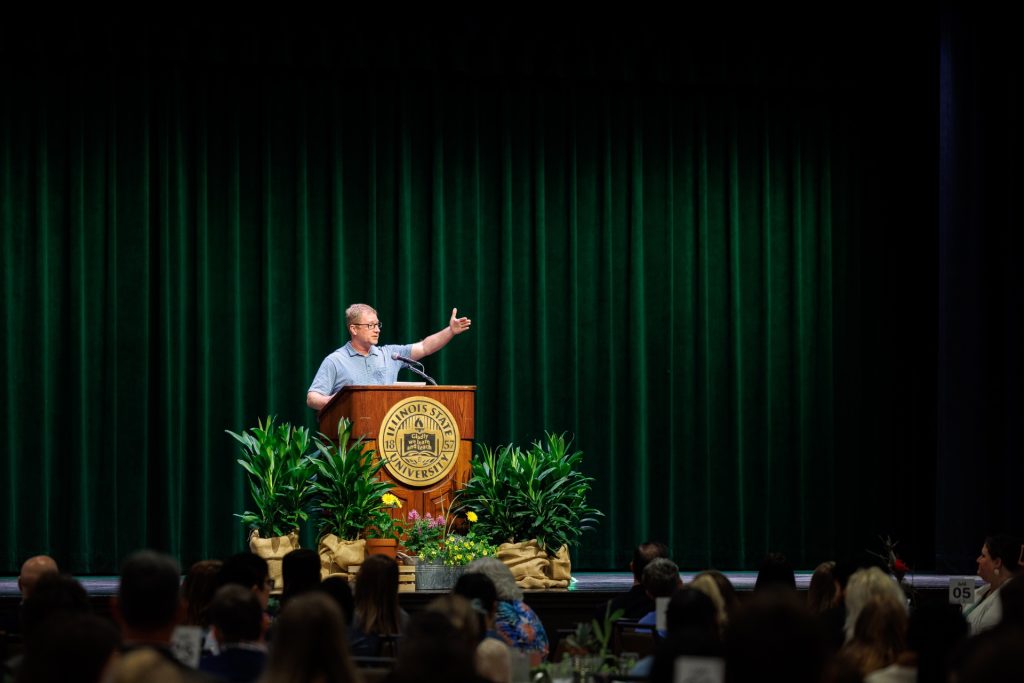 Author and journalist Kelsey Timmerman speaks about the importance of sustainable agriculture at the 2026 Earth Day Breakfast at Illinois State University. (Photo/Shea Grehan)
“Here we are in farm country, but so few of us actually farm,” Timmerman said. “Every day, we eat, and this is the way we’re connected with nature.”
Timmerman explained how much the United States depends on farm workers—the majority of whom are immigrants—and on agriculture from other countries to keep food on the table.
“Our breakfast wouldn’t be possible without farmers from around the world,” he said.
Senior sociology and political science major Amaya Olivas, who has attended the Earth Day Breakfast for the past four years, said the opportunity to support local farmers by buying produce at the market was a welcome addition to the event.
“I just enjoy building community here and seeing people that also care about sustainability. It bridges ISU to the local people in Bloomington-Normal,” Olivas said. “I think it’s a great option to have fresh produce, especially because so many students are in a food desert.”
A food desert is an area with limited access to fresh food. Olivas said that, for most students who live off campus, buying fresh produce is “a whole day’s ordeal,” and markets like this are a great alternative.
Teresa Brockman ’85, owner of Sunny Lane Farm in Eureka, brought a large selection of organic vegetables, herbs, plant starts, and homemade jam to sell. She said buying local produce uplifts the community.
“(It benefits us) economically, for both the farmer and the consumer,” Brockman said. “Buying locally, especially if it’s organic, supports a healthy ecosystem.”
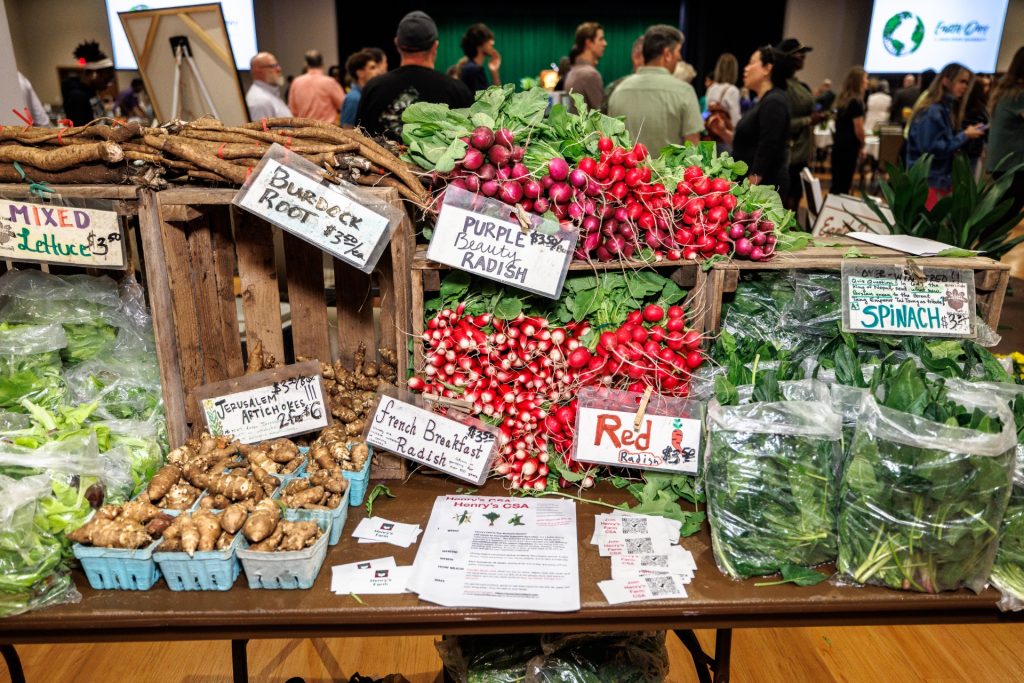 A colorful harvest of local, organic produce for sale at the 2026 Earth Day Breakfast farmers market at Illinois State University. (Photo/Shea Grehan)
The farmers market also featured booths where guests could learn about sustainable efforts on campus, including Redbird Fresh Market and the University’s Fell Arboretum.
Office of Sustainability Director Elisabeth Reed said the market was a success for both guests and vendors.
“It would be a great thing to incorporate with Earth Day going forward, maybe even in another capacity of having it more open to the public,” Reed said.
According to Reed, Earth Day first began on college campuses in 1970. She said the Earth Day Breakfast was created at Illinois State to bring people together, celebrate progress, recognize leadership, and renew society’s commitment to the environmental work ahead.
“There’s a lot we need to work on with our climate, and people don’t really know where to start or how they can make a difference. Having an event like this to bring everybody together to make those connections with others who are feeling the same way and to learn is a great way to celebrate Earth Day,” Reed said.
Before Timmerman took the stage for his keynote talk, attendees enjoyed a breakfast sourced from local farms with vegan options and fair-trade coffee and tea. As a zero waste event, at least 90% of the waste generated was diverted from landfills through reuse, recycling, or composting.
Senior political science major Izzy Ebersold gave closing remarks of hope for a more sustainable future.
“Regenerative practices aren’t just about farming differently; they’re about thinking differently,” Ebersold said. “They remind us that the choices we make here on campus and in our communities have ripple effects across the planet, for better or for worse, whether it’s the food we serve, the policies we support, or the conversations we have. We have the power and the responsibility to choose systems that heal soil, strengthen communities, and sustain future generations.”
Gwynneth Boynton, a graduate student in the college student personnel administration program, waited after the speech to buy a book and have it signed by Timmerman.
“One of my favorite things about being at ISU is the very intentional effort that they put into (sustainability). I love all of the different day-to-day resources on campus, but also events like this,” Boynton said.
The Earth Day Breakfast was co-sponsored by the College of Business; the Department of Geography, Geology, and the Environment; and Leadership, Education, and Development (LEAD).
Dining and Cooking