
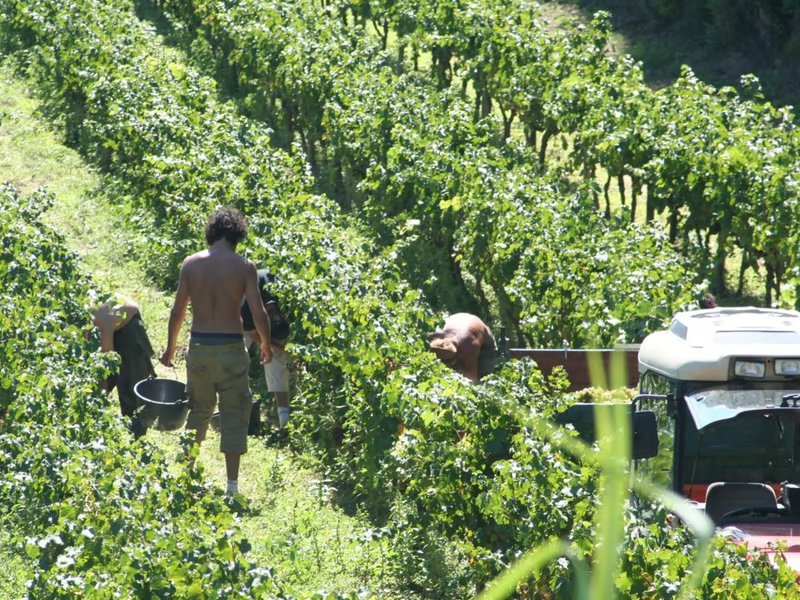
MARSEILLE, France (CN) — As a 15% tariff on EU goods went into effect Thursday, heads turned toward the wine and spirits sector in France, which represents billions in exports to the U.S., often by small, family-run businesses.
Just after midnight, U.S. President Donald Trump posted, “BIILLIONS OF DOLLARS, LARGELY FROM COUNTRIES THAT HAVE TAKEN ADVANTAGE OF THE UNITED STATES FOR MANY YEARS, LAUGHING ALL THE WAY, WILL START FLOWING INTO THE USA,” on his Truth Social network.
Experts agree the tariffs, part of the latest salvo in Trump’s global trade war, will strike a blow to this economy. But some are choosing to see the glass half full as tariffs on other goods and regions continue to multiply around the world.
Laurent Bunan, a third-generation winemaker at the Domaines Bunan vineyard in Provence, exports a significant part of his product to the U.S. He told Courthouse News that tariffs are particularly worrisome because they coincide with a weakened dollar, so price increases will be closer to 23-25%.
But he’s confident that Americans’ love of French wine could be strong enough to offset a worst-case scenario.
“I’m not afraid because we’re going to defend ourselves; we make quality wines, we make good products,” Bunan said. “Americans are big consumers who love European products, who love France, and who love the good wine we know how to make.”
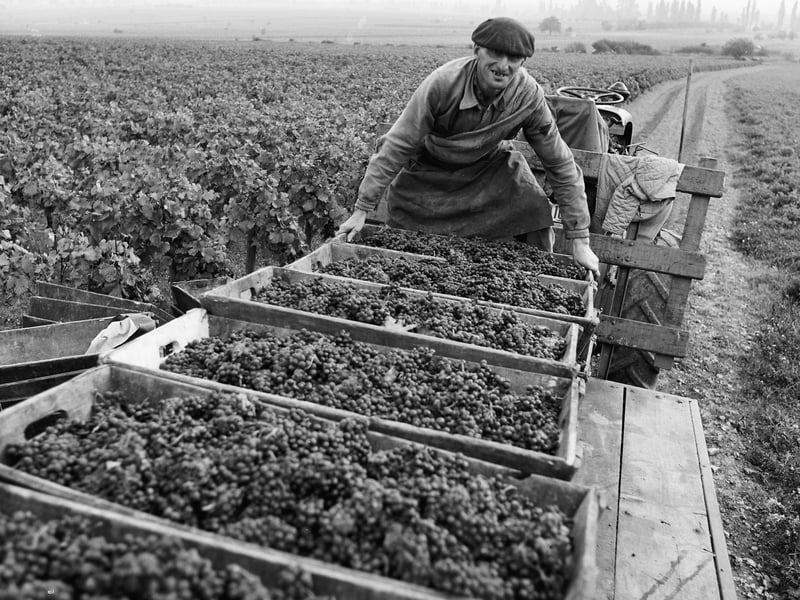 A farmer in Savigny-lès-Beaune, Burgundy, harvesting wine grapes in 1965. (Louis Falquet/Wikimedia Commons via Courthouse News)
Vincent Chatellier, an economics researcher at France’s National Research Institute for Agriculture, Food and Environment, agreed that the U.S. market that consumes French wine and spirits might be able to absorb the extra costs.
“We’re dealing with specific products, in fact, that Americans like and want,” he told Courthouse News. “The French products we export — whether it’s Chanel or cognac — there’s a market, and there’s elasticity … . If they want this product, they’ll pay for it.”
Chatellier said these products tend to reach wealthier consumers in urban areas.
“I’m telling you this from my experience, you’re not going to find French products in deep Iowa, it’s not easy,” he said.
For Chatellier, the bigger risk is uncertainty. If producers knew there would be a 15% customs duty for the next five years, they could decide whether to sell bottles for less. Then, they could work with their customers stateside — often long, strong partnerships — to develop a plan to balance costs for both sides.
Ignacio Sánchez Recarte, secretary general of the Comité Européen des Entreprises Vins, an organization that defends the interests of European wine companies, agrees that the 15% tariff on wine will likely look more like 30% in practice. He told Courthouse News that winemakers would likely have to absorb a large portion of that cost to avoid being pushed out of their established price range.
“This will cause this turnover to be reduced, a business bottleneck, and profits as well,” Recarte said. “And we’re also going to see a lot of companies that won’t be able to do this … . So, it’s a pretty hard blow for the sector.”
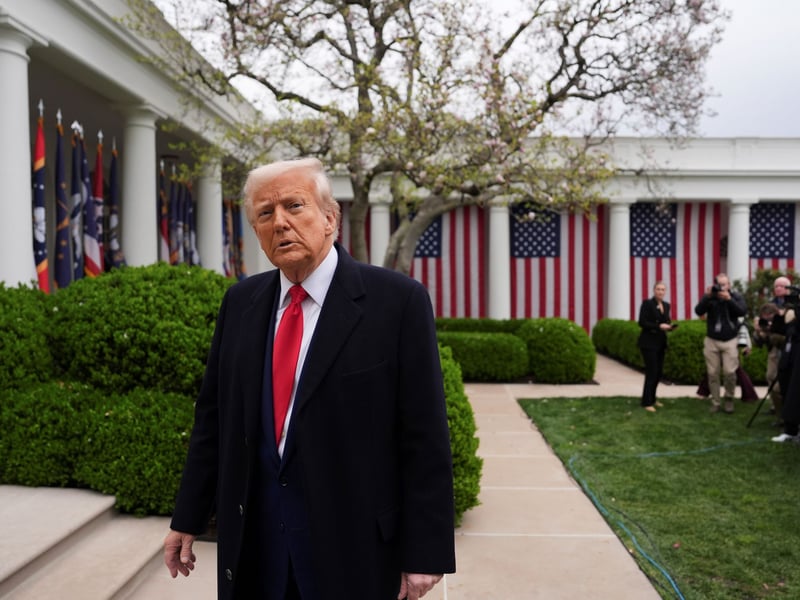 President Donald Trump departs after signing an executive order at an event to announce new tariffs in the Rose Garden of the White House, Wednesday, April 2, 2025, in Washington. (AP Photo/Evan Vucci)
Since there’s no way to know if these tariffs will last, he added, it’s the uncertainty that is most harmful. That is why Chatellier believes Ursula von der Leyen, the president of the European Commission, struck the blanket 15% deal for the 27-nation bloc.
The move was controversial. In France, some of the biggest political players — including Prime Minister François Bayrou and extreme-right leader Jordan Bardella — were outspokenly opposed to the deal, implying that Europe conceded to unfair terms that would drastically hurt the French economy. But Chatellier thinks the deal could have been the lesser of two evils.
“The economy is strong when it organizes itself, and that’s perhaps why Europe said, ‘Well, OK, let’s sign,’” he said. “Because in fact, a no-deal could cause more of a disaster [with its] uncertainty.”
In comparison to other major economies, the EU’s 15% looks relatively light. India is facing 50% tariffs as a punishment for buying Russian oil, which its foreign ministry said are “unfair, unjustified and unreasonable” actions. These are expected to come into force later this month if there’s no deal made before then.
Brazil is already subject to 50% tariffs; on Wednesday, Brazilian President Luiz Inácio Lula da Silva said, “Today my intuition says [Trump] doesn’t want to talk. And I’m not going to humiliate myself.”
Switzerland, which is not a member of the EU, is facing 39% tariffs.

Follow @lilyradzSubscribe to our free newsletters
Our weekly newsletter Closing Arguments offers the latest about ongoing
trials, major litigation and rulings in courthouses around the U.S. and the world,
while the monthly Under the Lights dishes the legal dirt from Hollywood,
sports, Big Tech and the arts.
Dining and Cooking