
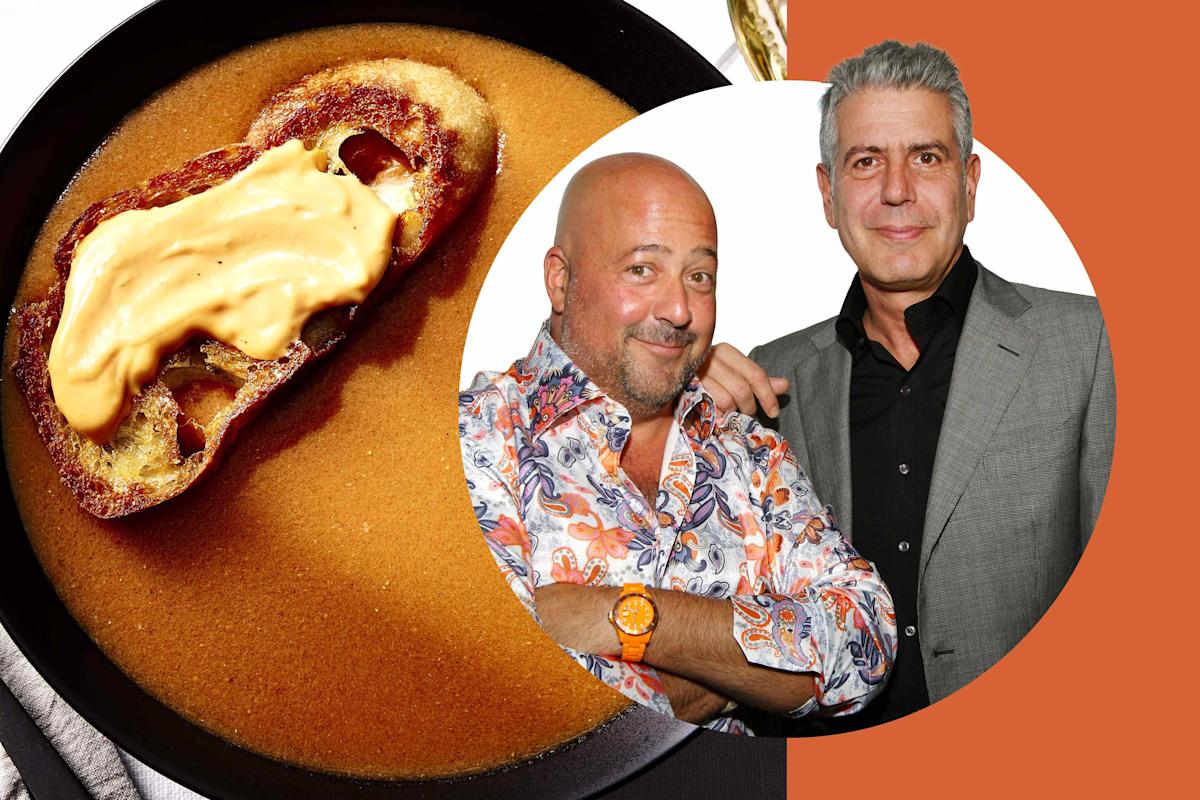
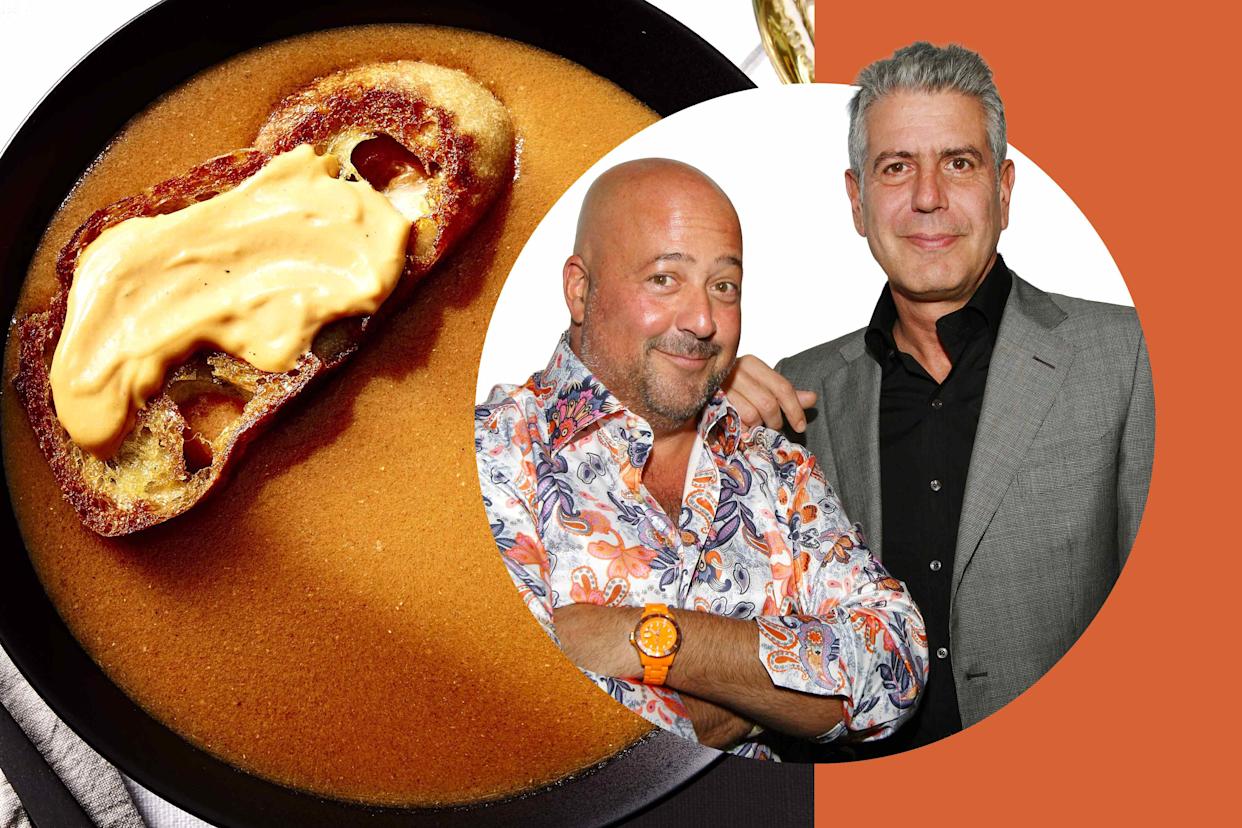
Credit: Food & Wine / Photo by Morgan Hunt Ward / Food Styling by Julian Hensarling / Prop Styling by Christina Daley / Getty Images
Bourdain called soupe de poisson the peasant cousin of bouillabaisse, and I think that’s exactly why he loved it so much. It’s the opposite of precious; no pomp, no curated tablescape. Just fish, bones, tomatoes, and time. In France, this is what the working class along the Mediterranean coast would make from scraps and rejects. You could call it a recipe for survival or subsistence eating, but Tony would’ve called it a noble truth.
The genius of this soup wasn’t just in the method; it was in the choice of fish. He calls for porgy and whiting — smaller, inexpensive, and often overlooked fish that some call bony. You won’t find them on ice at glitzy suburban supermarkets, but in coastal areas, they are prized. Tony knew that using porgy and whiting wasn’t just correct — it was defiant. It was his middle finger to the culinary establishment and, at the same time, a love letter to the cooks who make do with what’s left.
Related: How Anthony Bourdain Came to Love Christmas — or at Least Stop Dreading It
That’s the Bourdain paradox: The joyful rage and the tenderness were two sides of the same coin. He had an instinctive empathy for the world’s cooks, fishermen, dishwashers, and street vendors — the people who carry food culture forward without ever getting credited. He traveled to connect. He was a student of the table and had no wish to become its emperor.
His early trips to France lit that fuse. Before Kitchen Confidential and before the cameras, there was just a kid from New Jersey sitting in a French kitchen, realizing that food is the great equalizer. I had the same experience in an Italian kitchen at almost the same time.
“That’s the Bourdain paradox: The joyful rage and the tenderness were two sides of the same coin.”
Andrew Zimmern
Travel taught us lessons that became the foundation for our life’s works: that the richest experiences often come from the poorest kitchens. That eating is not about status but about story. That food is memory, labor, history, and identity, all mixed together in one bowl. Travel teaches humility. And humility was the real heart of Bourdain’s genius.
His soupe de poisson, published in the December 2012 issue of Food & Wine and excerpted from Bourdain’s 2004 Les Halles Cookbook, is an edible version of his credo: Eat like the locals, listen more than you talk, and never mistake poverty for lack of sophistication. The soup doesn’t try to impress. It tries to nourish. Deliciously. And it rewards patience — the slow simmer that coaxes sweetness from onions and depth from bones. That’s Tony, too. As you let him talk, the beautiful truth surfaces from the rough edges.
There’s also something deeply sincere about making a fish soup for the holidays. When much of the world is splurging on truffles and caviar, Tony reaches back for something more personal. He wasn’t rebelling against luxury; he was saying that luxury without meaning is hollow.
“When you make Bourdain’s soupe de poisson, you’re doing more than following a recipe. You’re participating in a worldview.”
Andrew Zimmern
When you make Bourdain’s soupe de poisson, you’re doing more than following a recipe. You’re participating in a worldview. You’re saying that the essence of good cooking is respect for ingredients, the people who catch them, and the hands that stir the pot. Tony believed that food should collapse the distance between you and someone else’s life. He understood that once you’ve shared a meal with someone, it becomes harder to other them.
In that sense, his soup isn’t just French — it’s universal. It’s the broth of humanity, strained through travel and memory. Like everything Tony touched, it’s a manifesto. A reminder to eat lower on the chain. To value simplicity. To find meaning in the small and the scrappy. That was the best part of him — and he had many great parts.
Make the soup. Taste the salt and the bones and the humility. That’s the flavor of the world. Tony tried to show it to us, and it matters now more than ever.
More on Anthony Bourdain
Read the original article on Food & Wine
Dining and Cooking