
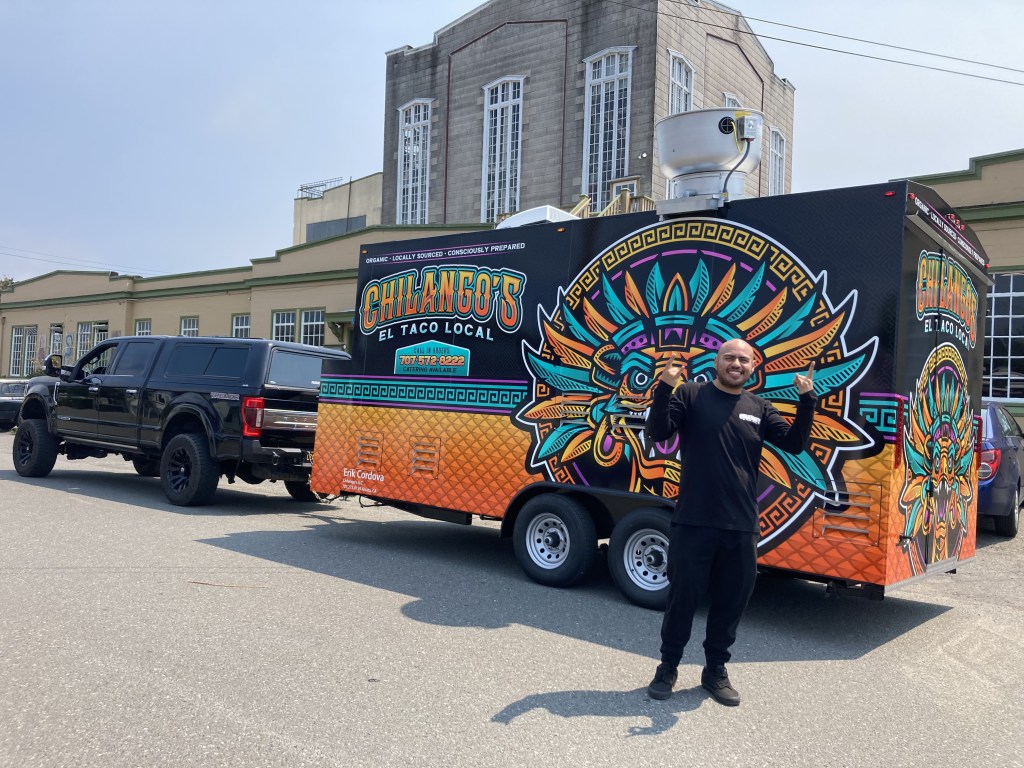
The savory smells of seared meat and simmering birria waft across the Union Street gas station parking lot. It’s the kind of thing that will make you suddenly, desperately hungry, even when you weren’t a minute ago. My burrito is wrapped in a pillowy, blistered, handmade flour tortilla. The carne asada is tender in the center and caramelized on the edges, but doesn’t drip grease in a way that foreshadows regret.
“The thing we care most about is how you feel after you eat,” Erick Cordova, the owner, tells me. “Do you feel heavy? Or do you feel like a million bucks? That says a lot about the food.”
Erick is a chilango, slang for a Mexico City native. Where he’s from, the street food scene is so dense you can walk one block and pass a dozen vendors, each selling their own version of the same quesadilla. He came to the U.S. at 18 and learned English behind the register of a taqueria, Los Coyotes, on 16th Street in San Francisco. He slept where he could, leaning on the generosity of strangers, and eventually landed on Island Mountain in Humboldt. Life on the mountain required a scrappy resourcefulness that came naturally to a chilango. “It’s weird how leaving your country makes you feel closer to it,” he says. “You start realizing how special it is.” He was one of the few who could drive a manual, so when the sun went down, he strapped on a headlamp to haul water in an army tanker with broken headlights. He was good at jerry-rigging almost anything. It was either eat ramen every night or learn how to cook, and in Mexico, cooking is a woman’s job, so he’d never learned. The first time he cooked rice, he burned it. The first time he served burgers, they were still cold in the middle. But he kept trying.
Erick met his wife, Amanda, during those years. “My wife changed so much for me,” he says. “She showed me what goes into food before it goes into your body.” Amanda Cordova taught him about sourcing and pesticides, about the difference between feeding someone and nourishing them. When they started Chilango’s, they built the menu around that distinction.
All the grains are organic, and the beef is Humboldt grass-fed. The rockfish comes from Trinidad and gets cooked on the flat top in olive oil, not deep-fried. Even the water runs through a Biocera filter at New World Water before becoming his agua de jamaica and horchata.
In Mexico City, corn tortillas are the standard. Flour is an American influence. When he first started Chilango’s, making flour tortillas by hand was a gamble. “They’re so hard to get right,” Erick says. After months of trial and error, those tortillas are the most raved-about item on the menu. “Consistency and discipline, that’s the key to everything.” Later this year, he’s launching them as a retail product alongside dried masa for corn tortillas.
Erick grew up in a culture where food is communal, where someone always has a pot on the stove and there’s a seat at the table whether you’re expected or not. “In Mexico, we share everything,” he says. “When someone has a pizza, they ask, ‘Hey, are you hungry? Do you want some?’” In the U.S., he once watched someone eat almost an entire pizza alone and toss the last three slices in the trash without offering any.
Humboldt was different. One morning, running late to open Chilango’s and scrambling to set up alone, a customer started putting out his tables and chairs so he could get the grill going. During a Saturday lunch rush, a woman walked up to the window while he was buried in orders. She set a basket of blackberries on the counter and said, “It’s for working so hard.”
“The community is so strong in Humboldt because it’s real,” he says. “We live in this bubble.”
Now Erick has a team of eight. Juan Valdovinos is great with the customers, Diego Hernandez is the most disciplined guy on the team, and thanks to José Gonzalez, Erick can have a life. He shakes his head, smiling. “It’s so funny that this tiny trailer can provide for so many,” he says. “I’m so lucky to have found my team. We’re spongy—we absorb the energy of the people closest to us.”
“More than exchanging food for money, you’re exchanging energy,” he says. “That’s what people like about Chilango’s. It’s the connection.”
Dining and Cooking