
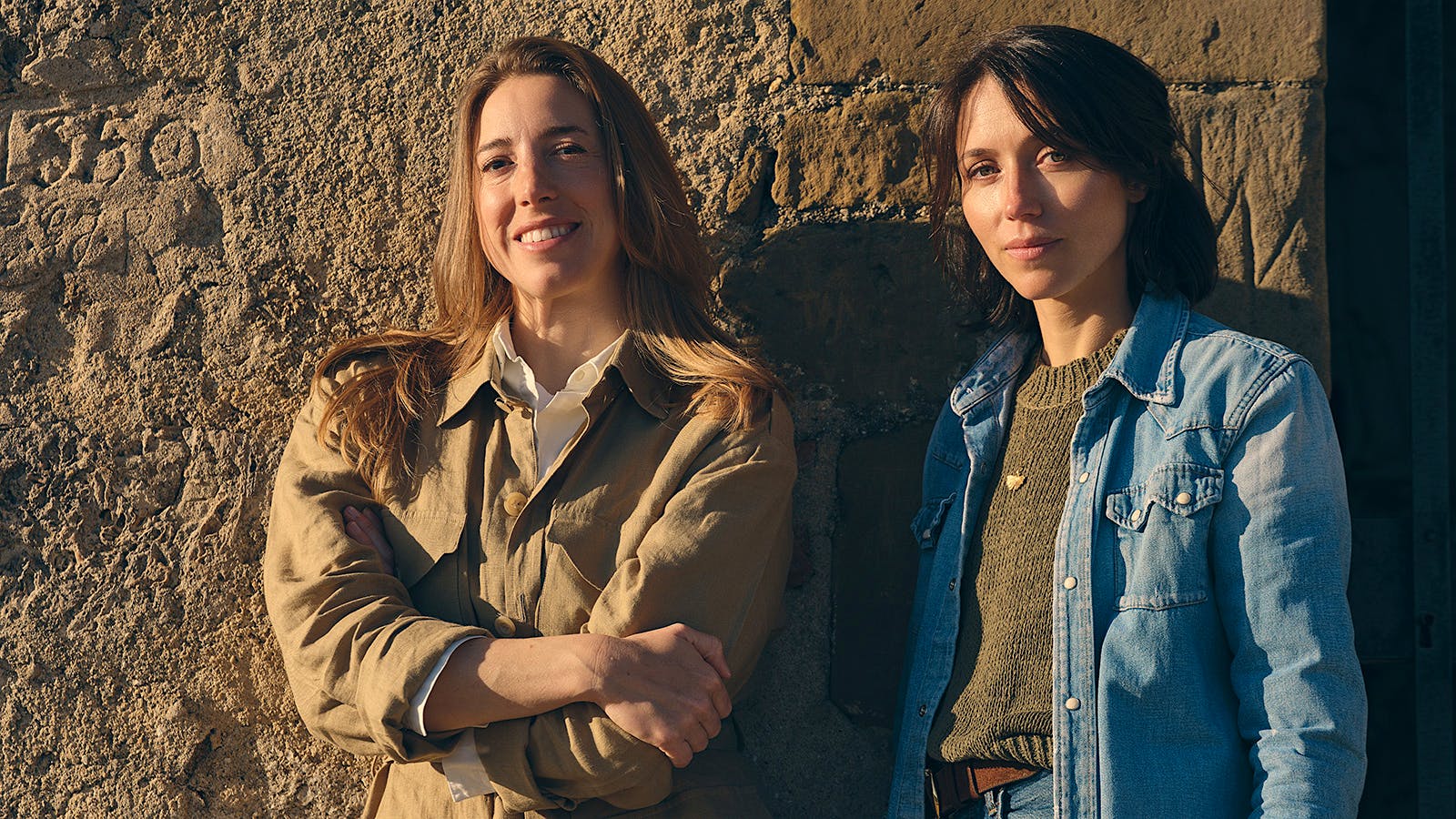
Change has come again for one of the Rhône’s legendary estates. The Frey family, who have owned the Paul Jaboulet Aîné domaine in Hermitage since 2006, have announced that the new head of viticulture and winemaking for their top Domaine de la Chapelle wines will be Chiara Pepe, the 32-year-old Italian winemaker who helms her family’s Emidio Pepe estate in Abruzzo.
Pepe replaces Caroline Frey, who had directed winemaking at the estate since her father, Swiss businessman Jean-Jacques Frey, took ownership 20 years ago. She stepped away from winemaking duties in June 2025, citing an illness and a desire to focus on her Swiss vineyards in the Valais.
“We weren’t looking for a revolution, just the next chapter in this story,” said Delphine Frey, Caroline’s younger sister and the director of the Frey family estates (they also own Château La Lagune in Bordeaux, Château Corton C. in Burgundy, vineyards in Switzerland and are part owners of Champagne Billecart-Salmon).
“La Chapelle is a singular site with an extraordinary heritage and real soul; we wanted someone with a profound respect for history but also a contemporary vision,” Delphine Frey told Wine Spectator. She first met Pepe in the summer of 2025. “After walking the vineyards and tasting together, I saw a natural connection between Chiara’s sensibility and this special place.”
Pepe will divide her time between Hermitage and her home in Abruzzo. A longtime fan of Northern Rhône wines, she admits to a lifelong obsession with Syrah. “The old-school style of Syrah stimulates my brain in a different way than other iconic wines,” she said. “Most of the bottles that shaped my winemaking path were Syrah. I’ve always dreamed of making it.”
A Rocky Path for a Legendary Vineyard
Few wines in the world carry the cultural weight of La Chapelle. Named for the tiny stone chapel at the summit of the granite-topped Hermitage hill, it is the top cuvée of Paul Jaboulet Aîné, the family estate founded in 1834 by Antoine Jaboulet. It’s a blend of Jaboulet’s most esteemed Hermitage parcel holdings, primarily Le Méal, Les Bessards and Les Greffieux.
Generations of Jaboulets produced some of the greatest wines in Hermitage’s history, which are among the world’s finest expressions of Syrah. Yet the Jaboulet legacy began to waver with the sudden death of Gérard Jaboulet in 1997 at age 55. Volumes increased while quality faltered throughout the early 2000s.
Due to financial strain and family infighting, the Jaboulets were forced to sell. Overnight, the Frey family became one of the appellation’s largest landowners with 55 acres of Hermitage vineyards in addition to other holdings throughout the Northern Rhône.
“Chiara is very charming, outgoing and full of passion. Hopefully this will be good for her. If this is good for La Chapelle it will be good for Hermitage. Jaboulet has an amazing history and the potential for amazing wines. La Chapelle should be at the top.”—Jean-Louis Chave
Under the family’s direction and with Caroline at the helm, significant investments were made to revive the floundering estate. She introduced organic and then biodynamic farming, modernized the cellar, reduced yields and undeniably boosted quality after years of decline.
Yet she made some controversial changes, too. For the top La Chapelle red, she shifted away from the tradition of aging in older barrels and large foudres, introduced a greater percentage of new oak barriques—smaller, 225-liter barrels—and pushed for a sleeker, more refined style with smoother tannins.
Caroline moved the estate’s flagship white Hermitage, Le Chevalier de Sterimberg (named for Gaspard de Sterimberg, the medieval knight who built the chapel on the hill), toward a fresher profile in place of the classic rich and honeyed opulence that these Marsanne-dominant wines typically offer. Earlier picking and less oxidative winemaking made the white noticeably more taut and mineral-tinged.
In fairness, any change or new idea she introduced at Hermitage’s most storied estate would have been met with skepticism. Many locals and longtime La Chapelle fans were wary of the wealthy foreign investors from the start. For traditionalists, Caroline’s more modern, polished style came at the expense of what mesmerizes wine lovers about Hermitage—its rustic, smoky, meaty, smoldering iron-edged wildness.
![Chiara Pepe in one of Jaboulet’s vineyard parcels on Hermitage.]](https://www.diningandcooking.com/wp-content/uploads/2026/04/ns_pepe-hermitage-vineyard-032726_1600.jpg)
Chiara Pepe is excited to learn about the terroir of Hermitage, one of the world’s most renowned vineyards. (Alberto Blasetti)
Then, in 2021, the Frey family announced they were splitting the top red and white cuvées off as a distinct brand, Domaine de la Chapelle, with a soon-to-be-built dedicated winery, separate from the larger-production range of other Paul Jaboulet Aîné wines. (The entire lineup of Jaboulet’s Northern Rhône wines has been revamped in the direction of an estate-driven approach, with lower-tier, négociant bottlings eliminated, volume reduced and quality boosted overall.)
What Does the Future Hold for La Chapelle?
Pepe’s arrival is sure to cause additional stir in the region. “We were not expecting this,” admitted Jean-Louis Chave, the 16th generation to helm his family’s iconic Hermitage estate. “The Italian touch in Hermitage? Chiara is very charming, outgoing and full of passion. Hopefully this will be good for her. If this is good for La Chapelle it will be good for Hermitage. Jaboulet has an amazing history and the potential for amazing wines. La Chapelle should be at the top.”
Pepe is the third generation to lead the Emidio Pepe estate, which was founded by her grandfather in 1964 and is one of the most esteemed in Abruzzo. She completed her first solo vintage in 2020. She’s an enthusiastic student of biodynamics, a practice she has already begun to fine-tune at Domaine de la Chapelle. “We have a deep connection to our living vineyards; this is something my sister started at La Chapelle and it’s important to me to continue,” said Delphine Frey.
Pepe brings a new vision for the wines, which she shared with Wine Spectator, and it will definitely take them in a new direction stylistically. A sharper focus on soil health, Pepe believes, will bring greater “liveliness and energy,” and changes to canopy management will increase sun protection, allowing for greater phenolic ripeness while preserving acidity. She is also considering the use of white clay treatments, which act like sunscreen, an approach she employs in Abruzzo to reduce vine temperatures during extreme heat.
In the cellar, Pepe believes the most significant change will be a shift to relying on ambient yeasts from the vineyards for fermentations, rather than adding selected yeasts in the winery. “This will give us more layered, subtle complexity because yeasts are part of the terroir; if you have one of the most incredible terroirs in the world, you want to make sure the yeasts are in the vinification.”
She will also introduce whole-berry fermentation to bring additional lift, freshness and aromatic complexity. Aiming for more gentle extraction of tannins, Pepe is installing a vertical basket press, which she favors for its ability to impart a more delicate tannin structure than many modern systems. “It’s an old-school thing,” she said. “And I like old-school wine.”
“For any strong terroir with incredible genetics, very little intervention is required. I don’t want to disrupt anything drastically. I feel the wines will be guiding us.”—Chiara Pepe
Over time, she plans to reduce the amount of new oak in the cellar by adding more concrete eggs and other large neutral containers. She also plans to extend bottle aging before release. “I know how important large wood has been historically in Hermitage, and I have a lot of respect for that. With Syrah it is important to appreciate its delicacy,” said Pepe. “There is a connection in the way it performs to the wines we make in Abruzzo. There is an element of density and rusticity and ageworthiness that is very similar to Pepe. It’s recognizable.”
Michel Chapoutier, the largest landowner in Hermitage, is optimistic about her influence. “It is a great thing that Chiara is Italian, because together with France and the Iberian Peninsula, Italy is among the countries that understands how to let the land speak. We have learned to manage the collective brand of the appellation alongside the individual signature of the winemaker. The Italian sensibility of someone like Chiara gives us reassurance regarding the respect of the Hermitage terroir and the integrity of La Chapelle. The important thing for me is that Caroline’s spirit, which she instilled into Maison Jaboulet, endures.”
The evolution at La Chapelle won’t be radical, Pepe stressed, and her first year will involve extensive experimentation. “For any strong terroir with incredible genetics, very little intervention is required,” Pepe said. “I don’t want to disrupt anything drastically. I feel the wines will be guiding us.”
Pepe emphasized that she is coming to the Rhône with humility. “I’m arriving with a learning attitude and asking lots of questions. Aside from a harvest in Patagonia and one in Burgundy, I’ve spent my whole life in Abruzzo.”
She has developed relationships with a number of Northern Rhône producers, including Cornas winemaker Thierry Allemand, whose traditional approach to Syrah has influenced her thinking. Having never worked with Syrah before, she said her first vintage will feature many trials and micro-fermentations so she can understand the genetics of place and how the grapes respond.
Locals and Hermitage lovers will be watching closely, hoping that the estate can find its footing and reclaim its former glory. “Caroline really did her best. She was so invested and has a genuine love for Hermitage,” said Chave, but he believes that the Jaboulet estate suffers from more systemic problems that made it difficult for her to truly triumph. “I wish Chiara all the best and I really hope she will succeed, even if it won’t be easy. If the story of Jaboulet improves, everyone will be happy about it.”
Stay on top of important wine stories with Wine Spectator’s free Breaking News Alerts.
Dining and Cooking