
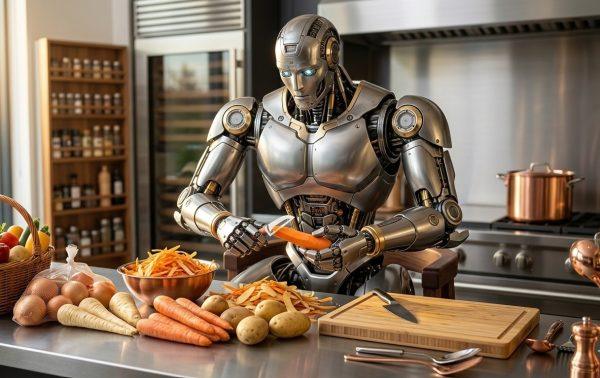
New technology developed by Swiss researchers allows robots to manipulate irregular objects and curved surfaces with ease.
By leveraging discrete differential geometry, these machines now transfer cutting and peeling skills, successfully mimicking human versatility.
This advancement promises to transform not only the food industry but also the future of domestic robotics and automated home assistance.
A new technological breakthrough is about to change household chores. It opens the door to a generation of versatile home robots capable of performing complex tasks like cooking, peeling and cutting, even when the objects have irregular or unpredictable shapes.
Traditionally, the manipulation of objects with complex shapes challenged technology. Most current systems rely on perfect 3D models or massive training databases to recognize an object. However, real life is not perfect; for example, one potato never matches another and a banana has curves that defy rigid scans.
Loading video…
Loading Video
Technology based on “point clouds”
Researchers from the Swiss Federal Institute of Technology (EPFL) and the Idiap Research Institute developed an innovative solution. Instead of trying to memorize every object, they created a system that uses a “point cloud map.”
This technology allows robots to identify key reference points on the surface of any object in real-time. Using principles of discrete differential geometry, the system builds orientation fields that guide the robot. This allows the machine to understand how to slide a knife or peel a surface, regardless of whether the object is a banana, a sweet potato, or even a mechanical part.
The ability to transfer skills
What makes this advancement truly disruptive is “skill transfer.” Humans possess an innate ability to generalize; if we learn to peel a potato, we can peel an apple using the same basic principle. Until now, machines struggled to replicate this.
Thanks to the modular framework developed by the Swiss team, robots can now:
Adapt in real-time: They do not need retraining every time they encounter a new object.
Operate in noisy environments: Unlike traditional systems, this method remains robust against incomplete data or sensors that fail to capture the perfect surface.
Execute delicate tasks: By combining vision, depth and force feedback, they perform precise cuts and peels, mimicking human dexterity.
The future of home robotics
This technological leap marks the beginning of a new era where robots transition from simple mechanical arms on an assembly line to active assistants. The ability to operate in cluttered environments, like a real kitchen or a workshop with scattered tools, represents the definitive step toward the mass adoption of service robotics.
Integrating these techniques with reinforcement learning and trajectory planning predicts a future where the “robotic chef” leaves the realm of science fiction to become a daily reality. With the capacity to generalize actions across variable geometric shapes, we are witnessing the birth of much more autonomous, versatile and useful robots for our daily lives.
Dining and Cooking