
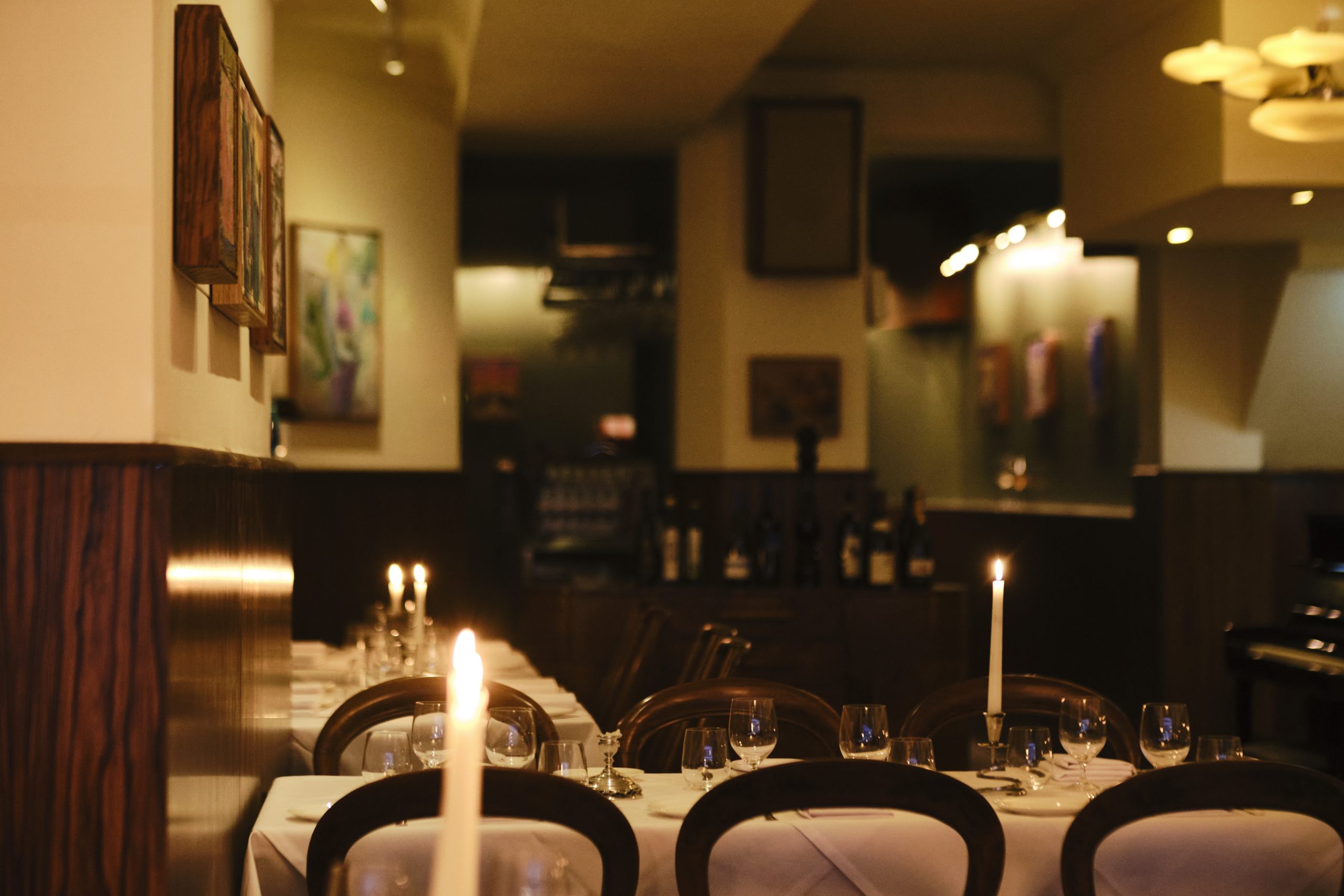
Douglas Blyde charts the return of Charlie Mellor and Cameron Dewar with Osteria Vibrato, a Soho restaurant where wine, music and meticulous hospitality converge in a richly controlled, operatic whole.
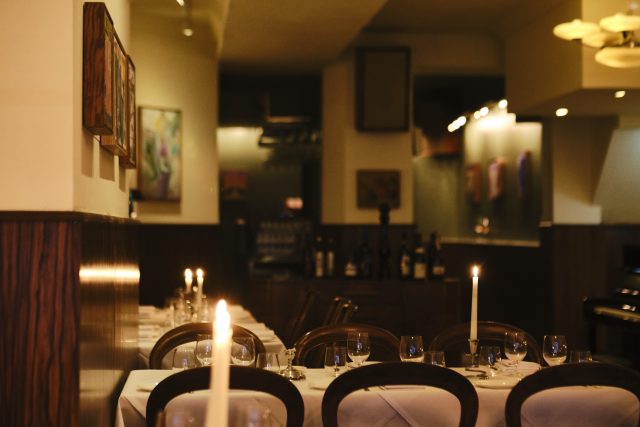
“With its toilets blasting opera, burgundy awning, and fag butt flicking aperitif drinkers outside acting as unpaid marketing, Osteria Vibrato is a Greek Street classic in the making… one which you will make desperate little excuses to return to,” wrote Sinéad Cranna in The Infatuation.
Following the closure of The Laughing Heart in November 2022, Charlie Mellor returns alongside long-time collaborator and fellow sommelier, Cameron Dewar. The name, drawn from musical terminology, points to Soho’s cultural charge and to Mellor’s former life as an operatic tenor. He arrived in London in 2008 to study at Guildhall School of Music and Drama, moving between stage and dining room across three continents.
The Laughing Heart, opened in 2016 with Tom Anglesea (now of Dovetale), built its following through control of room, list, and pace. Osteria Vibrato sharpens that approach.
A former pizzeria, the room leans into Italian cues without imitation. Terrazzo underfoot. Rosewood set against lime-washed walls. Staff in GH Bass loafers selecting ties from a box by mood. Candlelight held low across tables laid with unusually fine linen.
Martinis arrive cold and exact, poured high for a couple at the window who have been waiting all week for them. At the counter, head bartender, Kevin Price repairs a chipped glass with a blowtorch. It explains the restaurant. Nothing is discarded if it can be restored; nothing is hurried if it can be done properly.
Artwork rotates through Cedric Bardawil, including works by Mellor’s brother, Woody. An audiophile system, carried over from The Laughing Heart, gives the room its pulse. A piano sits embedded into the landing as though the building required it from the outset.
How many restaurants in London attempt this level of control across food, wine, sound, and space, and carry it through?
Drinks
Dewar’s route reads less like a CV than a tightening spiral. Melbourne, Attica. Singapore, Burnt Ends. London, 2014, into Viajante under Nuno Mendes, where he meets Leandro Carreira. A brief flare at L.C. at Climpson’s Arch, then a steady accumulation through Berenjak, Elystan Street, and Luca. By the time he joins Mellor in 2016, the direction is set – lists pared not by trend, but by conviction. What is removed carries as much weight as what remains.
“All our favourite trattorias and osterias in Italy run Italian and French side by side, so it felt natural,” he says. “The cellar is small, so we focused on wines we actually want to drink.” At roughly 250 references, with further stock held off site, the list reveals wines which hold your attention.
Italy is the spine, but not as a map. It is a set of voices. Cascina degli Ulivi, Le Coste, Testalonga, Arianna Occhipinti, Valentini, and Emidio Pepe. France runs alongside, not above. Jura is given room. The Loire carries weight. Burgundy appears selectively, filtered through a private view rather than a merchant’s spread.
Absence does the final work. Little polished Bordeaux. Champagne drawn towards growers – Bérèche, Prévost, Agrapart, Ruppert-Leroy – rather than the grandes marques. Spain reduced to a trace. Germany in flashes. The New World largely set aside, with England absent.
There is little cushioning for the hesitant. Bottles step quickly into three figures, particularly across Burgundy and Jura.
Partner Content
And if the table resists? “Then we meet them there,” says Dewar. “Some want to be taken somewhere new. Others want to stay with what they know. Both matter.”
Aperitivi establish the rhythm before any vinous decision is made. A Death in Venice draws Campari through col fondo over proper ice, bitter and alive. Cynar is handled without shortcuts. Martinis move constantly. Citrus is cut and expressed at the last moment, its oils hanging briefly before dissolving into the room.
Dishes
The kitchen sharpens the picture further. Gaia Enria, known for Burro e Salvia, was never concerned with nostalgia in the sense of replication. Her cooking takes regional Italian ideas and strips them back to their working parts. Head chef, Louis Lingwood brings a background shaped by St. JOHN Bread and Wine, Quo Vadis, Oldroyd, and Via Carota. The emphasis is on substance, not decoration.
A dish may begin in Lazio, pass through Liguria, and end somewhere less defined. Regions are material, not instruction. The £3 coperto sets the tone. Oils, parmesan, bread, and kitchen remnants arrive as part of a resourceful system.
Fritto misto carries Amalfi lemon which works quietly but decisively, paired with a rested 2020 Trebbiano from Francesco Guccione, served near room temperature to widen its frame. A Lazio-leaning dish of shaved artichoke with pecorino and olive oil from Lago di Bolsena sits alongside something anchored in Liguria, salt cod worked with potato and parsley into a seamless whole. A pepper mill appears over the shoulder at precisely the right moment.
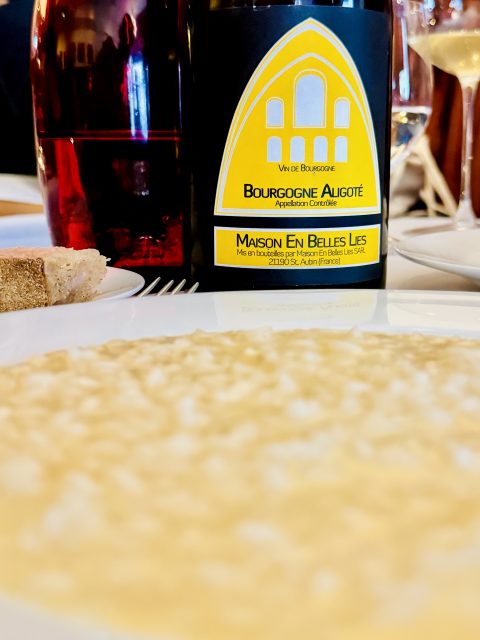
A white risotto, drawing from Lombardy, stands as one of London’s landmark dishes. Cooked from scratch, finished with 30-month Parmigiano Reggiano from an allocated wheel, it balances precision and indulgence. It meets a Bourgogne Aligoté from Maison en Belles Lies 2022, which carries the salt and cuts the richness with tension and a lightly reductive edge. A pairing which feels inevitable once encountered.
The main course centres on whole grilled lemon sole with plump Pantelleria capers and Tonda Iblea olive oil, nodding to Sicilia without fixing itself there. Alongside, a 2018 Brunello di Montalcino from Il Paradiso di Manfredi appears off list, shared across the table, with a Nerello Mascalese from Vino di Anna. One expansive, one fleeting. The latter nearly gone.
Last Sip
By the end of lunch, volume rises. “More vino for the table” is called across the room by a table who believe this is their home, and for a moment, it is difficult to argue otherwise. Dewar puts it simply: “We want people to leave feeling looked after, like they’ve spent time with someone they trust – whether it’s their first visit or their fiftieth.”
Opened on Valentine’s Day, Osteria Vibrato does not read as new. It feels established, as though it had been waiting for its doors to open. Mellor and Dewar have built something which restores the long lunch to its proper position in London life and pushes it further. It would not be outlandish to knight them for this service.
Best For
Authored wines and classic cocktails
Devotion to ingredients
Art and music
Value: 94, Size: 96, Range: 94, Originality: 97, Experience: 100; Total: 96.2
Osteria Vibrato – 6 Greek St, W1D 4DE; [email protected]; osteriavibrato.co.uk
Related news
Wine List of Week: The Ragged Robin
Pub in row with Greenwich Council over seating
A look at The Ritz’s wine list
Dining and Cooking