
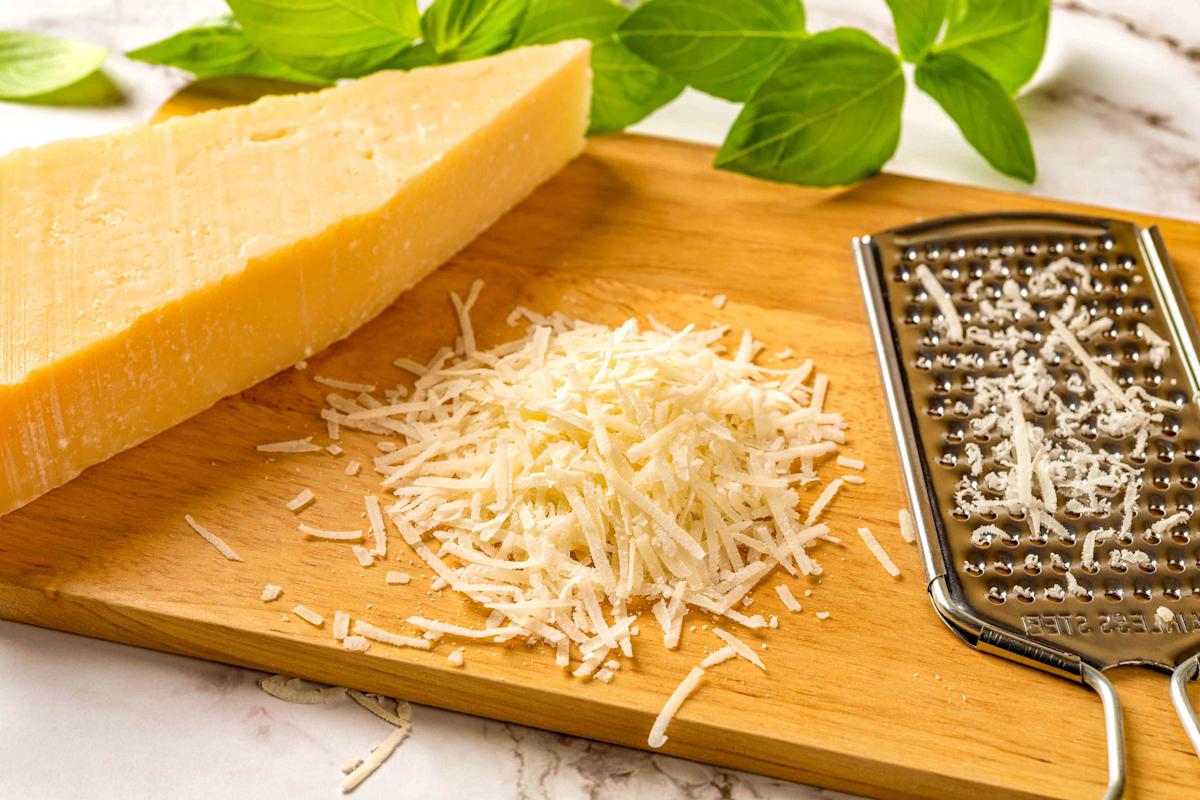

Credit: Simply Recipes / Getty Images
Key Takeaways
True Parmigiano Reggiano is marked on the rind and labeled as made in Italy.
Knockoff Parmesan often costs more, but lacks the superior taste of the real thing.
Proper storage can extend the shelf life of Parmigiano Reggiano for months.
Being a food editor comes with many perks and steady learning opportunities. A colleague at Food & Wine recommended the wonton soup at NYC’s Wu’s Wonton King, and it’s truly the best I’ve ever had. Last year, I visited an almond orchard in California, where I got in a bee suit and learned that without bees, we wouldn’t have almonds. And a few months ago, I took a trip to Parma, Italy, to tour a Parmigiano Reggiano dairy factory and taste a lot of cheese. (Watch a snippet of my tour in the Reel below.)
This trip forever changed the way I shop for Parmesan, a name synonymous with Parmigiano Reggiano in America. It’s a staple cheese that immediately upgrades salads, dinner rolls, casseroles, and of course, pasta—my fridge is never without it.
I learned that Parmigiano Reggiano and Parmesan are not the same product, and there is an easy way to ID the real stuff at the grocery store so that you can enjoy the best-tasting product and never pay more for a knockoff.
What Is Parmigiano Reggiano, Officially?
Parmigiano Reggiano is an Italian aged cheese with a Protected Designation of Origin (PDO), a mark of quality earned by following strict and elaborate rules that govern everything from what the milked cows eat through each stage of production and sale.
For example, Parmigiano Reggiano can be produced only in Parma, Reggio Emilia, Modena, Mantua, and Bologna. Only three ingredients are used: cow’s milk, rennet, and salt, with no preservatives or additives. The cheese matures for a minimum of 12 months before it can be labeled as Parmigiano Reggiano. Each wheel of cheese (about four million per year) is individually inspected by an expert certified by The Consortium, the governing body for Parmigiano Reggiano.
At 12 months, the cheese is sweeter and creamier, ideal for snacking. The longer it matures—typically 24, 36, and 48 months—the crumblier and richer it becomes, with a price to match.

Credit: Simply Recipes / Paolo Picciotto
Two Ways To Tell If It’s the Real Stuff
What Americans refer to as Parmesan cheese—like the green plastic bottle of Kraft grated “Parmesan Cheese” or blocks labeled as Parmesan in supermarkets and cheese counters—is not true Parmigiano Reggiano. (In 2021, Kraft Heinz sold its cheese products to Groupe Lactalis, a French company.)
Why does this matter? Because the real stuff tastes better, and sometimes the knockoffs are more expensive. Our nerdy food friends over at Serious Eats taste-tested Parmigiano Reggiano and various domestic Parmesan cheeses and determined that “we simply can’t, in good conscience, steer you to any of the domestic cheeses we tried when the real version is so much better.”
Here are two ways to tell if you’re paying for real Parmigiano Reggiano:
1. Marks on the rinds: During production, each wheel of cheese is engraved with its name, Parmigiano Reggiano, in dots (see image above). If you’re buying a wheel or a hunk with rind on it, you should be able to see these markings.
2. Read the label: In the U.S., the name Parmigiano Reggiano is protected—only the real cheese product that passed DOP inspection can be labeled as such. Look for the name and “made in Italy” or “from Italy” on the packaging. This is true whether the cheese is sold in a wheel, wedge, block, grated, or shredded.
How To Store Parmigiano Reggiano
Store Parmigiano Reggiano in the refrigerator—the ideal temperature is 39°F to 46°F. It’s best to store it wrapped in plastic wrap or a glass plastic container far from smelly foods.
How long the cheese will last depends on how long it’s been aged. Twelve to 18-month cheeses contain more moisture, so they will last for about 15 days when stored properly; 24-month cheeses last about one month, and older cheeses indefinitely. Do not toss the cheese if it develops mold on the surface—you can remove the mold with a knife and still enjoy the cheese.
Read the original article on Simply Recipes
Dining and Cooking