
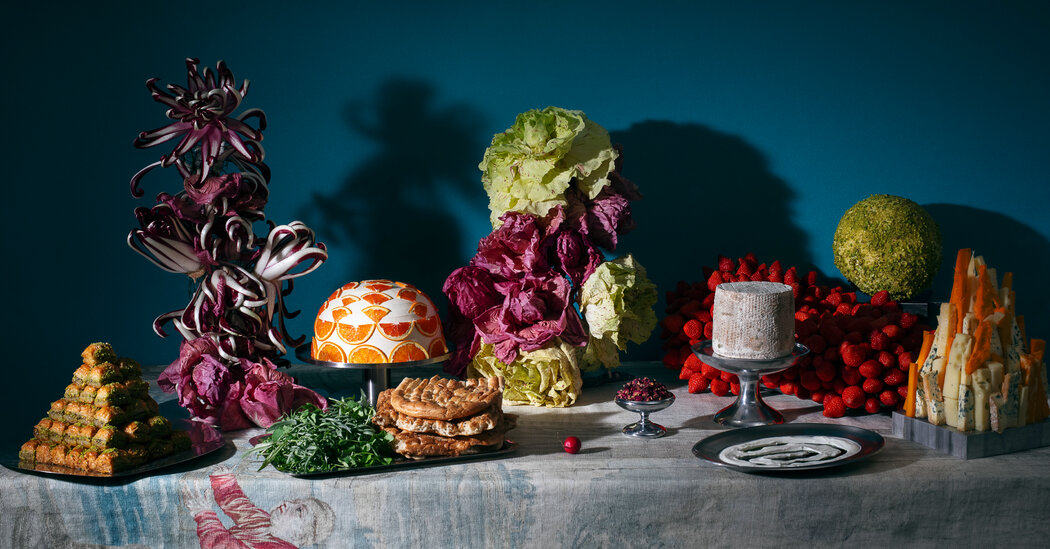
After the premiere of Josh Safdie’s film “Marty Supreme” in December, the cast and crew gathered at the National Arts Club in Manhattan not for a black-tie meal with place settings but for an apéritif dînatoire — a French-born cocktail-and-dinner-party hybrid that’s become increasingly popular in the United States. Inside the Victorian Gothic townhouse, a series of grazing tables that resembled 1700s Dutch still lifes had been styled by the New York chef Libby Willis. Guests circulated through the club’s rooms, choosing cured meats, chicken roulade and chocolate-covered strawberries from crystal and sterling vessels. Sue Chan, whose creative marketing and event company in New York produced the party, says one of the format’s appeals is that it translates easily to social media. “It’s exciting and photogenic to see a huge display of food,” says Chan, 42, as opposed to the individual servings of a sit-down dinner or the smaller passed hors d’oeuvres of a cocktail party. “And it allows people to mingle more.” It also offers more flexibility for guests who, in the age of GLP-1 drugs, might just want to eat a small amount — or nothing at all.
Joining the French word for “dinner” (“dîner”) with the suffix “-atoire,” indicating a function or purpose (essentially: a meal that replaces a more formal dinner), the apéritif (or apéro, as it’s colloquially referred to in France) dînatoire is a 21st-century spin on the aperitif, a pre-dinner ritual that gained traction in France during the Belle Époque. In the prewar culture of the late 19th century, Parisians would flock to restaurants in the early evening for a drink — Dubonnet, a mix of fortified wine and quinine, and absinthe were popular — and snacks such as peanuts and olives. Over the past few decades, a new version of the apéro has expanded to cover not only cocktail hour but supper too.
The change reflects the increasing popularity of casual dining in France, where the apéro dînatoire typically takes place not at events but at home, with a few trays of light fare laid out on a coffee table along with wine. The only rule is that most items should be bite-size. The meal often begins with palate openers like crudités and charcuterie, which are followed by a round of something more substantial and warm such as miniquiches, gougères (French cheese puffs) or cake salé (a savory, meaty, cheesy bread). Dessert consists of fruits or mignardises (small pastries), like madeleines or macarons. When Charlotte Sitbon, a co-founder and the creative director of Balbosté, the Paris-based creative event agency that counts Dior, Louis Vuitton and Chanel as clients, recently hosted friends for apéro dînatoire at her apartment in Neuilly-sur-Seine outside Paris, she served a spread of winter radishes with butter, meatballs and an apple tart. “Everything is organic, seasonal and straightforward,” says Sitbon, 39. “No fuss, no styling for the sake of it, just food that feels generous.”
But in the United States, where food artists have been outdoing themselves with radicchio towers and trompe l’oeil cakes, the apéritif dînatoire has taken on a flashier form. In February, for New York Fashion Week, J.Crew hosted a standing-only party with five tables designed by the Vietnamese food artist and stylist Thu Pham Buser. One featured butter sculptures and bread in the shape of bow ties. Hand-engraved gourds and a large bowl of squash ajo blanco, a chilled Spanish soup, were placed on another and, for dessert, there was an eye-shaped Pavlova layered with toasted sesame meringue, passion-fruit curd and whole blackberries.
The New York food artist Jen Monroe, 36, has interpreted the dînatoire in other visually arresting ways for her fashion and design clients. Last summer, at the Manhattan showroom of the furniture company Design Within Reach, she arranged one table with rounds of saucisson sec and loaves of sourdough; another had braided arches of bread that resembled a partially submerged sea monster interspersed with clusters of mini-carrot tops, endives and purple asparagus planted into a butternut squash-and-tahini dip that had been pooled directly onto the table. “There’s been much more demand for food with a flexible format,” she says, in part because it’s simply easier to pull off. With a dînatoire, there’s no need for a commercial kitchen. It also lends itself well to a theme: In December, for the brand Beni Rugs’ holiday party, the chef and food writer Andy Baraghani, 36, created an après-ski table for a crowd of around 150 at the founder’s Manhattan loft. It included a chalet-shaped ice luge for martinis, piles of shrimp cocktail on crushed ice, vegetable fondue and a two-foot-tall baked alaska that was set ablaze midway through the evening. “It felt like one long cocktail party,” says Baraghani, “but everyone was well fed.”
E
Ella Riley-Adams
Social Media Editor for T Magazine
I like that at an apéritif dînatoire you’re less likely to leave hungry than at a cocktail party but can avoid the formalities of a dinner. I hadn’t heard of it before I started editing this piece, but now I’m noticing it everywhere (and thinking about how I might throw one myself).
Our family has been doing this for years at holidays. But we didn’t have such a fancy name for it. We just called it grazing. It works well for a large family of varying ages who come and go at different times during the holiday. No one ever left hungry, believe me.

Liz
Alaska
In the South, this kind of spread is standard cocktail party fare. It’s called “heavy hors d’oerves” and is plenty for dinner.
Read 283 comments
Set designer’s assistant: Uma Tufekcic. Chef’s assistant: Jason Khaytin. Food styling assistant: Katherine Carothers. Photo assistants: Ivory Serra, Anna Nosworthy
Dining and Cooking